
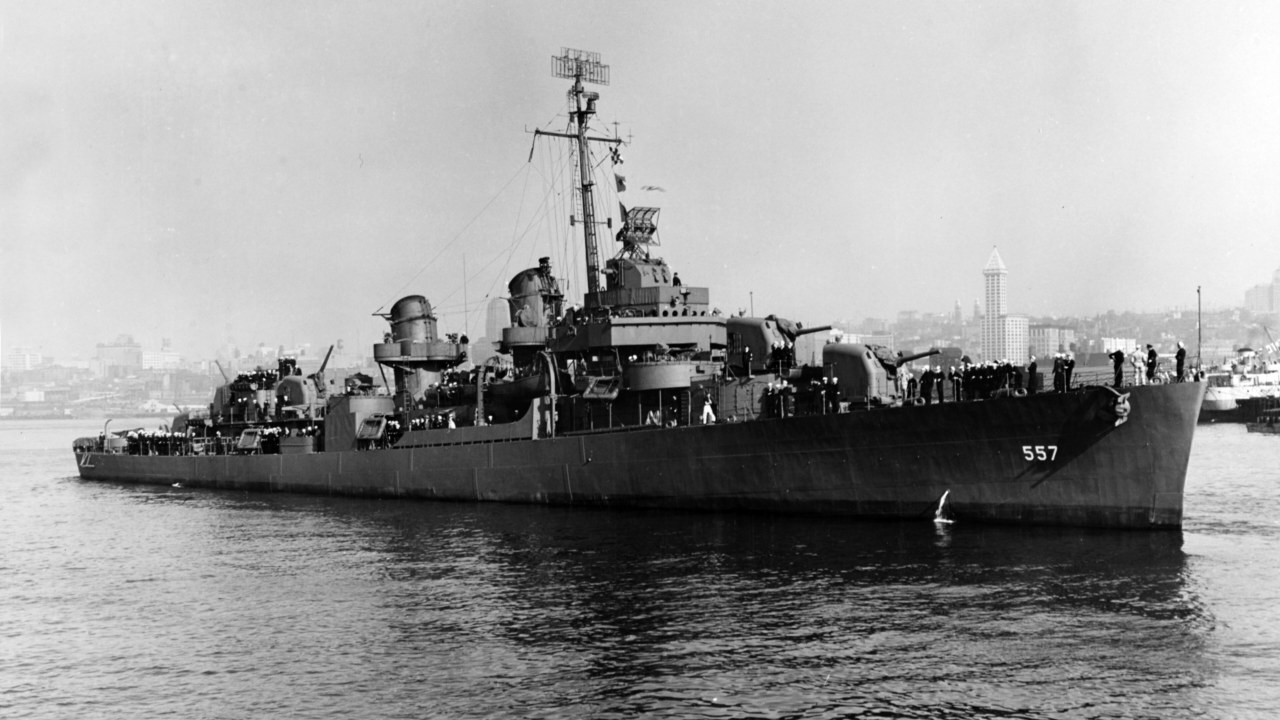
Twenty-one thousand feet of water off Samar separated the wreck of USS Johnston (DD-557) from the surface until a two-person submersible named Limiting Factor went down to it. The Naval History and Heritage Command (NHHC) says explorer Victor Vescovo’s team found the destroyer’s bow about 21,180 feet down, on an undersea cliff face, and that imagery showing the hull number 557 confirmed the ship’s identity. Johnston, a Fletcher-class destroyer, was lost at the Battle off Samar, part of the Battle of Leyte Gulf, on Oct. 25, 1944.
The 2021 expedition was sponsored by Caladan Oceanic and led by Vescovo, who funded and piloted the submersible, according to Smithsonian Magazine. It followed a 2019 find of Fletcher-class wreckage at the same site, and it put a name on the ship.
The Navy’s history command laid out the identification in its announcement, “Wreckage Confirmed as Heroic USS Johnston (DD 557),” which says the visit “was conducted via Vescovo’s manned deep submersible ‘Limiting Factor,’ which has previously been to the deepest point in all five oceans.” NHHC said Vulcan Inc. had located the first wreckage there in October 2019, at more than 20,000 feet.
Two eight-hour dives from DSSV Pressure Drop
The dives were made on March 31, 2021, according to Caladan Oceanic as reported in a Smithsonian Magazine account dated April 7, 2021. That account describes Limiting Factor as a two-seat craft with a titanium pressure hull nine centimeters thick.
The descent was not a single plunge. Divernet’s report of April 2, 2021 says the team made two dives, each about eight hours long, from the mother ship DSSV Pressure Drop, with Vescovo at the controls both times. On the second dive he was joined by Shane Eigler, a senior technician with Triton Submarines; Divernet identifies Limiting Factor as a Triton submersible. Divernet put the depth at 6.45 kilometers, on the edge of the Emden Deep, and reported that the number 557 was clearly visible on both sides of the bow.
Lt. Cmdr. Parks Stephenson, a historian and former naval officer, helped locate and survey the wreck, per the same Divernet report.
What the Navy received
Vescovo committed to giving the Navy all of the expedition’s sonar data, imagery and field notes, NHHC said. He described the team’s rule at the site in the command’s announcement:
“We have a strict ‘look, don’t touch’ policy, but we collect a lot of material that is very useful to historians and naval archivists.”
NHHC Director Rear Adm. Sam Cox, U.S. Navy (Retired), responded to the first imagery in the same release: “The image is impressive and we look forward to seeing the rest of the data collected during the expedition.” Vescovo also laid a wreath at the battle site, NHHC said.
Johnston at Samar, Oct. 25, 1944
The destroyer had been in commission for less than a year when she went down. The Navy’s Dictionary of American Naval Fighting Ships says Johnston was built by Seattle-Tacoma Shipbuilding Corp. in Seattle, launched on March 25, 1943, and commissioned on Oct. 27, 1943, with Lt. Cmdr. Ernest E. Evans assuming command that day.
At Samar, per NHHC, Cmdr. Evans led the outgunned Johnston into a much larger Japanese force to protect the landing force and the escort carrier Gambier Bay (CVE-73). The ship was hit, Evans was seriously wounded, and Johnston was eventually abandoned and sank. “Of the crew of 327, only 141 survived,” the command’s announcement says.
Evans was awarded a posthumous Medal of Honor. NHHC notes he was the first Native American in the U.S. Navy to receive it.
The bow section Limiting Factor reached remains where it came to rest, about 21,180 feet down, with the expedition’s sonar data, imagery and notes committed to the Navy’s historians.
Top image: USS Johnston (DD-557) underway off Seattle, Washington, on Oct. 27, 1943. Image Credit: U.S. Navy / Naval History and Heritage Command (NH 63495) — Public domain / Wikimedia Commons
This article was produced with the assistance of AI and reviewed by Combat Rated editors prior to publication.