
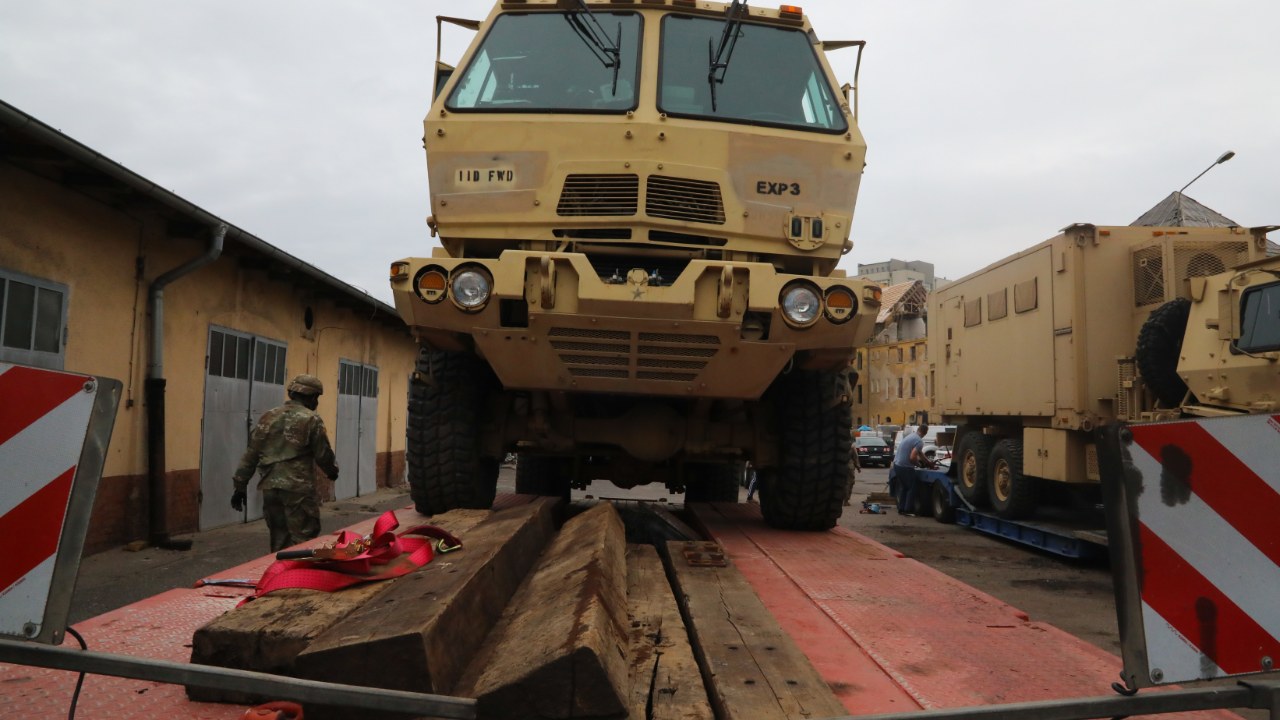
An M1087 expandable van is standing in for the tents a U.S. Army forward surgical team in Germany has long used to set up its operating space. The 67th Forward Resuscitative and Surgical Detachment, part of the Kaiserslautern-based 30th Medical Brigade, is testing the van as a prototype surgical platform for large-scale combat operations. The team’s leaders say it cuts the time needed to get an operating room running from about two hours to about 30 minutes.
The prototype is the 30th Medical Brigade’s attempt to make far-forward surgery faster to start, faster to move and harder to find. It is still a prototype, and the brigade describes a long-term plan rather than a fielding decision.
The details come from a 21st Theater Sustainment Command article published on army.mil on Oct. 6, 2026, written by Sgt. Griffin Payne of 21st TSC Public Affairs. Maj. Nicholas Cylus, chief of clinical readiness for the 519th Hospital Center, put the gain in plain numbers: “The prototype reduces setup time from approximately two hours to about 30 minutes,” and the team can displace in approximately 15 to 20 minutes, according to the article.
From tents to a truck-mounted operating room
The surgical team “traditionally relies on Army tents to establish its operating space,” the Army article says. Under that method, the tent has to go up before the surgical suite can be built inside it. With the M1087, the team drives the vehicle into position and expands it, and the operating space is already in the box.
The M1087 is not a new vehicle. The Federation of American Scientists’ reference entry on the type lists it as a 5-ton expansible van in the Army’s Medium Tactical Vehicle family, with a 5,000-pound payload. “The M1087 van sides pull out from the main body to form the office complex,” the FAS entry on the M1087 says, describing a hydraulic expansion drive with a manual backup. The original concept, per the same entry, was a mobile office for use at various echelons in the field. The 30th Medical Brigade’s prototype turns that box into a surgical suite.
Inside, Cylus said, “The platform also features two operating room beds and provides the team greater self-reliance.” The army.mil article says the van can support one surgical patient, with room for up to two. It can run for approximately nine hours on battery power and uses its own generation capability to recharge those batteries, according to the article.
Smaller footprint at Saber Junction
Speed is one half of the case the brigade makes. Concealment is the other. The van’s smaller footprint is easier to hide than a tent complex, and the Army article says that during the Saber Junction exercise the team “used that smaller footprint to hide in plain sight,” keeping personnel safe while the opposing force maneuvered around them. The article does not give the exercise dates or location.
Capt. Josh Hagen, a critical care nurse with the detachment, described the difference at the team level. “The 1087 definitely helps us move faster,” he said in the article. “It is a quicker teardown, a quicker setup.”
The detachment’s full team numbers 20 people, the article says, and it can split into two 10-person teams. Combined with the 15-to-20-minute displacement time Cylus cited, that gives the brigade a surgical element built to move as the fight changes, which is the purpose the Army article assigns to the prototype.
The brigade’s plan for six vans
Col. Nathanael C. Forrester, commander of the 30th Medical Brigade, framed the prototype as part of a wider push to adapt medical units to the modern battlefield. In the army.mil article he said:
“We’ve got to continue to adapt on how we fight, how we maneuver, how we protect ourselves.”
“That’s exactly what the M1087 is going to be doing for us,” he said of the van. Forrester also said he has told his soldiers, “Improve your foxhole,” and to “make your organization better,” according to the article.
For now there is one prototype in the hands of one detachment. The brigade’s stated next step is scale: “The long-term intent could eventually include six M1087s for the surgical teams,” the Oct. 6, 2026 Army article says. No fielding date, contract or cost for those additional vans appears in the release.
Top image: Soldiers load M1087 expandable vans onto trucks in Poznan, Poland. These are FMTV expandable vans like the 67th FRSD’s prototype, not the surgical van itself. Image Credit: U.S. Army National Guard photo by Spc. Cody Kellum — Public domain / Wikimedia Commons
This article was produced with the assistance of AI and reviewed by Combat Rated editors prior to publication.