
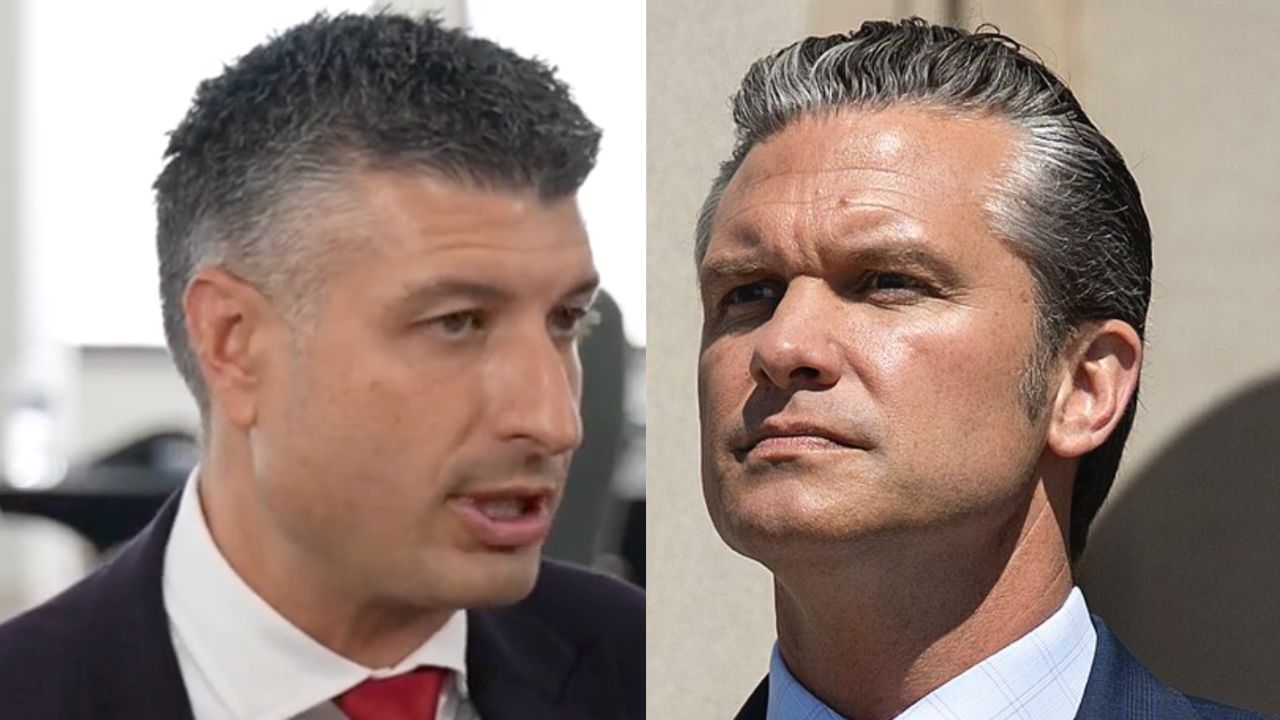
U.S. Rep. Tom Barrett, a Michigan Republican who spent 22 years in the U.S. Army, publicly urged Defense Secretary Pete Hegseth on Friday to “seriously reconsider” the Pentagon’s plan to livestream the firing squad execution of Fort Hood gunman Nidal Hasan. Barrett called Hasan “an evil person” in the same message, but said that making a “public spectacle” of his death “does not serve a public interest.” The post is a rare public break from the Pentagon’s plans by a Republican with deep military credentials, and it landed one day after the Pentagon confirmed the livestream.
Barrett posted the statement on X at 2:50 p.m. on Friday, Oct. 9, 2026. The full text reads:
“Secretary Hegseth should seriously reconsider this decision.
Nidal Hasan is an evil person. He betrayed our country, killed 13 American soldiers, and wounded dozens more at Fort Hood — a place I trained the year before his brutal attack.
That does not change the fact that our American values should strive to elevate human dignity. Making a public spectacle out of an already tragic situation is unnecessary and does not serve a public interest.”
Barrett’s reference to training at Fort Hood the year before the attack ties him personally to the installation where the shooting took place. Hasan opened fire there on Nov. 5, 2009, and Barrett’s message makes clear he views the base, and the soldiers killed there, as more than a distant news story. He is a former helicopter pilot who still holds the rank of chief warrant officer in the Michigan Army National Guard, according to his public biography, and he represents Michigan’s 7th Congressional District.
The Decision Barrett Is Responding To
Barrett’s post followed a rapid series of announcements. President Donald Trump approved the execution by firing squad of Hasan, a former Army major and psychiatrist, after Hegseth recommended it, Pentagon spokesperson Sean Parnell said on X on Monday. “Judgement day for Hasan has finally come,” Parnell wrote. If carried out, it would be the first U.S. military execution since 1961.
The Army then announced that the execution would take place at Fort Hood on Dec. 3. Speaking Wednesday to a conservative television outlet aboard the USS Abraham Lincoln, Hegseth said the public would be able to see it. “We’ll make sure that people are able to watch it, that it’s public,” he said. Asked whether Hasan had made any final requests or contacted the administration, Hegseth replied: “Don’t care. We’ll see him on Dec. 3.”
On Thursday, Pentagon officials clarified that “public” meant a livestream and said more details would follow, as reported by The Associated Press. The White House referred questions about the plan to the Pentagon. Hegseth has said the military has not used a firing squad for an execution since World War II, and the last military execution of any kind was the hanging of Army Pvt. John Bennett on April 13, 1961.
Hegseth had pushed for the sentence well before Trump’s approval. “I am 100% committed to ensuring the death penalty is carried out for Nidal Hasan,” he said in an earlier statement. Hasan was convicted in 2013 of killing 13 people and wounding 32 others at the Fort Hood Soldier Readiness Center, where soldiers were lined up for immunizations and medical clearance before deployment. His final legal appeal was rejected in April 2025, clearing the way for an execution date.
Legal Experts Raise Questions About a Public Execution
Legal scholars offer mixed assessments of the livestream plan. Elisabeth Semel, co-director of the Death Penalty Clinic at UC Berkeley Law, said she could not recall a case in which a public execution was instigated by the government and that it “raises serious questions about what is the motivation of the government.” Deborah Denno of Fordham University said a livestream could make the process “much more transparent.” Brenner Fissell of Villanova Law said firing squads can be “a quicker, cleaner, more precise way to execute a prisoner,” but that he did not think speed was the motivation, pointing instead to the “lethality culture” Hegseth has emphasized.
The timeline itself is not settled. Experts told the AP that Hasan could file a habeas petition in civilian court, which could delay the execution significantly, though given his conduct at trial he may not seek one. Hasan fired his lawyers, represented himself, rested his case without calling a witness, and made no closing argument. His former civilian attorney John Galligan said Hasan had no lawyer present when he was notified of Trump’s approval, calling that a breach of Army regulations. An Army spokeswoman said multiple attempts were made to reach his counsel and that officials “adhered to policy.”
The plan also arrives against a backdrop of recent remarks by Trump on public executions abroad. On Jan. 14, Trump told reporters of Iran, “It’s stopping, and there’s no plan for executions,” and in his State of the Union address days before the Iran war began he said the U.S. had “stopped them from hanging a lot of them.” Amnesty International has said it knew of at least 17 public executions in 2025, 11 in Iran and six in Afghanistan.
Capital punishment is also under scrutiny at home. Trump approved the Hasan execution days after a failed lethal injection attempt on Christa Pike in Tennessee led that state’s governor to halt further executions this year and order an independent review. Asked whether the episode would change his approach, Trump called it “an interesting situation.”
Barrett’s Military Background and Record
Barrett joined the Army after high school and served 22 years, with postings in Iraq, Guantanamo Bay, Kuwait and the Korean DMZ, logging more than 1,000 hours flying advanced helicopters. He later served four years each in the Michigan House and Senate before winning his congressional seat.
His public breaks with the administration have centered on the Iran war. On March 5, Barrett issued a statement explaining his vote against a War Powers Resolution, saying Trump “has earned the opportunity to resolve this conflict quickly and with minimal casualties.” His position shifted as the conflict continued. In May he introduced an Authorization for Use of Military Force, saying, “Two things have been clear from the very beginning: Iran cannot be allowed to develop a nuclear weapon and the United States of America cannot be dragged into another endless war.” His office says he is the first and only member of Congress to introduce such an authorization for the conflict.
Barrett went on to vote for three measures requiring congressional authorization for continued operations in Iran. The first failed 212-212, the second passed 215-208 on June 3, and the third passed 214-208 on July 23. After the third vote he said: “My position hasn’t changed. Only Congress has the authority to authorize military action in Iran. I remain ready to work with anyone to eliminate hostile threats to our nation without getting us into another endless war.”
Trump publicly criticized Barrett over the war powers votes, yet has kept his endorsement. Barrett holds a swing district that handicappers rate as a toss-up, and he faces a competitive reelection contest in November. When Rep. Thomas Massie, R-Ky., introduced articles of impeachment against Hegseth in September over the Iran war and other actions, reporting identified Barrett as one of the Republicans who had joined Democrats on war powers votes. Barrett has not been reported to have signed on to either that effort or the earlier one filed by House Democrats in April.
The Pentagon has not publicly responded to Barrett’s post. The execution is currently scheduled for Dec. 3 at Fort Hood, and officials have said additional details about the livestream will be released.