
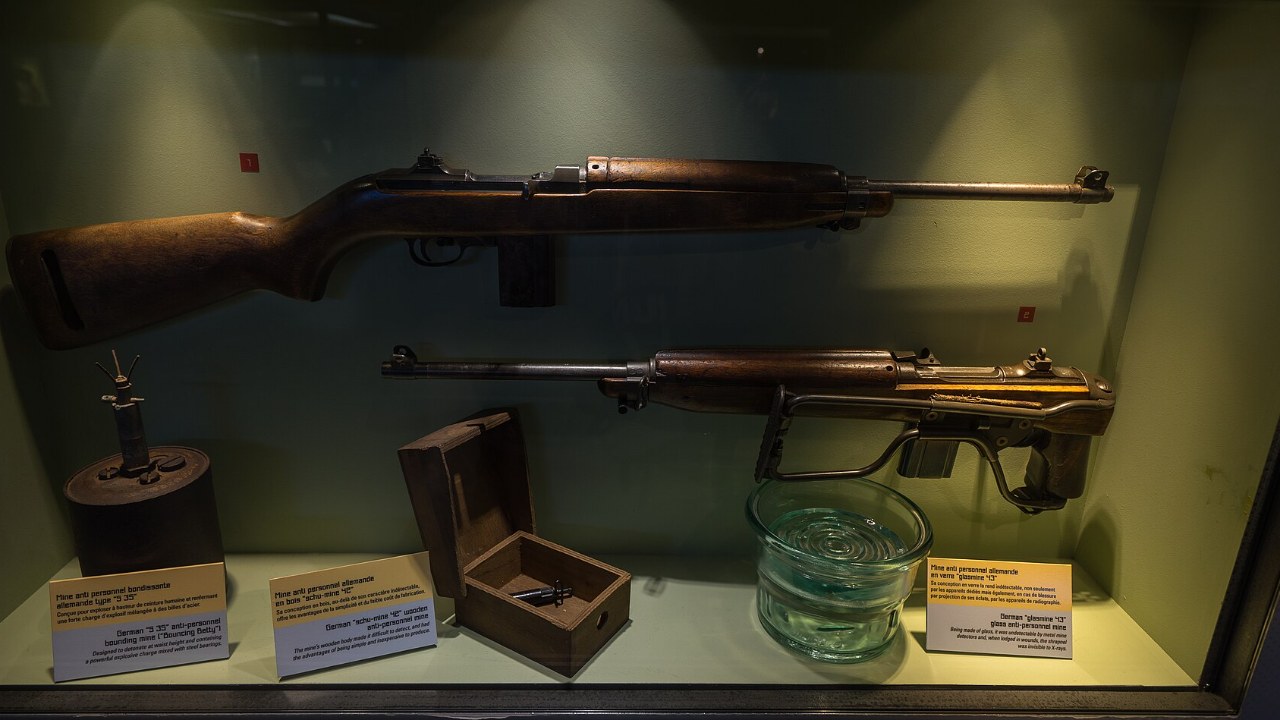
The specification called for a rifle that weighed no more than five pounds. What the U.S. Army got from that requirement was the M1 carbine, and by the National Firearms Museum’s count more than 6 million of them had been built by 1945.
The museum goes further than the production total. It calls the carbine the most widely produced military arm in U.S. history, a claim built on wartime output from companies that, for the most part, had never made a firearm before the war.
The National Firearms Museum’s collection entry for a U.S. Winchester M1 semi-automatic carbine puts it in one sentence: “Over 6 million carbines had been manufactured by 1945, making it the most widely-produced military arm in U.S. history.” The museum, which is operated by the National Rifle Association, lists the example in its World War II gallery. That particular carbine is an early folding-sight model that, per the museum, “was used in the Pacific island campaigns in 1944 and 1945.”
A five-pound requirement
The carbine answered a specific Army request. The museum describes the goal as a semi-automatic personal-defense arm, more effective than a sidearm but lighter than a battle rifle, and it records the key number: “Specifications for the new rifle were issued; among these was the requirement that its weight not exceed five pounds.” The same entry says “the successful design was to have an effective range of 300 yards.”
The Army Historical Foundation’s history of the M2 carbine traces the program to 1940, when “the Chief of Ordnance was issued an order to develop and test light rifles for service use.” Trials narrowed the field, and the Ordnance Department dropped an early requirement for automatic fire, “leading to what became the M1 Carbine,” the foundation writes. It also gives the weight contrast that made the carbine attractive: the M1 Garand weighed “11.5 pounds loaded with its eight-round clip.”
Winchester’s entry came together fast. The National Firearms Museum says the company “put together a crude hand-made model based on a scaled-down Garand receiver” and used “the short-stroke gas system invented by David M. Williams.” In testing, Winchester’s design “emerged as the winner by unanimous decision of the testing officers,” the museum says, and it went “from design to hand-built prototype to adoption by the Army in only a few months.”
The production order followed immediately. “Less than a month before the Japanese attack on Pearl Harbor, Winchester received a contract for 350,000 carbines,” the museum records. That was only the beginning.
IBM, General Motors and the prime contractors
The carbine’s numbers came from American industry at large rather than from the government arsenals. The National Park Service’s overview of U.S. small arms of World War II at Springfield Armory National Historic Site notes that “the US M1 Carbine was never made at Springfield Armory, but by a number of private contractors.”
The National Firearms Museum gives the scale of that effort: “Ten primary contractors, including Winchester, I.B.M., and General Motors, assembled and delivered finished arms.” It adds that “most of these were turned out by companies having no previous experience in firearms manufacture.”
The national collections hold examples of that civilian-industry output. The Smithsonian’s National Museum of American History catalogs an IBM Corp. U.S. M1 carbine, made by IBM around 1943. Britain’s Imperial War Museums hold an M1A1 carbine made by the Inland Manufacturing Division of General Motors Corporation in Dayton, Ohio, a post-war gift to Sir Colin Gubbins from former members of the Norwegian Resistance, according to the museum’s record.
That M1A1 represents one of the variants. The National Firearms Museum says “a folding metal stock version, designated the M1A1, was also produced for airborne operations,” and it lists the T3 and the M2 selective-fire carbine among the other versions.
After 1945
The carbine outlived the war that produced it. The Army Historical Foundation puts wartime output at “nearly six million of these carbines” in World War II alone, a figure consistent with the museum’s total. The National Firearms Museum says the carbines “saw action with U.S. troops in Korea,” and that “they had been officially replaced by the M14 in 1957.” The Army Historical Foundation’s history of the M14 rifle dates that designation to June 1957, when the T44E4 “earned the final designation as the Rifle, 7.62mm, M14.” The foundation adds that M1 and M2 carbines “became the standard issue rifle for the ARVN early in the war” in Vietnam, referring to the Army of the Republic of Vietnam.
The 6 million figure and the “most widely-produced” superlative remain the museum’s own claims. The record that backs them sits in the contract history the museum documents: one 350,000-carbine order to Winchester weeks before Pearl Harbor, and ten prime contractors turning out the rest.
Top image: An M1 carbine, top, with other World War II weapons in a display case at the Musée mémorial de la Bataille de Normandie in France. Image Credit: Falcon® Photography — CC BY-SA 2.0 / Wikimedia Commons
This article was produced with the assistance of AI and reviewed by Combat Rated editors prior to publication.