
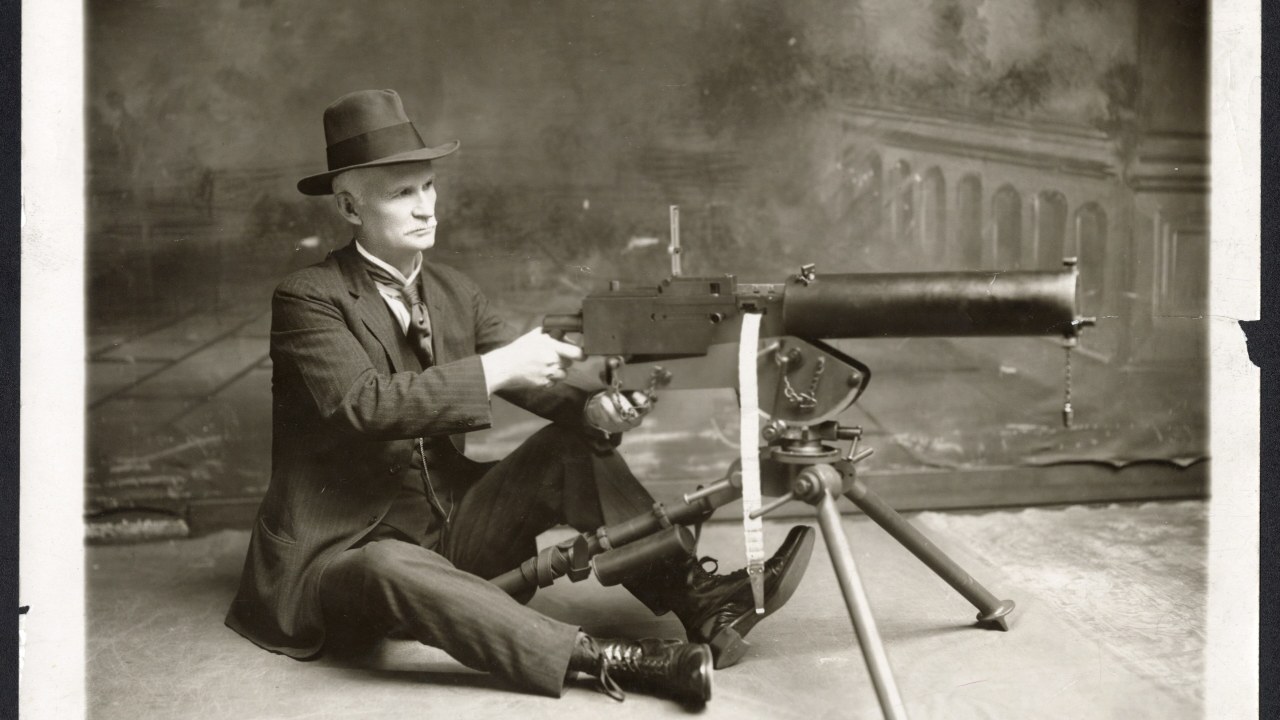
John Moses Browning, born to a gunsmith in the Utah Territory in 1855, left behind 128 patents and more than 100 different guns, by the count of the National Museum of the U.S. Air Force. His designs armed American troops from the Model 1911 pistol to the .50-caliber machine gun. The museum says that machine gun is still in service and has been used in every U.S. conflict since World War II.
Browning did not live to see most of that record. He died in 1926, and the heavy machine gun he left behind went on to serve for the rest of the century and beyond.
The Air Force museum makes the case in its World War II gallery exhibit, “Elegant Simplicity: The Weapon Designs of John Moses Browning.” The exhibit text calls Browning “among the United States’ most prolific inventors” and states: “He held 128 unique patents and designed over 100 different guns. Many modern firearms still use mechanisms he designed.” It adds that during World War II, “his guns served on land, sea, and in the air of every major theater and battlefield.”
From an Ogden gun shop to Army trials
Browning learned the trade at home. A Hill Air Force Base public affairs article, written by 2nd Lt. Stacy Glaus of the 75th Air Base Wing to mark Browning’s 156th birthday, says “His father owned a gunshop in Ogden where he learned the tricks of the trade.” The same article says that in 1879 “Browning patented his first gun, the breech-loading single shot rifle.”
The American Society of Mechanical Engineers counts his output a little differently than the Air Force museum does. ASME, whose Landmark No. 141 is the Browning Firearms Collection at Ogden’s Union Station Museum, with a ceremony recorded in January 1989, says he “held more than 128 patents covering 80 distinct firearms” produced by Winchester, Remington, Colt, Fabrique Nationale and others. The display includes “35 pistols, 33 rifles, 33 shotguns, and 9 military automatics,” per ASME. Its military list includes the Colt .45 automatic pistol, the Browning Automatic Rifle and machine guns in .30 and .50 calibers.
World War I brought those military designs into Army service. John Keilers of the U.S. Army Military History Institute wrote in a Jan. 12, 2009, Army.mil history article that “Browning’s weapon went through the Army’s trials process in May 1917.” The gun was accepted and designated “the .30 Caliber, Browning M1917 Heavy Machine Gun,” Keilers wrote, adding that “Over 70,000 of the guns were produced.” A second design followed as “the Browning Automatic Rifle, Model of 1918, .30 Caliber, or the BAR.”
The pistol and the .30-caliber gun
The Air Force museum exhibit traces how long Browning’s designs stayed in the inventory. The Model 1911 pistol was adopted on March 29, 1911, and “served as the primary sidearm for the US Military until 1985,” the exhibit says. The museum displays an M1911A1 used by Gen. Nathan Twining after he ditched his B-17 in the Pacific in January 1943; stranded in life rafts, he used the pistol to shoot an albatross to feed his crew.
The military adopted a modernized version of Browning’s World War I-era machine gun in 1935, according to the exhibit. That M1919 “served throughout World War II and in the Korean War until it was replaced in 1957.” The Army Air Forces designated their aircraft machine guns as “M2” variants and configured them either fixed, as an aircraft’s primary weapon, or flexible, for gunners defending the aircraft in flight.
The .50-caliber M2 outlives its designer
The heavier gun grew out of a problem the Army saw at the end of World War I. “.30-cal machines guns were becoming less effective against better-armored tanks and airplanes,” the museum’s exhibit says, so “The US Army turned to Browning to design a machine gun capable of firing a new .50-cal cartridge.” Browning “developed a working prototype before he died in 1926.”
The exhibit shows the result as the Browning AN/M2, nicknamed “Ma Deuce,” in its fixed aircraft configuration. Hill Air Force Base’s article says the M2 “was so effective that it was used on almost every combat aircraft in World War II.” The museum’s summary of its record is the line that carries the headline: “The weapon is still in service today and has been used extensively in every US conflict since World War II.”
The exhibit sits in the museum’s World War II Gallery, where the 1911, the M1919 and the AN/M2 are shown together as Browning’s record in American service, a century after the inventor’s death.
Top image: John Moses Browning, seated with one of his machine guns, in a photo from before his death in 1926. Image Credit: Photographer unknown, via National Museum of the U.S. Air Force — Public domain / Wikimedia Commons
This article was produced with the assistance of AI and reviewed by Combat Rated editors prior to publication.