
“It had the appearance of a plank moving in the water.” That was how the officer of the deck aboard USS Housatonic described the object he spotted off Charleston Harbor just before 9 o’clock on the night of Feb. 17, 1864. The plank was the Confederate submarine H.L. Hunley, and within minutes the Union sloop-of-war was on the bottom, along with the submarine that sank her.
It was a first in naval warfare. A hand-cranked boat carrying a black-powder charge on a long spar had sunk an enemy warship in combat, and the cost of doing it was the submarine and everyone aboard her.
The Naval History and Heritage Command’s page on the Confederate submarine H.L. Hunley states the record plainly: “On 17 February 1864, H.L. Hunley rammed her torpedo into the Union sloop-of-war Housatonic, sinking both ships off the entrance to Charleston Harbor.” The same page calls it “the first time a submarine sank a warship in combat.” Housatonic lost two officers and three enlisted men, NHHC records. Hunley sank with all hands and, in NHHC’s words, “was not seen again for 131 years.”
A privately built boat from Mobile
Hunley was not a Confederate Navy design in the usual sense. NHHC’s H.L. Hunley wreck page says she was “privately built in 1863 by Park and Lyons of Mobile, Alabama, with the financial backing of Horace Lawson Hunley.” Propulsion came from muscle. The boat was “powered by a hand crank operated by a crew of seven,” with an eighth man to pilot her, per the same page.
The weapon was just as basic. NHHC describes “a torpedo packed with explosive black powder bolted to a 16-foot spar.” On the night of the attack, Hunley rammed Housatonic below the waterline, detonating the charge and tearing a hole in the Union ship’s hull.
Two losses before the attack
The boat sank twice before she ever reached the blockade. According to the Friends of the Hunley account of the sinkings, the submarine was moored at Fort Johnson on Aug. 29, 1863, preparing for her first attack, “when it suddenly sank at the dock.” Five crew members died, and the boat was retrieved after several weeks.
The second loss involved the man whose name the boat carried. On Oct. 15, 1863, Horace Hunley scheduled a demonstration in Charleston Harbor, and all eight men aboard were lost, Hunley among them, the Friends of the Hunley records. The boat was recovered on Nov. 7, 1863. Rescuers reported that the forward ballast tank valve had been left open. NHHC’s biographical note on the Hunley page confirms that Horace Lawson Hunley “lost his life in her on 15 October 1863.”
Raised and refitted a second time, the submarine went back to work with a new crew. NHHC’s wreck page says the attack came “after months of practice runs and weather delays.”
USS Housatonic, a blockader off the bar
The target was no small picket boat. NHHC’s Dictionary of American Naval Fighting Ships entry for Housatonic lists her as a 1,240-ton screw sloop launched at the Boston Navy Yard on Nov. 20, 1861, and commissioned there on Aug. 29, 1862. She arrived at Charleston on Sept. 19, 1862, joined the South Atlantic Blockading Squadron and “took station outside the bar.”
The DANFS entry records that the crew slipped the anchor chain, backed the engine and went to quarters once the object was sighted, but too late. Hunley struck the starboard side forward of the mizzen-mast, in what DANFS calls “history’s first successful submarine attack on a warship.” The sloop went down quickly. Boats rescued many of her crew, and others climbed into the rigging, which stayed above water after the ship settled on the bottom.
Northern newspapers recorded the speed of the loss. A letter from off Charleston dated Feb. 18, 1864, first printed in the Boston Herald and reprinted by the Charleston Mercury on March 14, 1864, is preserved by the American Battlefield Trust as a primary source on the destruction of the Housatonic. It reported that “the ship sunk rapidly in less than eight minutes from the time the torpedo machine was first seen.”
Found in 1995, raised in 2000
The submarine stayed lost for more than a century. The Friends of the Hunley search and recovery history says Clive Cussler and his team with the National Underwater and Marine Agency located the wreck on May 3, 1995, about four miles off Sullivan’s Island in nearly 30 feet of water. The same account says “it was ultimately determined the Hunley was owned by the United States government.”
Recovery took five more years of engineering. Divers placed 30 slings beneath the hull, attached to an overhead truss, and on Aug. 8, 2000, at 8:37 a.m., “the sub broke the surface for the first time in over 136 years,” according to NHHC’s wreck page. The boat went by barge to the Warren Lasch Conservation Center, now part of the Clemson University Restoration Institute.
The Hunley in conservation
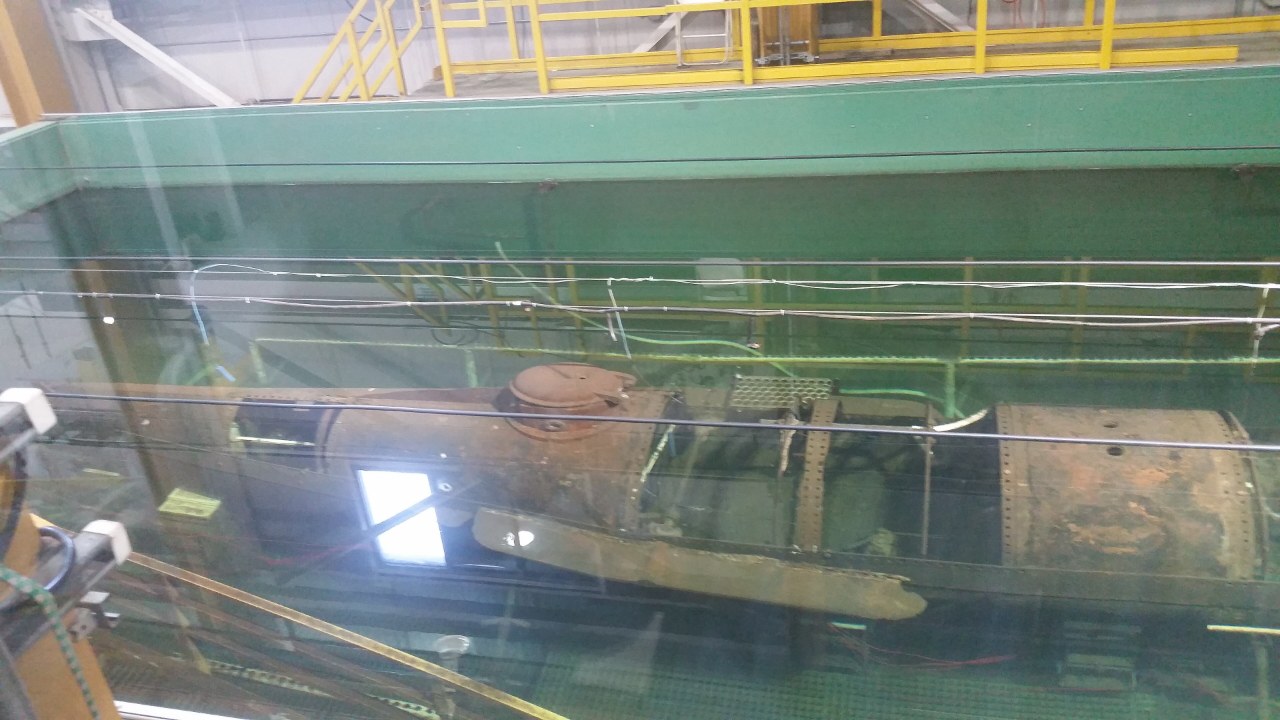
The work on the hull is still under way. The Friends of the Hunley conservation page says the submarine rests in a 75,000-gallon tank, that she was rotated upright over three days in June 2011, and that Clemson conservators removed about 1,200 pounds of concretion in 2014 before chemical treatment began. The current phase, salt removal, is estimated to take about five to seven years, per the same page.
Objects recovered from inside the hull are reaching the public first. The Friends of the Hunley lists an exhibition, “Textiles from the Deep: Findings from the H.L. Hunley Submarine,” opening at The Charleston Museum on Oct. 3, 2026, with conserved clothing and personal items from the boat’s eight-man crew. The submarine itself remains in its tank at the Warren Lasch Conservation Center, where a permanent museum for the Hunley is still in the planning stage.
Top image: The recovered H.L. Hunley in its conservation tank in North Charleston, South Carolina, in 2017. Image Credit: Pi3.124 — CC BY-SA 4.0 / Wikimedia Commons
This article was produced with the assistance of AI and reviewed by Combat Rated editors prior to publication.