
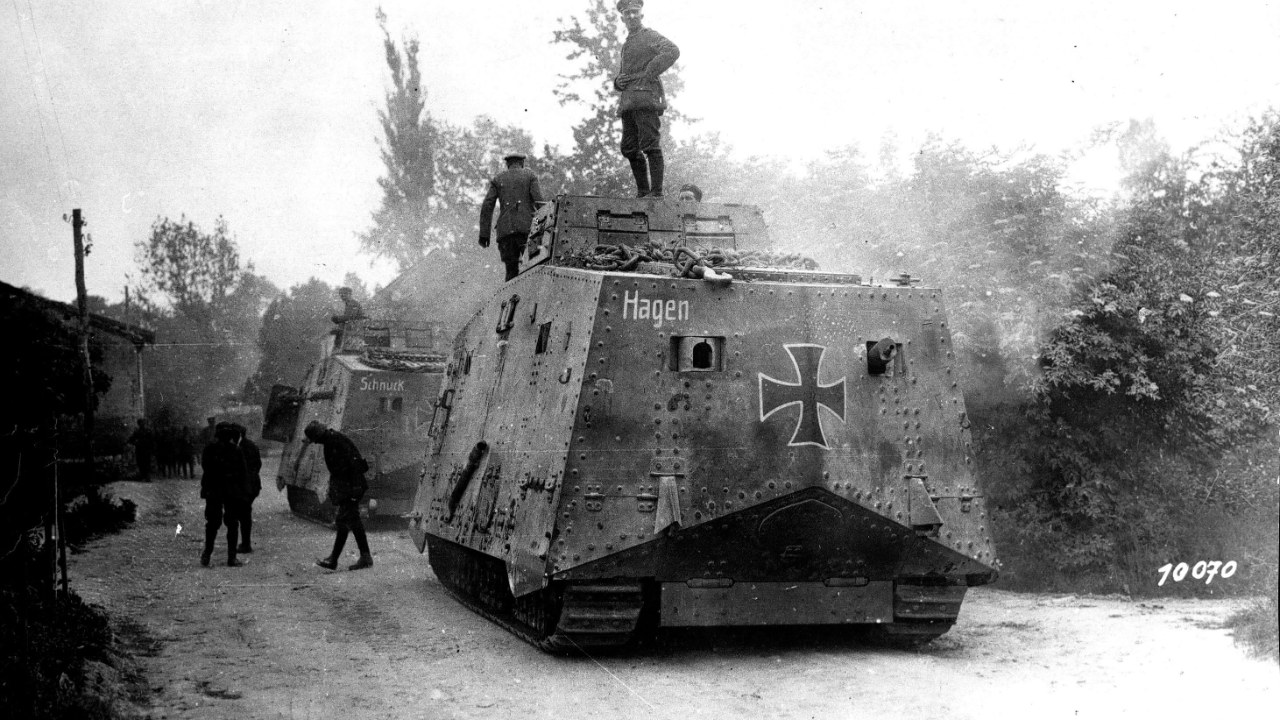
Villers-Bretonneux, a town in France’s Somme region, is where tanks first fought tanks. On April 24, 1918, the German A7V tank Nixe disabled two British female Mark IV tanks before a male Mark IV, No. 4066, severely damaged it. Nixe made it back to German lines, but its engines failed and, by the Australian War Memorial’s account, it was apparently never recovered and repaired.
The engagement tested something no one had yet seen in combat: what happens when one crew’s target is another tank. The answer at Villers-Bretonneux depended heavily on which British tanks Nixe met.
The Australian War Memorial’s photograph record P01726.002 shows an extensively damaged A7V near the town and identifies it as “apparently tank 561 Nixe in which Second Lieutenant Wilhelm Biltz of Abteilung 2 fought the first tank versus tank battle on 24 April 1918.” The record states that “two British female Mark IV tanks were disabled by Nixe before it was severely damaged by male Mark IV tank No. 4066.”
Thirteen A7Vs from Marcelcave
Nixe was one of a small German armored force. “On the morning of 24 April 1918, 13 German A7V tanks in three groups left the town of Marcelcave to attack the British lines in and between the towns of Villers-Bretonneux and Cachy,” Andrew Currey wrote in a Nov. 23, 2016 Australian War Memorial article. He added that 10 of the 13 made it to the start line.
Germany never had many of them to send. “Only 20 German A7V Sturmpanzerwagens, which was crewed with 18 to 26 men on board, were ever built for use in war,” the memorial said in a May 26, 2017 media release. The same release described the battle at Villers-Bretonneux as the moment “opposing tanks fought head to head for the first time in what was a watershed moment in the evolution of tank warfare.”
That release concerned a different A7V, Mephisto, which also fought at Villers-Bretonneux. Nixe’s story ends differently.
Male and female Mark IVs
The British side of the fight turned on a quirk of First World War tank design. British heavy tanks came in two armament patterns, and the difference shaped this engagement.
The Tank Museum at Bovington explains the split in its history of First World War tank armament. Male tanks carried “two Ordnance Quick Firing 6 pounder Hotchkiss 8cwt guns” along with Hotchkiss machine guns. When production grew, “it was decided to fit half the tanks with Vickers heavy machine guns instead, resulting in Male and Female tanks,” and “Female tanks were armed with 4” Vickers guns. The museum gives one reason for building the females: “the fear that gun armed tanks might be overwhelmed by massed infantry attack.”
The female armament, in other words, was chosen with infantry in mind. That is the context for the memorial’s account: the two Mark IVs Nixe disabled were females, and the tank that severely damaged Nixe, No. 4066, was a male carrying 6-pounder guns.
What happened to Nixe
Damage in the duel did not stop Nixe on the spot. The memorial’s photograph record says that “although Nixe was able to return to the German lines after the battle the engines failed,” and that the tank “was evidently partially disassembled after the battle,” which is the condition shown in the photograph.
Currey’s 2016 article gives a slightly different ending. Nixe, he wrote, “almost made it back before being stopped by engine failure. Perhaps believing it was unlikely to be salvaged it was blown up that night.” Both accounts agree on the essential point: the A7V that fought the first tank-against-tank action did not fight again.
The photograph of Nixe remains in the Australian War Memorial’s collection, catalogued as accession number P01726.002 and dated April 24, 1918, at Villers-Bretonneux.
Top image: A German A7V, the tank “Hagen” (No. 528), in 1918. Nixe, which fought at Villers-Bretonneux, was another of the 20 A7Vs the Australian War Memorial says were built. Image Credit: Photographer unknown, 1918 — Public domain / Wikimedia Commons
This article was produced with the assistance of AI and reviewed by Combat Rated editors prior to publication.