
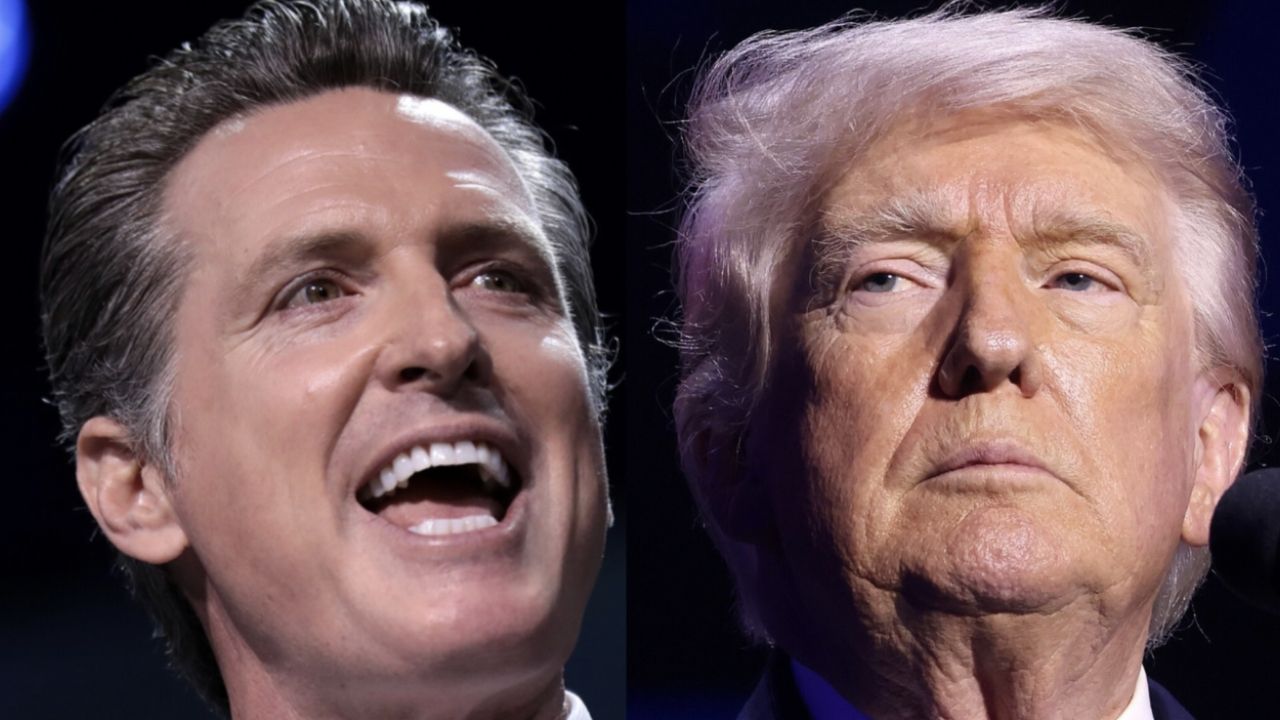
California Gov. Gavin Newsom accused President Donald Trump on Tuesday of endangering two of the state’s largest cities and one of the country’s biggest naval hubs. Newsom said the president’s remarks about Iran “taking out” Los Angeles and San Diego were “dangerous — if not treasonous,” and he ordered the state’s primary intelligence-sharing agency to watch for any sign that foreign adversaries might act on them. The governor posted his statement on X at 10:27 a.m. ET, hours after Trump made the comments at a campaign rally in Nebraska, where he defended the U.S. war with Iran.
The Governor’s Statement
Newsom’s post carried two paragraphs. It read in full:
“Donald Trump’s remarks were dangerous — if not treasonous — putting a target on two of our biggest cities and one of America’s largest naval hubs.
I am directing the State Threat Assessment Center to actively monitor the situation in the event that foreign actors interpret the President’s remarks as an invitation to target California.”
The statement frames Trump’s words as a potential national security problem for California and reaches past the usual political criticism. Newsom’s directive puts the state’s own threat-monitoring apparatus on alert over a presidential remark. The State Threat Assessment Center is the state agency responsible for detecting and preventing security threats in California.
What Trump Said in Nebraska
Trump made the remarks Monday night at a Republican political rally in Nebraska while justifying the war with Iran as necessary for “keeping the world safe.” He argued that the conflict was worth its costs, then turned to the possibility of strikes on U.S. soil.
“It’s a small price to pay for keeping the world safe, keeping our country safe,” Trump said. “They can take out a city. Let them take out Los Angeles, let them take out San Diego.” Portions of the crowd cheered as he named the two California cities.
Trump also said the war was “going to end very soon” but gave no details on how. Among the main justifications he has offered for launching the war this year is preventing Iran from developing a nuclear weapon. Last week, Trump turned down Iran’s latest cease-fire proposal, which would have reopened the Strait of Hormuz and restarted talks on Tehran’s nuclear program in exchange for U.S. concessions.
Newsom’s Broader Condemnation
Before and alongside his directive on the threat center, Newsom attacked the president’s comments on social media, calling Trump “deranged and dangerous.” He tied the remarks to the president’s earlier deployment of federal forces in California.
“After sending the National Guard and Marines to occupy California, Donald Trump is now saying our foreign enemies should ‘take out’ Los Angeles and San Diego,” Newsom wrote.
The reference points back to the 2025 deployments in Los Angeles. Newsom accused Trump of a “brazen abuse of power” when military personnel were sent to secure federal buildings during protests against immigration enforcement, some of which turned violent. Trump, for his part, called Newsom incompetent over his handling of those protests.
California Officials Respond
Other California leaders joined the criticism within hours. San Diego Mayor Todd Gloria wrote that his city was not “collateral damage” and not “expendable.” “Keep our city out of your reckless war talk,” he added.
Los Angeles Mayor Karen Bass said the comments were “dangerous” and could “potentially compromise” the city’s safety. “The role of a president is to protect the country, not to actively threaten it and encourage attacks on American lives,” she said in a social media statement.
The remarks also reached the campaign trail. Jim Desmond, a San Diego County supervisor endorsed by Trump in his bid to represent California’s 48th Congressional District, said he “vehemently” disagreed with the president. “No American city is expendable, and no American family should ever be treated as collateral damage,” Desmond wrote.
His Democratic opponent, San Diego City Councilmember Marni von Wilpert, called it “indefensible that Jim Desmond continues to support Trump’s war and continues to be backed and funded by a President who jokes about the 1.4 million people in San Diego being ‘taken out’ by a foreign adversary.”
The White House Pushes Back
The White House rejected the interpretation advanced by Newsom and the other California officials. White House Communications Director Stephen Cheung described the reaction as a “media freakout” that was “not rooted in reality.”
“He was clearly stating US cities would have been threatened if a nuclear Iran hadn’t been stopped,” Cheung wrote on X. “America is safer because of the President. Iran has no nuclear, no navy, no air force, and no money.”
A separate post from the official White House rapid response account called journalists who reported on the comments “buffoons.” It said Trump “was saying the US is fighting to STOP Iran from having the ability to take out LA and San Diego with a nuclear weapon — which they would if they had the chance.” The administration has repeatedly argued that disrupting Iran’s nuclear program was essential to U.S. national security and that the problems stemming from the conflict were necessary costs.
Why the Two Cities Matter
Both cities host significant U.S. military infrastructure, which gives Newsom’s warning its weight. San Diego is the eighth-largest city in the country and home to Naval Base San Diego, the home port of the U.S. Pacific Fleet. It also hosts Naval Amphibious Base Coronado, the main West Coast training center for Navy SEALs, and Marine Corps Base Camp Pendleton, where about 70,000 service members and civilians work. The city sits roughly 17 miles from the Mexican border.
About 120 miles to the north, Los Angeles is the second most populous city in the United States. It is home to the headquarters of U.S. Space Force’s Space Systems Command and to Los Angeles Air Force Base.
California’s Earlier Threat Warnings
The State Threat Assessment Center has been used this way before. After Trump announced U.S. strikes on Iranian nuclear sites in 2025, Newsom said the center was “actively monitoring for any potential impacts in California.” He added that there were “no specific or credible counter threats we are aware of at this time” and urged residents to “stay vigilant and report suspicious activity.”
The March Drone Alert
Concern about retaliation against California has surfaced during this war as well. In March, the FBI warned police departments about unverified information that Iran had allegedly aspired to conduct a surprise attack using unmanned aerial vehicles launched from an unidentified vessel off the U.S. coast, specifically targeting unspecified sites in California if the United States struck Iran.
Newsom said at the time that drone threats “have always been top of mind” and that the state was maintaining “a posture of preparedness for worst-case scenarios.” His office said the Governor’s Office of Emergency Services was working with state, local and federal security officials to protect communities.
The White House took a different line. Press Secretary Karoline Leavitt said, “No such threat from Iran to our homeland exists, and it never did.”
A Running Feud Over the War
The exchange is the latest in a long-running confrontation between the president and a governor widely viewed as a likely 2028 presidential contender. Newsom has used his social media accounts to mock Trump’s handling of the war, including after the president suggested the conflict would end whenever he felt it “in my bones.” Trump, earlier this year, mocked Newsom’s dyslexia, saying presidents should not have learning disabilities. The remark drew criticism from dyslexia charities.
What Comes Next
Trump has not directly responded to the statements from California officials. It is not clear whether the State Threat Assessment Center has identified any specific threat tied to the remarks, and Newsom’s post described the directive as precautionary, citing the possibility that foreign actors could interpret the president’s words as an invitation.
The dispute leaves an open question about how the war’s costs are weighed. Trump called them “a small price” for national safety, while California officials argue that naming American cities in that context turns residents into potential targets. With the war still unresolved, the Strait of Hormuz closed and a cease-fire proposal rejected, the argument over what the president meant is likely to carry into the midterm campaigns, including the competitive race in California’s 48th District.