
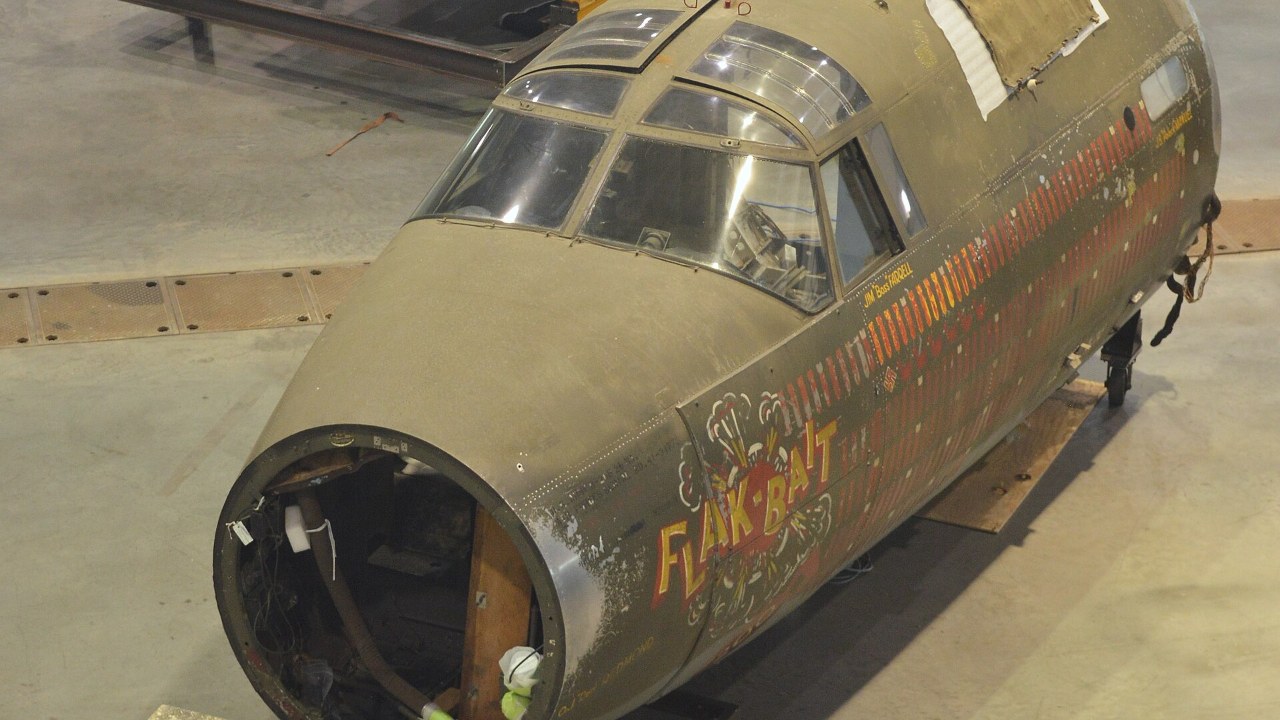
How many missions did Flak-Bait fly? The Smithsonian’s National Air and Space Museum gives a careful answer: over 200 combat missions, more than any other U.S. aircraft in World War II. The exact count is harder, and a researcher writing for the museum has laid out four competing figures for the same Martin B-26B Marauder.
The bomber survives in the museum’s collection, one of very few of its type left. Its war record is painted on its fuselage in rows of small symbols, and those symbols turned out to be the best evidence of all.
The museum set out the problem in an editorial story, “How Many Missions Did Flak-Bait Fly?,” published Jan. 18, 2018, by Joe Romito, a museum docent and volunteer researcher. The piece states that “it flew over 200 combat missions, more than any other U.S. aircraft in World War II.” It also notes that of the more than 5,000 B-26s built during the war, just seven survive, “and that makes Flak-Bait special.”
Four counts for one Marauder
Each figure in circulation comes from a different record, and Romito’s story walks through them in turn.
- 216 comes from the combat mission reports of the 322nd Bombardment Group, Flak-Bait’s parent organization during its 21 months of combat operations. “These records show that Flak-Bait was assigned to fly on 216 missions,” Romito wrote.
- 215 is the length of a list compiled after the war by the B-26 Marauder Historical Society. Romito found that it contains four missions not in the official records and leaves out five that are in the 322nd’s files.
- 202 is “the other most commonly reported mission count,” cited by several Flak-Bait crew members in letters and interviews.
- 206 is the figure Romito reached by reading the fuselage markings.
The 216 figure has a known weakness. As Romito explained, a bomber was often assigned to a mission and then did not complete it because of weather, mechanical problems or other factors, and in most cases the 322nd’s records do not say whether a given mission was flown to completion. An assignment count is not a flown count.
Those records span a long war. A museum image caption for Flak-Bait’s front fuselage says the bomber served with the 449th Bombardment Squadron, 322nd Bombardment Group, under the Eighth and Ninth Air Forces. It flew from bases in England and, after D-Day, on which it flew two missions, from bases in France and Belgium.
The crew’s 202 and the decoy missions
The crew figure carries the weight of eyewitness memory, and the museum’s own collection record uses it. The object page for the Martin B-26B-25-MA Marauder says Flak-Bait “survived 202 combat missions over Europe, more than any other American aircraft during World War II.”
Romito’s research adds a qualification. “These veterans usually point out that the number doesn’t include missions on which Flak-Bait was assigned to fly in a decoy or diversionary role,” he wrote. He argued those flights belong in the total because “diversionary missions were flown over hostile territory, where they were subject to attacks by enemy fighters, flak, or both.”
That is the source of the gap between the museum’s own pages. The object record repeats the veterans’ 202, while the researcher’s study counts the decoy flights as combat. Both agree on the claim that matters most: more than 200, and more than any other American aircraft of the war.
Reading the bombs on the fuselage
The 206 count comes from the airplane itself. Romito counted 207 symbols painted on the fuselage: 199 regular-sized bombs, one larger bomb for mission number 200, six ducks for diversionary missions and a swastika for an enemy fighter shot down. Some sources give 207 as the mission count, he noted, but the only way to reach it is to include the swastika. “This is clearly a mistake,” he wrote.
Take the swastika out and the paint adds up to 206 missions. “I think this is the definitive answer, at least until a more authoritative source comes along,” Romito concluded. The museum’s story also includes a photograph of the crew posing with the bomber after its 200th mission on April 17, 1945.
The 207 figure appears even inside the Smithsonian. The museum’s archive record for a wartime photograph collection donated by Sherman V. Best Jr., a co-pilot with the 449th Bombardment Squadron, says Flak-Bait survived “207 operational missions over Europe, more than any other American aircraft during World War II.” The same record says the bomber was built at the Glenn L. Martin Company’s Baltimore plant and “was completed in April 1943, when it was flown to England.”
For scale, the same story offers a comparison with a better-known bomber. The B-17 Memphis Belle “earned fame when it completed 25 missions, less than one-eighth of Flak-Bait’s total.”
Serial 41-31773 and the 322nd Bomb Group
The museum’s collection record identifies the aircraft by its Army Air Forces serial number, 41-31773, and gives the 322nd Bombardment Group’s nickname as the “Annihilators.” Per the same record, Lt. James J. Farrell of Greenwich, Connecticut, flew more missions in Flak-Bait than any other pilot, and he named the bomber after “Flea Bait,” his brother’s nickname for the family dog. The Air Force transferred the bomber to the National Air Museum in May 1949.
Flak-Bait is now in the hands of the museum’s conservators. The museum’s preservation project page calls it “an exceptionally rare and significant World War II artifact” and says the overriding theme of the treatment is preservation of the original airplane. The work is being carried out in the Mary Baker Engen Restoration Hangar at the Steven F. Udvar-Hazy Center in Chantilly, Virginia, where visitors can see it. According to the museum, the project’s completion will mark the first time Flak-Bait has been fully assembled since the end of World War II.
Top image: The forward fuselage of the B-26 Marauder Flak-Bait, with its name art, photographed during preservation work. Image Credit: Alan Wilson — CC BY-SA 2.0 / Wikimedia Commons
This article was produced with the assistance of AI and reviewed by Combat Rated editors prior to publication.