
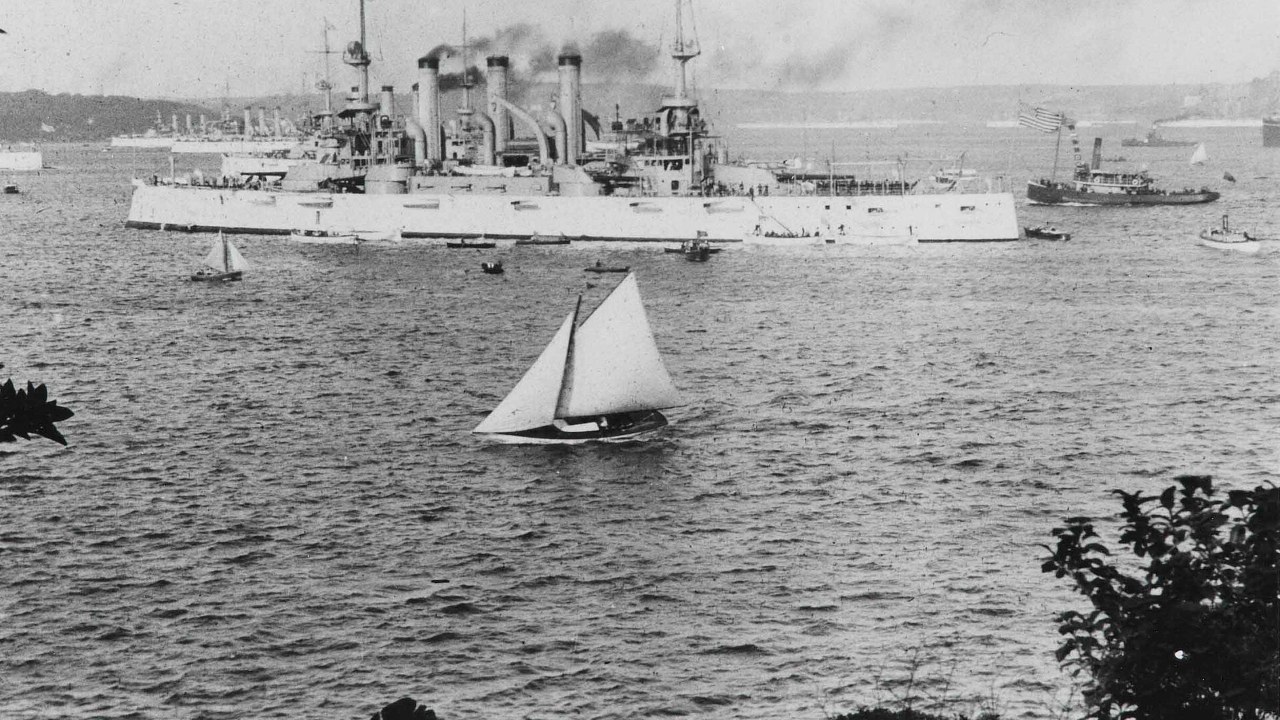
Hampton Roads, Virginia, was both the starting line and the finish. Sixteen steel-hulled battleships, painted white, steamed out of the roadstead on Dec. 16, 1907, and came back on Feb. 22, 1909. In between they covered 43,000 miles and made 20 port calls on six continents.
The cruise is remembered as a diplomatic statement. For the 14,000 sailors and Marines aboard, it was 14 months at sea and in foreign ports, with gunnery practice along the way.
Those figures come from the Naval History and Heritage Command’s page on The World Cruise of the Great White Fleet, the Navy’s own historical record of the voyage. NHHC states that the fleet “circumnavigated the globe in 14 months, a journey of 43,000 miles that included 20 port calls across six continents,” and that “Fourteen thousand Sailors and Marines participated in the voyage, leaving a lasting legacy at home and abroad.”
NHHC describes the ships as “16 steam-powered, steel-hulled battleships.” Steam and steel are the point of the description: this was a modern battle line sent around the world, and steam-powered ships meant the voyage ran on coal.
NHHC credits the voyage with practical gains for the Navy itself. The sailors and Marines “gained valuable at-sea experience and significantly improved the accuracy of fleet gunnery through practice exercises,” the command states. It also ties the cruise to a changing workforce: the twentieth-century Navy’s technology “led to greater demand for technical ratings such as electricians.”
Life aboard improved in at least one way. “Thanks to the recent introduction of refrigerator ships, crews enjoyed improved food offerings,” according to NHHC.
Three legs, from Trinidad to Gibraltar
The route ran in stages. The Library of Congress research guide Theodore Roosevelt’s “Great White Fleet”: Topics in Chronicling America lays out the timeline. After leaving Hampton Roads, the Atlantic Fleet headed for South America, stopping “in Trinidad, Brazil, Chile, Peru, and Mexico” before arriving in San Francisco on May 7, 1908.
The second leg began July 7, 1908, when the fleet departed San Francisco “bound for eastern Asia,” with stops in Hawaii, New Zealand, Australia, the Philippines, Japan and China, per the Library of Congress timeline. The third leg started Dec. 1, 1908, when the fleet left the Philippines and called in Ceylon, Egypt, Italy and Gibraltar on the way home. The guide calls the voyage “one of the greatest peacetime achievements of the U.S. Navy.”
NHHC confirms the structure, noting that the cruise “consisted of three different legs or sections.”
Two battleships swapped at San Francisco
The fleet that came home was not exactly the fleet that left. NHHC records that two of the original 16 battleships “were replaced after reaching San Francisco due to excessive coal consumption.” NHHC’s page does not name the two ships; the reason it gives is fuel, the same coal that every ship in the fleet depended on.
The command changed at San Francisco as well. According to the Theodore Roosevelt Presidential Library’s account of the Great White Fleet, the fleet sailed from Hampton Roads “under the command of Rear Admiral Robley ‘Fighting Bob’ Evans.” The library notes that Evans, “his health failing, was relieved at San Francisco, and Rear Admiral Charles Sperry led the fleet across the Pacific and home.”
President Theodore Roosevelt had ordered the cruise; the library describes its purpose as showing that “America was now a world power with global reach and formidable military capability,” and singles out the stop in Japan as especially significant.
The fleet arrived back at Hampton Roads on Feb. 22, 1909, the date the Library of Congress timeline gives for the arrival that completed the voyage, and the date NHHC uses to close its record of the world cruise.
Top image: Ships of the Great White Fleet in Sydney Harbour, Australia, in 1908. Image Credit: Australian National Maritime Museum — No known copyright restrictions / Wikimedia Commons
This article was produced with the assistance of AI and reviewed by Combat Rated editors prior to publication.