
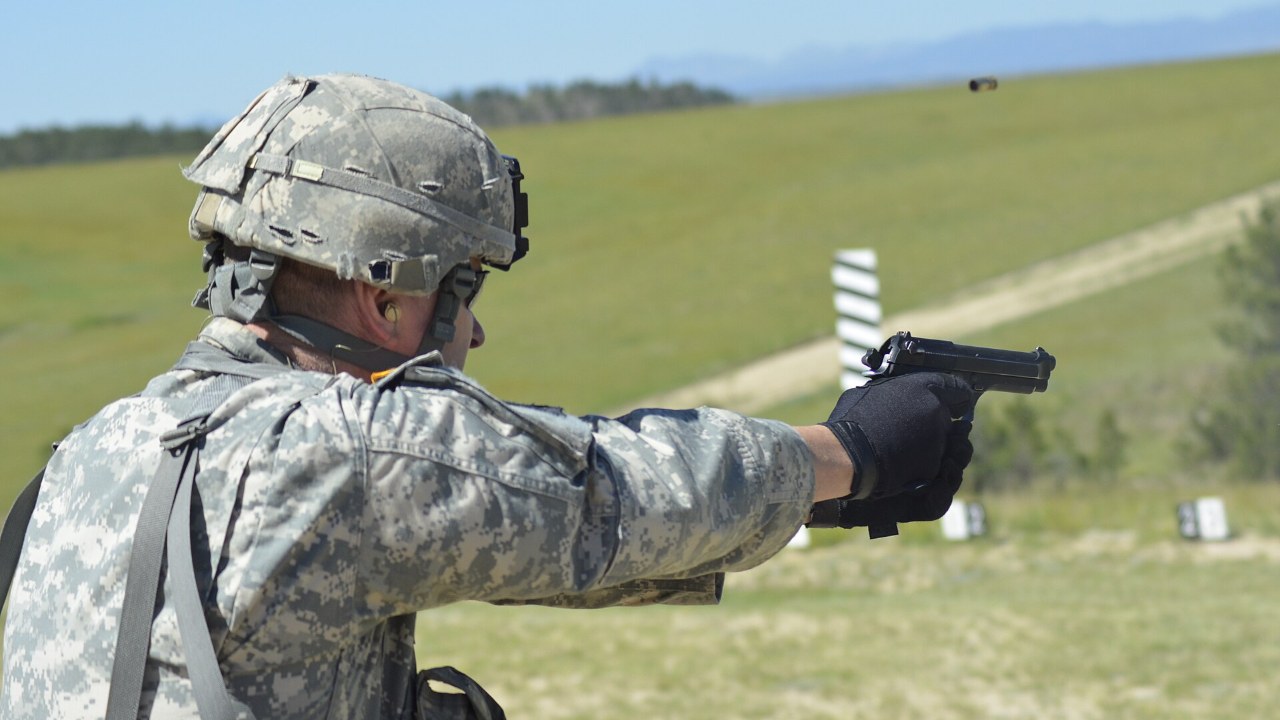
A 9mm pistol, the Beretta 92F, displaced the .45-caliber M1911A1 as the standard U.S. military sidearm in 1985, when the Army adopted it as the M9. Two pressures drove the change: an aging stock of .45s that had not been manufactured in four decades, and a push to put every service on the same NATO-standard 9mm cartridge.
The switch took most of a decade of testing, drew protests from losing bidders and a federal audit, and produced a pistol that served until a new generation of handguns began replacing it in 2017.
The fullest service-side history is Leatherneck magazine’s March 15, 2023 account by Sam Lichtman, published by the Marine Corps Association. It reports that “On Feb. 14, 1985, the U.S. Army officially adopted the Beretta 92F as the M9 pistol,” and that the M17 and M18 “began to replace M9s and M9A1s in 2017.”
Worn-out .45s and 25 kinds of handgun
The problem began with inventory. According to Leatherneck, the U.S. military at the time had “more than 25 different makes and models of handguns and more than 100 different types of handgun ammunition in inventory,” and “the last M1911A1s were manufactured in 1945.” Col. Chris Woodbridge, USMC (Ret.), described the condition of the remaining .45s to the magazine: “They were like maracas, they were so loose.”
Congress and the Pentagon set the direction. The Government Accountability Office’s predecessor, the General Accounting Office, laid out the chain of decisions in a June 1986 report on the pistol procurement: “In 1978, the House Committee on Appropriations reported on the proliferation of handguns and ammunition in the military and recommended standardization.” In 1980, the report says, the Defense Department determined that “a pistol which used the North Atlantic Treaty Organization’s (NATO) standard 9-millimeter (mm.) ammunition could replace all .45 and .38-caliber handguns in its inventory.”
Seven years of trials
The Air Force moved first. Leatherneck reports that the Air Force Armament Laboratory began testing nine pistol designs in a program that ran from 1977 to 1980, calling for “a pistol chambered in 9×19 mm for standardization with the rest of NATO, with a magazine capacity of at least 13 rounds and a double-action/single-action trigger system.” The Army issued its own XM9 requirements in 1981, received samples from four manufacturers and ended that program the following February, finding that none met its requirements. Eight manufacturers entered the renewed trials in early 1984. The GAO’s 1986 report states that samples were submitted in January 1984 and testing began in February 1984, and describes the April 1985 contract as having “culminated a lengthy, 7-year process requiring three iterations of testing.”
The contract, the protests and the audit
The award was contested. The GAO reported that “The Beretta contract was not signed until April 10, 1985,” because “The Army delayed signing the contract due to bid protests filed with GAO and litigation.” The multiyear contract, per the same report, covered 315,930 pistols at a total cost of about $75 million over five contract years.
GAO’s review was not a clean bill. In a separate June 5, 1986 report, the agency found that the Army had not favored Beretta but had unfairly eliminated one competitor through flawed testing procedures, including overstating the specification for required trigger pressure.
Accounts of the adoption date differ. Leatherneck gives Feb. 14, 1985; the GAO’s 1986 report gives April 10, 1985 for the signed contract; and the Army has dated the M9’s arrival to 1986. In a July 9, 2015 Army article, PEO Soldier spokesperson Debi Dawson said handgun technology had advanced “since 1986, when the M9 entered the Army’s inventory.”
Early production problems
The new pistol’s first years were not trouble-free. In testimony delivered Sept. 15, 1988, Milton J. Socolar, special assistant to the Comptroller General, reported that “the Army rejected the December 1987 and January 1988 production lots totaling about 12,000 weapons” over frame cracks, and that the M9 had experienced several slide failures traced to a fatigue crack near the slide’s locking-lug slot. As of Aug. 17, 1988, he testified, the Army had accepted delivery of 133,830 M9s, about 42 percent of the contract.
The M9 nonetheless remained the standard sidearm until its successors, the M17 and M18 pistols, began replacing it in 2017. Leatherneck reports that the last of the legacy pistols have already left Marine Corps service.
Top image: A U.S. Army military police soldier qualifies with the M9 pistol in 2016. Image Credit: U.S. Army photo by Pfc. Michael Britt — Public domain / Wikimedia Commons
This article was produced with the assistance of AI and reviewed by Combat Rated editors prior to publication.