
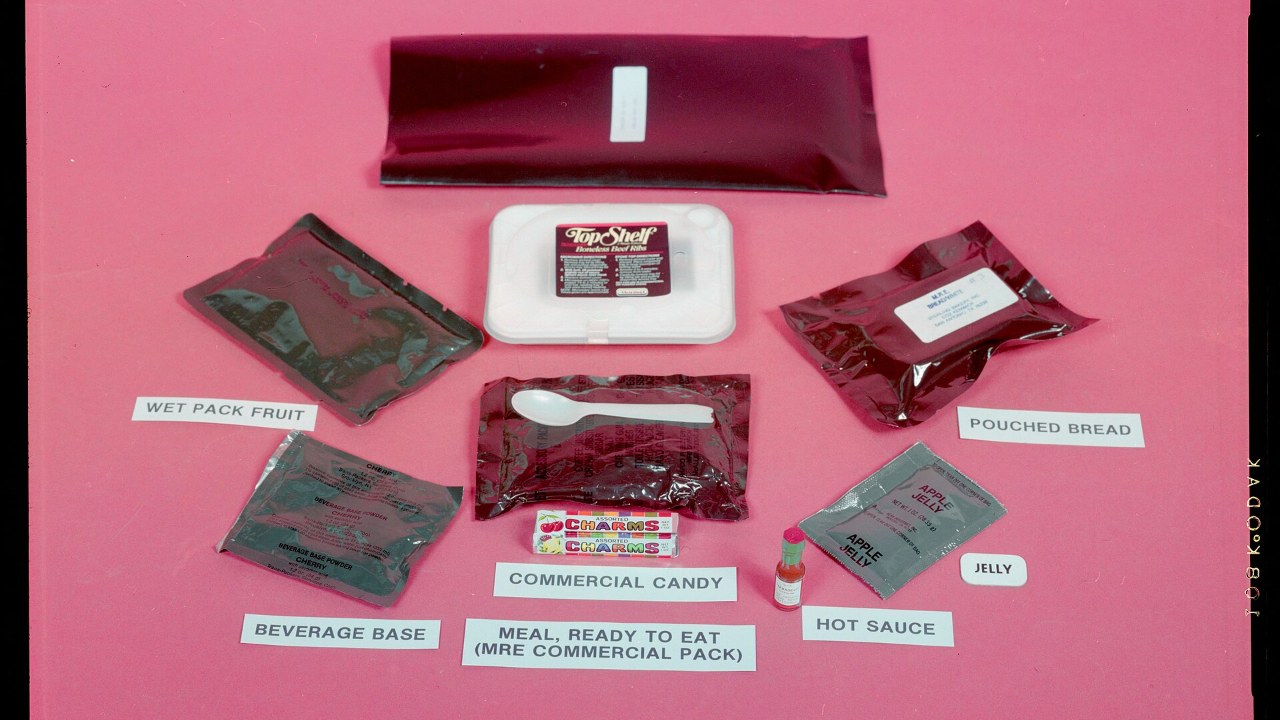
Before Operation Desert Shield/Storm, the Army planned to feed soldiers one Meal, Ready-to-Eat and two hot meals a day. In the Gulf, the MRE carried a far bigger share: more than 91 million of them went to the theater, half of all meals shipped there. Each one is built to average 1,250 kilocalories and to keep for three years at 80 degrees Fahrenheit.
Those two numbers, calories and shelf life, are the whole design brief of a field ration. It has to fuel a soldier who cannot get to a mess tent, and it has to survive sitting in a warehouse or a truck until someone needs it.
The current specifications come from the Defense Logistics Agency. DLA Troop Support’s MRE program page states that each meal provides an average of 1,250 kilocalories, split 13% protein, 36% fat and 51% carbohydrates, plus one-third of the Military Recommended Daily Allowance of vitamins and minerals. “The shelf life of the MRE is three (3) years at 80 degrees F,” the page states, adding that refrigeration can extend it.
DLA lists “twenty-four different varieties of meals,” packed in two cases: menus 1 through 12 in Case A and 13 through 24 in Case B. “Each meal bag contains an entrée and a variety of other components,” the agency says. MREs are restricted to the U.S. military services and authorized federally funded agencies; DLA’s page notes that private-sector purchases are not permitted.
The heater that changed the meal
A built-in way to heat the entrée was added in the early 1990s. “Since mid 1992, a flameless ration heating device has also been packed into each meal bag,” according to DLA. It lets a soldier warm the entrée without a stove or open flame.
An Army rations reference dates the change slightly differently. the Army Natick Soldier Research, Development and Engineering Center’s Operational Rations of the Department of Defense, Natick PAM 30-25, 9th edition (August 2012) says a Flameless Ration Heater “has been included in most MRE menus since 1993,” and that its chemical reaction raises the temperature of an entrée by 100 degrees Fahrenheit in 10 to 15 minutes. The same pamphlet gives the MRE’s history in one line: “The MRE went into full production in 1980, with the first MREs hitting the field in 1983.” It put the per-meal figure at the time at approximately 1,300 calories and confirmed the three-year shelf life at 80 degrees.
91 million meals in Desert Shield/Storm
Operation Desert Shield/Storm put the ration to work at scale. The Army Quartermaster Museum preserves an Autumn 1991 Quartermaster Professional Bulletin article, The Army Family of Rations. It states that “during Operation Desert Shield/Storm, the primary individual ration was the MRE,” and that “more than 91 million meals or 50 percent of the meals shipped to the Joint Operations Area (JOA) were MREs.”
The meals sent to the Gulf were the newest versions. The bulletin lists improvements including “increased entree size, two breakfast entrees (ham and egg omelet and corned beef hash),” along with name-brand candies, hot sauce, coffee, beverage powder and wet towelettes. During the operation, it adds, the MRE “was enhanced with fresh fruits and fruit juice.”
The heater came too late for most of the troops who would have used it. The 1991 bulletin says the flameless ration heater was “shipped in bulk with distribution problems and the rapid end of the war, few soldiers realized the benefit,” though it “received high reviews from soldiers and leaders alike.” That experience lines up with DLA’s account of heaters being packed into every meal bag from mid-1992.
Smaller rations alongside the MRE
The MRE is still the standard individual ration, but the Army’s food scientists keep building lighter alternatives for specific missions. In a July 21, 2025 article from DEVCOM Soldier Center Public Affairs, the Army announced the Close Combat Assault Ration, reporting a “39% reduction in volume and 17% reduction in weight as compared to the FSR,” the First Strike Ration. Erin Gaffney-Stomberg, chief of the center’s Combat Feeding Division, put the principle behind every ration in one line:
“We have a long standing saying in the food world that it’s not nutrition if it’s not eaten.” — Erin Gaffney-Stomberg, PhD, Combat Feeding Division Chief, DEVCOM Soldier Center
For the MRE itself, DLA’s published standard holds: 24 menus, an average of 1,250 kilocalories per bag, and three years of shelf life at 80 degrees Fahrenheit.
Top image: The contents of a Meal, Ready-to-Eat. Image Credit: U.S. Army Natick Soldier Systems Center — Public domain / Wikimedia Commons
This article was produced with the assistance of AI and reviewed by Combat Rated editors prior to publication.