
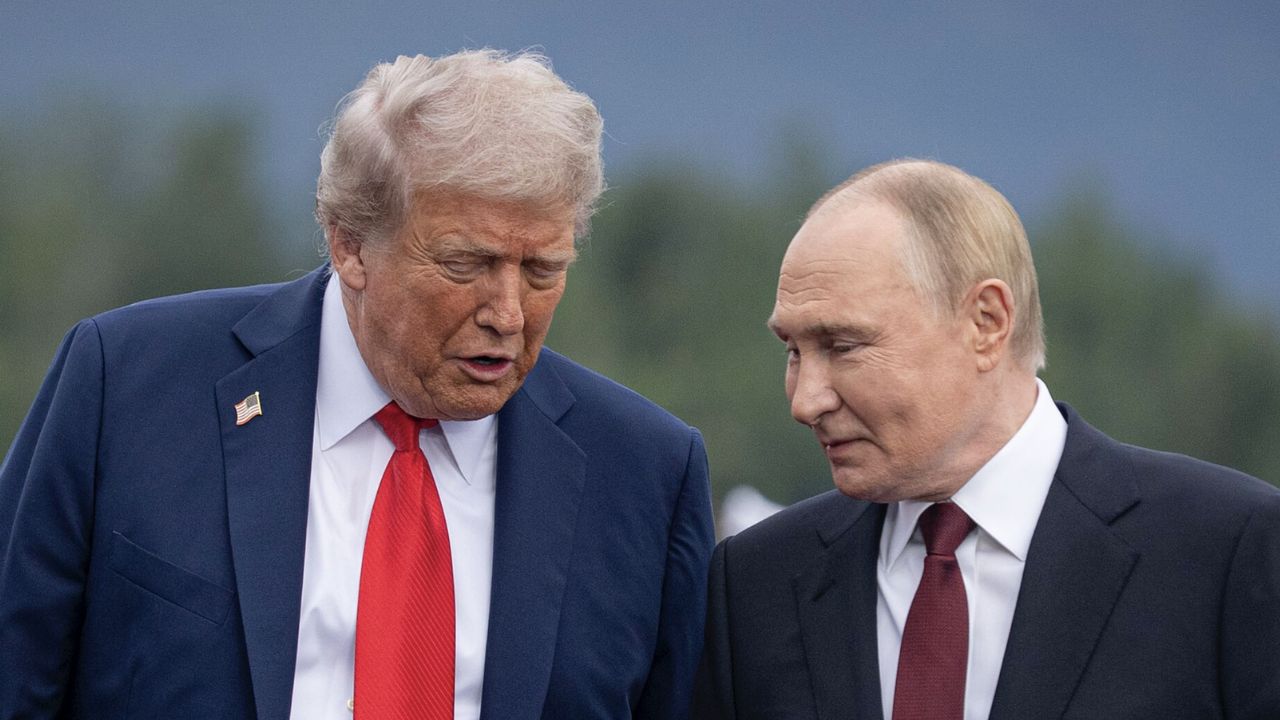
Trump Weighs Business Deals With Russia Before Putin Ends the War in Ukraine
The Trump administration is considering signing business deals with Russia before the war in Ukraine ends, a shift from President Trump’s earlier position that economic agreements with Moscow should wait until a peace settlement is reached, according to two people close to the talks. Officials believe offering Russia economic incentives could help persuade President Vladimir Putin and members of Russia’s elite to support ending the war, which has now stretched past four and a half years.
A Reversal From “Not Until the War Is Settled”
Trump has previously described Russia’s economic potential as “tremendous,” but he had held out business deals as a reward reserved for a Russia that agrees to peace. Ahead of his Alaska summit with Putin last year, Trump said of the Russians, “They want to do business. But they’re not doing business until we get the war settled.” The emerging shift suggests that Trump’s envoys, Steve Witkoff and Jared Kushner, are searching for new leverage now that Ukraine has made clear it will not withdraw from the portion of the Donbas region that Putin insists he must control before ending the war.
Envoys Press Putin Over Broken Promises
During a meeting at the Kremlin earlier this month, Putin told Trump’s envoys that Russian troops would capture the entirety of Ukraine’s Donbas region within months and that Russia was prepared to further batter Ukraine’s electricity grid ahead of winter. Kushner pushed back, telling Putin he had made the same prediction a year earlier and asking what the odds were that they would return in another year to hear the same claim again. The exchange was described by a person familiar with the talks and by a U.S. official.
Officials Say Deals Could Sway Russia’s Elite
A U.S. official, speaking on condition of anonymity to discuss the negotiations candidly, said deals with Russia struck before the war’s end were now possible because they would demonstrate that the United States is serious about resetting its relationship with Moscow. The official said the administration wants to create incentives for members of Russia’s elite to push Putin toward peace, and that executing some business deals before a settlement could help convince anti-American hawks in Putin’s circle that Trump genuinely intends to build a new relationship with Russia.
Congress Sends Trump a Sanctions Bill Aimed at Russia’s Economy
Even as the administration weighs incentives for Moscow, Congress this week passed a sweeping sanctions measure targeting Russia’s energy sector. The House approved the bill 262 to 159 on Wednesday, sending it to Trump’s desk after it had cleared the Senate 86 to 11 the previous month.The legislation passed the Senate 86-11 and the House by 262-159, with 58 Democrats joining most Republicans in favor. The measure was named the Lindsey O. Graham Sanctioning Russia and Iran Act of 2026, in honor of the South Carolina Republican who championed it before his death in July.
What the New Law Does
The law allows the president to impose tariffs of up to 100% on the five largest purchasers of Russian oil and natural gas, and it sanctions Putin himself along with Russian government officials, oligarchs, and financial institutions. The bill’s most significant new authority lets the president place tariffs of up to 100% on third countries buying large volumes of Russian energy, according to the nonpartisan Center for Strategic and International Studies, replacing an earlier proposal for a blanket 500% tariff with a narrower tool that carves out countries reducing their reliance on Russian energy. Analysts have noted the law would hit China and India hardest, since they are the largest buyers of Russian crude.
Beijing Objects, Democrats Raise Concerns Over Enforcement
China’s government pushed back on the measure. A Chinese foreign ministry spokesperson said Beijing has “consistently opposed long-arm jurisdiction that lacks a basis in international law and has not been authorized by the UN Security Council.” Some House Democrats who ultimately voted for the bill raised concerns about how broadly the administration could apply it. Representative Don Beyer of Virginia said the bill “has a loophole that would allow him to define basically any country as a facilitator of evading Russian sanctions,” adding that the president could then impose tariffs “with no guardrails or oversight, and no expiration.”
Republicans Frame the Bill as Leverage for Trump
Representative Michael McCaul of Texas, one of the bill’s leading proponents, said after the House vote that “this bill will cripple Russia’s war machine and finally bring Putin to the negotiating table.” Senator Darline Graham of South Carolina, who replaced her brother in his Senate seat after his death, said the law would “increase the president’s negotiating leverage.”
Zelensky Thanks Trump, Invokes Graham’s Memory
President Volodymyr Zelensky of Ukraine thanked Trump and lawmakers after the bill’s enactment. “The best way to honor Lindsey’s memory will be to implement the provisions of this law fully and swiftly,” he said on social media. “And the best reward for everyone helping us put pressure on Russia to end its war will be peace.”
Trump’s Frustration With the Stalled War
Trump has voiced growing frustration with his inability to end the war despite campaign promises to do so on his first day in office. “The holdup is two people that hate each other,” Trump said after speaking with Putin. “I think more than anything else, it’s two people that hate each other.”
Carrots, Not Just Sticks
Despite the new sanctions law, officials say the administration’s focus with Russia has increasingly shifted toward incentives rather than pressure alone. It remains unclear exactly which deals are under discussion, though Kremlin foreign policy adviser Yuri Ushakov said after Putin’s September 5 meeting with Witkoff and Kushner that “economic issues and potential major mutually beneficial Russian-American projects were discussed in some detail.” Also present at that Kremlin meeting was Kirill Dmitriev, Putin’s special representative for investment and economic cooperation with foreign countries.
What Russia Has Offered
Moscow has spent much of the past year and a half promoting business opportunities to Washington, floating deals covering rare earths, aluminum, joint ventures in the Arctic, and even involving U.S. companies in selling Russian natural gas to Europe. Dmitriev, one of Russia’s key negotiators with the U.S., has said discussions on joint rare-earth extraction projects are already underway. “Rare earth metals are an important area for cooperation, and we have certainly begun discussions on various rare earth metals and projects in Russia,” Dmitriev said, adding that Russia and the U.S. should pursue joint projects “in the Arctic and other regions” as well.
The Kremlin’s Long Courtship on Minerals
The overtures on rare earths are not new. Kremlin spokesman Dmitry Peskov has previously said Russia holds vast untapped reserves it is prepared to offer American companies, framing it as a straightforward matter of supply and demand. “Americans need rare earth metals. We have plenty of them,” Peskov said, adding that Moscow would be ready for joint projects once there is “a moment of political will” on the American side.
The Donbas Impasse Behind the Shift
The renewed push for economic incentives comes after talks over a possible Ukrainian withdrawal from the rest of the Donbas ran aground. Ukrainian officials had floated calling the contested area “Donnyland” earlier this year in an attempt to persuade Trump to push back harder against Russia’s territorial demands. Speaking by video link at the YES Annual Meeting in Kyiv last weekend, Kushner acknowledged the impasse directly, saying Putin had “laid out his line of what he wants to achieve” and that “if Ukraine, you know, wanted to withdraw to that line, then obviously, we have the rest of the deal set up and put together. Ukraine right now does not want to do that.” Part of the audience reportedly responded with laughter, reflecting skepticism among Ukraine’s allies toward the administration’s characterization of the talks as evenhanded.
Analysts See a Bigger Concession in the Making
Balazs Jarabik, a former European Union diplomat in Kyiv now with the political analysis firm R.Politik, said the signals point to Washington “considering bigger concessions toward Russia.” He said the U.S. “is now signaling that some deals could move forward if Moscow first demonstrates concrete restraint,” a departure from the administration’s earlier resistance to signing agreements before a cease-fire.
What Comes Next
Negotiations to end the war had largely stalled earlier this year as Witkoff and Kushner turned their attention to the conflict with Iran. This month’s trip to Moscow and Kyiv appears intended to restart those talks, with Ukrainian officials saying trilateral negotiations between the United States, Ukraine, and Russia could resume in October. Officials expect that round to focus on the possibility of a limited cease-fire, potentially halting strikes on shipping in the Black Sea or on energy infrastructure, even as the question of business deals with Moscow continues to loom over the broader push for peace.