
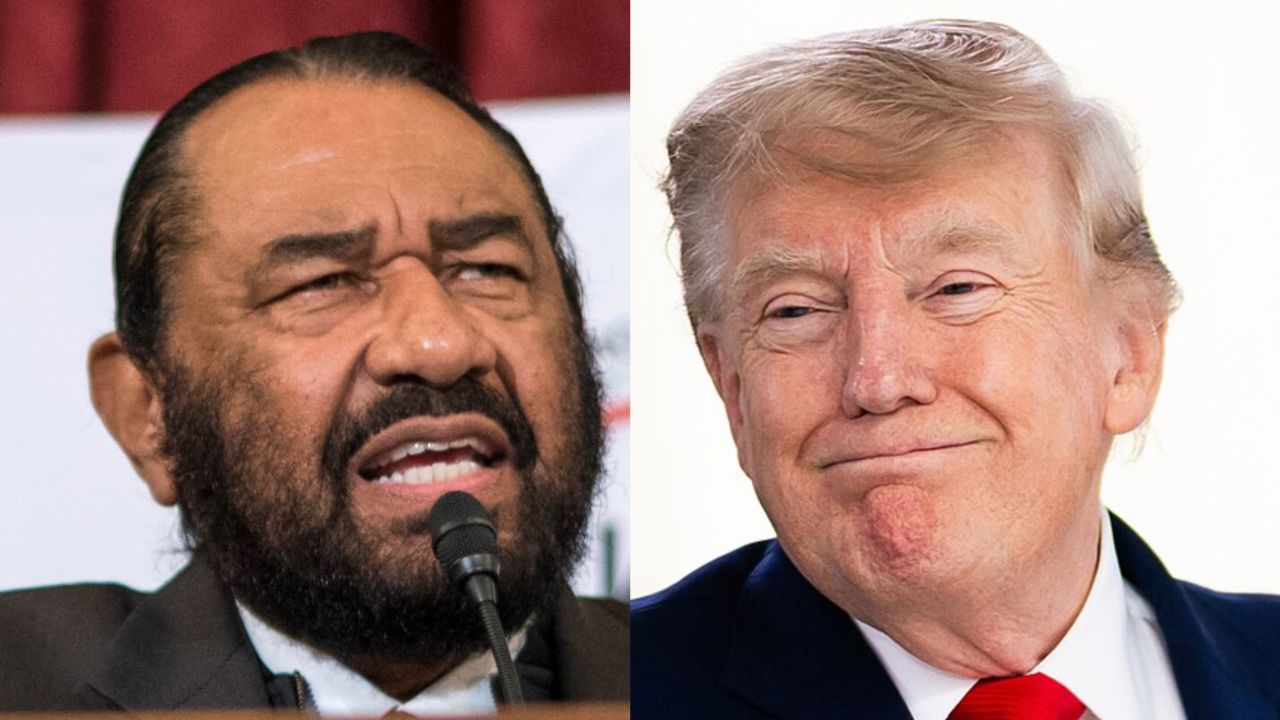
The House of Representatives voted 232-147 on Tuesday to table articles of impeachment against President Trump filed by Representative Al Green (D-Texas), killing the eighth impeachment attempt Green has launched against the president since 2017 and exposing a deep rift within the Democratic Party over how aggressively to confront the White House ahead of the November midterms.
Green’s resolution, H.Res. 1486, accused Trump of transforming Immigration and Customs Enforcement and Customs and Border Protection into “dangerous, unaccountable paramilitary police forces” and cited the deaths of four people during immigration enforcement operations earlier this year: Renée Good and Alex Pretti in Minneapolis, Lorenzo Salgado Araujo in Houston, and Johan Sebastián Durán Guerrero in Maine.
“President Trump, using the powers of his high office, individually and in coordination with officers in his administration, has transformed ICE and CBP into dangerous, unaccountable paramilitary police forces that operate without oversight and pose a direct threat to the constitutional order of the United States and the people of the United States,” the articles read. “By such abuses of power, President Trump is brazenly and wantonly devolving the United States democratic republic into an authoritarian regime.”
The administration has defended the shootings as instances of federal officers acting in self-defense, a claim that relatives of the victims and, in some cases, camera footage have disputed.
Eighteen Democrats broke with their party to join nearly every Republican in voting to table the resolution, including Representatives Henry Cuellar of Texas, Jared Golden of Maine, Marie Gluesenkamp Perez of Washington, Jared Moskowitz of Florida, Kathy Castor of Florida and Emanuel Cleaver of Missouri.
Forty-six to forty-seven other Democrats, including the party’s top three House leaders — Hakeem Jeffries of New York, Katherine Clark of Massachusetts and Pete Aguilar of California — voted “present,” declining to register a position on the merits of impeachment at all. They were joined by Representative Thomas Massie, the Kentucky Republican and frequent Trump critic, who separately moved on Tuesday to impeach Defense Secretary Pete Hegseth.
Jeffries, Clark and Aguilar explained their refusal to back the measure in a joint statement issued Monday night, arguing that Green had bypassed the formal investigative process that typically precedes impeachment proceedings. “None of that serious work has been done, with the Republican majority focused solely on rubber stamping Donald Trump’s extreme agenda,” the three leaders said.
Aguilar, who chairs the House Democratic Caucus, went further in comments ahead of the vote, framing the entire effort as a distraction manufactured by Green’s political opponents rather than a genuine party priority. “This is something oftentimes I think the right-wing media wants us to talk about,” Aguilar said. “But it’s not anything that’s top of the agenda for House Democrats.”
Green, addressing colleagues on the House floor, acknowledged his long history of pushing impeachment and accused fellow Democrats of effectively shielding the president by refusing to vote yes. “It is hard for me to believe that we have Democrats who are going to vote to maintain the president in office,” he said, characterizing anything short of a vote to impeach as tantamount to support for Trump remaining in the White House.
In a letter to colleagues the week before the vote, Green framed the push as a moral imperative rather than a political calculation, dismissing colleagues who preferred to wait for the outcome of ongoing investigations. “To those who say, ‘Wait until next year’ and ‘Buckle up’ when the investigations start, I say: How many more lives must we lose, and how many more loved ones of victims have to plead for help before the self-evident evidence from videos and President Trump’s own words compel us to act?” he wrote.
Not every Democrat who opposed tabling the measure was comfortable with leadership’s “present” strategy. Representative Adelita Grijalva of Arizona said she believed Trump deserved impeachment and rejected sidestepping the question on procedural grounds. “I think that my constituents in Southern Arizona sent me here to vote yea or nay, and that’s what I’m going to do,” she said.
Tuesday’s vote marked the third time Green has forced a House-wide impeachment vote against Trump during the president’s second term, following a June 2025 effort over unauthorized military strikes on Iran, which failed 344-79, and a subsequent effort accusing Trump of inciting violence against lawmakers and judges. The shift in vote totals across those three efforts — from an overwhelming bipartisan rejection to a much narrower, more contested outcome — reflects a gradual hardening of Democratic sentiment toward the president even as leadership continues to resist a formal impeachment push.
Green filed H.Res. 1486 on August 24 and used a privileged resolution — a procedural mechanism that compels the full House to act on a measure within two legislative days — to force Tuesday’s vote, guaranteeing Republican leadership could not simply let the resolution die in committee.
The timing placed Democrats in an uncomfortable position just 50 days before the midterm elections, during the House’s final scheduled week in session before campaign season intensifies. Party strategists have argued for months that Democrats’ strongest message heading into November centers on the cost of living and the broader economy, not impeachment, and that dwelling on Trump’s removal risks energizing his base more than it mobilizes swing voters.
Green will not be part of that November campaign. The 22-year House veteran lost his Democratic primary in May to Christian Menefee by more than two to one, a defeat driven in part by a Republican-led redistricting effort that reshaped his Houston-area seat. He has said he intends to force at least one more impeachment vote before leaving Congress at the end of the year.
Green is no stranger to bucking his own party’s leadership on impeachment. During Trump’s first term, he was the first House Democrat to force impeachment articles to a floor vote, doing so in 2017 over Trump’s response to the white-supremacist march in Charlottesville, Virginia, well before party leaders were prepared to support such a move. He has also drawn formal rebuke from his colleagues, including a censure vote after heckling Trump during a 2025 joint address to Congress.
Republicans have seized on the repeated impeachment pushes to cast Democrats as out of step with mainstream voters as they defend their narrow House majority in November. With Tuesday’s vote behind them, both parties now shift attention to a midterm campaign in which the balance of power in the House — and whether a future Democratic majority would revisit the question of impeachment altogether — remains squarely on the ballot.