
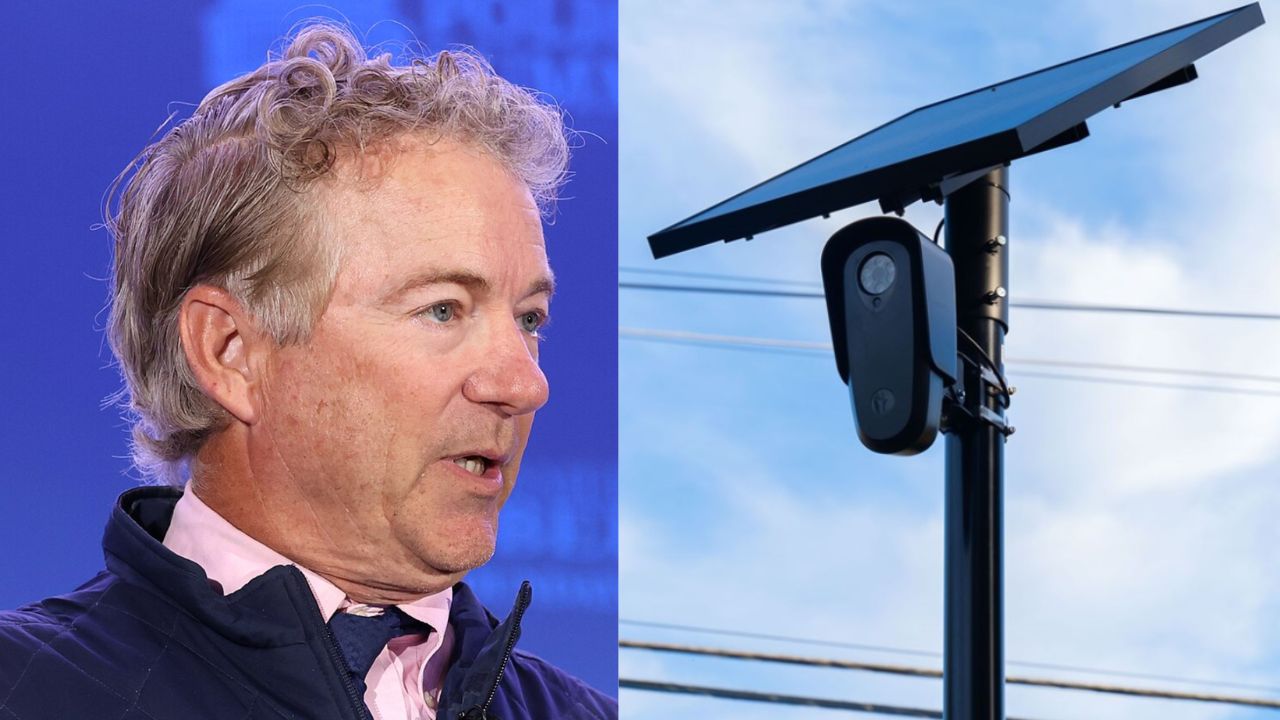
U.S. Senator Rand Paul, R-Ky., took to X on Sunday, September 13, 2026, to deliver a fresh warning about the rapid expansion of Flock Safety’s license-plate-reading camera network, arguing that the company’s central pitch to the American public — that citizens must give up a measure of privacy in exchange for safety — is a bargain the country cannot afford to make. The post continued a monthslong campaign by the libertarian-leaning senator against Flock, a surveillance technology company whose cameras now monitor roads in every U.S. state except Alaska.
The Full Post
Paul’s post, published at 2:31 PM on September 13, quoted directly from a New Yorker article examining Flock’s founder before delivering his own verdict. The senator’s post read, in its entirety:
“‘The company, which has a hundred and thirty thousand cameras monitoring the streets of the U.S., frames privacy as a worthwhile trade-off for safety and security, echoing the language of the post-9/11 surveillance boom.’
We can’t trade our rights for the feeling of ‘safety.'”
Paul linked to a September 9 New Yorker piece by Brady Brickner-Wood titled “Flock Wants a Closely Surveilled World with No Exit,” which profiles Flock Safety founder Garrett Langley and traces the company’s evolution from a homemade, solar-powered camera built to stop neighborhood carjackings in Atlanta into a nationwide surveillance apparatus now valued at more than eight billion dollars.
Langley’s “Compromise” and the Backlash That Followed
The New Yorker article that Paul cited describes Langley telling audiences, including during a TED talk last month, that Americans “deserve the right to be safe” regardless of “the color of your skin, your political affiliation, or your income level,” and that achieving a crime-free society requires the public to “sacrifice” its privacy. That framing has become a recurring flashpoint between Paul and the Flock founder. In an August interview with Fox News, Langley argued that Americans “value” privacy but that safety also matters, and that the country needs to “prioritize” a “compromise” between the two. Paul responded on X that Langley wanted Americans to “compromise” away their Fourth Amendment rights, adding that “our Founding Fathers are rolling in their graves at this suggestion.” Langley pushed back directly at the senator, writing that the comment was not his own and that Flock “believe[s] in the constitution,” while insisting Americans “deserve to be safe.”
A Company Built From a Solar-Powered Camera
According to the New Yorker’s reporting, Langley’s interest in surveillance technology began in 2017 after a wave of thefts in his Atlanta neighborhood led him to call local police, who told him that without eyewitness accounts or license-plate footage, the perpetrators were effectively untraceable. Langley, then a tech entrepreneur, enlisted two former classmates and built rudimentary license-plate cameras out of Android phones and solar panels. What began as a product sold to homeowners’ associations grew, by 2020, into a network embedded in public roads through partnerships with local police departments across the country.
Scale of the Network
Flock’s cameras have since evolved well beyond license-plate capture. The New Yorker reports that the devices now log a vehicle’s make, model, and color, data that law enforcement agencies can access without a warrant or judicial sign-off. The company has credited its technology with breaking up crime rings and locating missing persons, including in the case of a mass shooter at Brown University who was tracked using Flock data. Around 40 percent of U.S. law-enforcement agencies now hold contracts with the company, and its cameras are deployed in every state except Alaska. Separately, Senator Josh Hawley, R-Mo., has cited even larger figures in his own inquiry into the company, describing a network of roughly 120,000 cameras across 49 states processing more than 20 billion vehicle scans every month.
Documented Cases of Abuse
Much of the bipartisan alarm over Flock has been driven by specific, documented instances of misuse. The New Yorker piece notes that a Texas sheriff’s deputy searched a pool of more than eighty thousand Flock cameras to build a case against a woman who had allegedly obtained a medication abortion, and that Immigration and Customs Enforcement has used Flock data obtained through municipal police departments to locate and detain immigrants. A separate Washington Post investigation, found that at least 69 police officials nationwide have been accused, charged with, or convicted of misusing Flock’s license-plate readers or similar systems for unauthorized purposes. In one case highlighted in that reporting, an officer was found to have tracked his wife’s car 3,759 times. Separately, an audit in California reportedly led the Los Angeles Police Department to terminate its Flock contract after officers made 161 incorrect stops over two months based on false stolen-vehicle flags.
Paul’s Own Track Record on Flock
Sunday’s post is not an isolated statement. On August 20, 2026, Paul used X to respond to a report from Young Americans for Liberty summarizing the Washington Post’s findings on officer misuse of Flock cameras, writing simply that the abuses amounted to “not to mention a 4th Amendment violation.” Weeks earlier, following Langley’s Fox News appearance, Paul had accused the CEO of asking Americans to trade away constitutional protections, a post that circulated widely across conservative media outlets covering the growing rift between Flock and its Republican critics.
The Federal Trade Commission Inquiry
Paul’s objections to Flock extend beyond social media commentary. According to reporting on the senator’s advocacy, Paul joined Oregon Senator Ron Wyden last fall in demanding a Federal Trade Commission investigation into Flock’s security practices, after reports surfaced that stolen police logins had exposed vehicle-tracking data to unauthorized users. The reporting noted that the system reportedly lacked multi-factor authentication, leaving a database capable of tracking any driver in America vulnerable to anyone who obtained a compromised password.
A Parallel Senate Investigation Gains Steam
Paul’s criticism has coincided with a formal Senate probe led by a fellow Republican. On August 26, 2026, Senator Josh Hawley, chairman of the Senate Judiciary Subcommittee on Crime and Counterterrorism, sent a letter to Langley demanding documentation on data retention, access controls, and known instances of misuse. Hawley wrote that Flock has “assembled an unprecedented national surveillance network” and demanded the company produce all requested documents by September 8, 2026. He argued separately that “Americans do not surrender their privacy rights when they drive to work, drop their kids off at school or go to church.” A Flock spokesperson told the Daily Caller News Foundation that the company intended to cooperate with the subcommittee and “look[ed] forward to working with Senator Hawley.”
The Investigation Widens
Hawley’s inquiry has since expanded beyond Flock. The senator sent follow-up letters to the chief executives of Motorola Solutions, Verkada, and Axon Enterprise, informing them that his subcommittee was extending scrutiny to the broader AI-powered camera industry and setting a September 16, 2026, deadline for those companies to respond. In his letter announcing the expansion, Hawley wrote that while Flock had drawn the earliest attention, “Flock does not stand alone in this industry,” noting that other companies are “building large camera networks, assisted by artificial intelligence, that intrude on the privacy of all Americans.”
Flock’s Response to Mounting Pressure
Facing the twin pressures of state-level rollbacks and federal scrutiny, Flock announced changes to its data practices on August 13, 2026. The company said it was changing its default and recommended data-retention period from 30 days down to seven, while introducing an “Evidence Mode” intended to preserve records tied to active investigations and expanding an audit-assistance program. However, reporting on the announcement noted that existing customers would retain their previously approved retention periods unless they actively opted to shorten them, meaning the change does not establish a universal seven-day deletion standard across departments already using the network.
Red States Begin Cutting Ties
The backlash against Flock has crossed party lines in ways that have surprised observers of the debate. The New Yorker article Paul cited notes that Texas Governor Greg Abbott instructed state agencies late last month to freeze spending on Flock cameras, while Florida Governor Ron DeSantis revoked permits for automated license-plate readers on state highways and ordered their removal. Republican officials in Indiana, Kansas, and Tennessee have likewise voiced support for restrictions on the technology, citing the public’s right to privacy even as they maintain broadly tough-on-crime records.
Paul’s Broader Legislative Record on Surveillance
Paul’s objections to Flock fit into a longer pattern of Fourth Amendment advocacy in the Senate. In July 2026, he introduced S. 4998, the Fourth Amendment Restoration and Protection Act of 2026, legislation described in legislative tracking as a measure that would sharply limit how U.S. intelligence authorities can use certain surveillance powers against American citizens and other U.S. persons. As of publication, the bill had no cosponsors. Earlier this year, Paul, in his role as chairman of the Senate Homeland Security and Governmental Affairs Committee, also released files related to Biden-era FBI surveillance of a Catholic school teacher, a matter his office framed as further evidence of unchecked government monitoring of ordinary citizens.
Grassroots Resistance and the DeFlock Movement
Public opposition to Flock has also taken more direct forms. The New Yorker reports that nearly half of Americans oppose automated license-plate readers, according to Washington Post polling, and that some residents have resorted to damaging or removing cameras from public spaces. A crowdsourced mapping application called DeFlock has emerged as a hub for the anti-surveillance movement, cataloguing camera locations nationwide alongside legal resources. Langley has previously described the DeFlock project as “terroristic,” a characterization he later attempted to walk back after it drew criticism for echoing post-9/11 rhetoric that cast dissent as a security threat.
The Broader Debate Over Privacy and Security
The framing at the center of Paul’s Sunday post — that safety and privacy are being presented as a forced trade-off — has deep roots in American surveillance policy. The New Yorker article traces the “compromise” language back to the Patriot Act era, when then-Attorney General John Ashcroft pressed Congress to expand law-enforcement surveillance powers in the weeks following the September 11 attacks, arguing that “talk won’t prevent terrorism; tools can help prevent terrorism.” Legal scholars cited in the piece, including Justice Samuel Alito’s 2012 concurrence in United States v. Jones, have long grappled with the tension between technological convenience and constitutional privacy protections, a debate Paul’s post suggests has entered a new phase with the rise of nationwide camera networks.
What Comes Next
With Hawley’s subcommittee deadlines for Flock, Motorola, Verkada, and Axon Enterprise falling in mid-September, and with Paul continuing to press the issue on social media and through legislation, the fight over Flock’s role in American policing shows no sign of resolving quickly. Paul’s Sunday post — arguing plainly that the country “can’t trade our rights for the feeling of ‘safety'” — signals that the senator intends to keep the pressure on Flock and its law-enforcement partners as the company’s technology continues to expand, even as state governments, congressional investigators, and grassroots activists move in the opposite direction.