
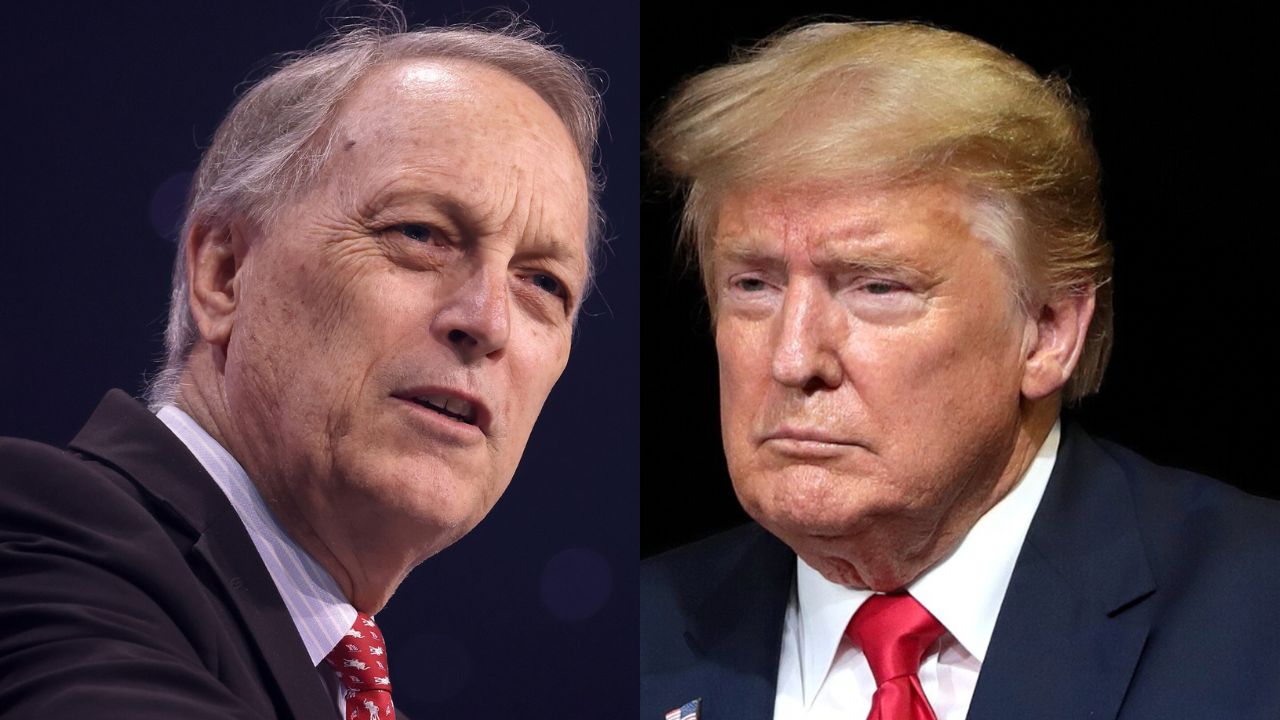
Rep. Andy Biggs, R-Ariz., issued a stark warning on Thursday night after the United States government’s total debt officially surpassed $40 trillion, calling the figure a “grim milestone” that will leave future generations to bear the weight of decades of unrestrained federal spending. In a post to X, Biggs delivered a blunt assessment of the nation’s fiscal trajectory, closing his message with a three-word plea: “God help us.”
Biggs’s statement, posted at 9:27 p.m. on August 20, 2026, read in full:
“$40 trillion in debt is a grim milestone for our nation.
Our children and grandchildren will be forced to suffer the immense consequences of the inaction and fear of making tough decisions to bring our spending under control.
God help us.”
Debt Crossed $40 Trillion While Congress Was Out of Washington
The debt milestone landed at a politically awkward moment. According to Treasury Department data, gross federal debt reached $40.05 trillion, a figure that arrived while members of Congress were away from the U.S. Capitol and not in session. Biggs seized on that timing directly, framing the absence of lawmakers as emblematic of a broader pattern of avoidance on fiscal matters that has spanned both parties for years.
Full Statement Released Through Congressional Office
In a separate, more detailed statement released the same day through his congressional office, Biggs expanded on his position, tying the debt milestone to what he described as a bipartisan failure of political will stretching back decades. The full statement read:
“It was fitting that America reached this grim debt milestone while legislators were absent from our nation’s capital. For decades, Members of Congress have shown catastrophic unseriousness about reining in government spending and leaving a better future for the next generation. Regardless of which party controls Congress, I have sounded the alarm on this fiscal cliff since I entered the U.S. House of Representatives and have introduced legislation to help solve this crisis. Our children and grandchildren will be forced to suffer the immense consequences of this inaction and fear of making tough decisions. No one should be surprised when that time arrives for our great nation.”
A Recurring Warning Since Entering Congress
Biggs, who represents Arizona’s 5th Congressional District and has served in the U.S. House since 2017, has positioned the national debt as a central and recurring concern of his tenure. His office noted that he has “sounded the alarm on this fiscal cliff” since first taking office, applying the criticism to Congresses controlled by both Republicans and Democrats rather than singling out either party. That framing places the blame on institutional inertia in Washington rather than on any single administration or majority.
Legislative Record on Federal Spending
According to his congressional office, Biggs has introduced multiple pieces of legislation over the course of his time in the House aimed at addressing the debt crisis. Among them is a proposed constitutional amendment that would require the federal government to operate under a balanced budget, permanently prohibiting deficit spending and imposing a two-thirds supermajority requirement on any legislation that creates a new tax. He has also introduced a resolution formally recognizing the national debt as a threat to U.S. national security, along with what his office described as hundreds of individual bills aimed at reducing nondefense discretionary spending.
The Treasury Numbers Behind the Milestone
The debt figure Biggs referenced reflects a rapid escalation in federal borrowing. Treasury Department data released this week showed the nation’s gross debt reaching $40.05 trillion, more than double where it stood a decade ago, when the debt totaled roughly $19.4 trillion. The department’s most recent monthly accounting also showed a July deficit exceeding $432 billion, the highest monthly shortfall since March 2021, with the year-to-date deficit nearing $1.8 trillion, a larger gap than over the same period the previous year.
From $1 Trillion to $40 Trillion: A Timeline of Acceleration
Fiscal watchdogs have emphasized how dramatically the pace of federal borrowing has quickened. It took the United States roughly 200 years to accumulate its first $1 trillion in debt, a threshold reached in 1981. The debt crossed the $30 trillion mark only about four and a half years ago. Analysts now say the country is adding roughly $6 billion in new debt per day, with more than half of that amount going toward interest payments on debt already accumulated, a sum that now exceeds what the federal government budgets for national defense.
Other Republican Lawmakers Echo the Alarm
Biggs was not alone among House Republicans in responding to the milestone. House Budget Committee Chairman Jodey Arrington, R-Texas, released his own statement calling the debt “an existential threat to the future of our nation” and noting that the country is “mortgaging our kids’ entire future to pay for today’s spending.” Arrington used the moment to renew calls for a constitutional convention aimed at forcing a balanced federal budget, arguing that Congress has repeatedly failed to “muster the collective courage to meet the moment.”
Fiscal Watchdogs Warn of Long-Term Consequences
Independent budget analysts have echoed the urgency reflected in Biggs’s statement. Maya MacGuineas, president of the nonpartisan Committee for a Responsible Federal Budget, said the gross national debt has doubled over the past decade and quadrupled over roughly two decades, calling the trajectory “staggering” in its predictability. Michael Peterson, CEO of the nonpartisan Peter G. Peterson Foundation, similarly noted that the federal government has run deficits for 26 consecutive years while largely ignoring the structural drivers of the shortfall, a dynamic he said has “clearly been accelerating” as the debt problem compounds.
What the Debt Means for Ordinary Americans
Beyond the political rhetoric, analysts have pointed to concrete financial effects tied to the rising debt load. The federal government is projected to spend more than $1 trillion on net interest payments in 2026 alone, an amount that now exceeds spending on any mandatory program other than Social Security and Medicare. As borrowing costs climb, that dynamic has been linked to elevated mortgage rates and broader financial pressure on households, a connection budget analysts say Americans are increasingly recognizing.
Debt Growth Has Outpaced Recent Decades
Government data shows that the pace of debt accumulation in the current decade has significantly outstripped prior eras. Total federal debt has doubled since January 2017, when it stood at approximately $19.95 trillion. During that period, spending tied to the COVID-19 pandemic response contributed heavily to a $7.8 trillion increase in the debt, part of a broader trend that has continued even as the immediate public health emergency receded.
A Bipartisan Framing of Blame
Notably, Biggs’s statement did not single out either political party, instead describing the debt crisis as the product of “catastrophic unseriousness” that has persisted “regardless of which party controls Congress.” That framing places responsibility on the institution as a whole, spanning Republican and Democratic majorities alike, rather than attributing the crisis to any single administration or legislative session.
Broader Political Fallout Ahead of the Midterms
The debt milestone arrives as fiscal issues take on renewed political weight heading into the 2026 midterm elections. Budget analysts have suggested that rising borrowing costs and their downstream effects on everyday expenses, particularly housing, are prompting more voters to link the abstract figure of the national debt to their own financial circumstances, a shift that could shape how the issue is debated on the campaign trail in the coming months.
Biggs’s Warning Looks Ahead
Biggs closed both his social media post and his formal statement with warnings aimed squarely at the future rather than the present, cautioning that the consequences of continued inaction will ultimately fall on younger and future generations. His statement that “no one should be surprised when that time arrives for our great nation” positioned the $40 trillion threshold not as an isolated event, but as a marker along a trajectory he has warned about since entering Congress in 2017.