
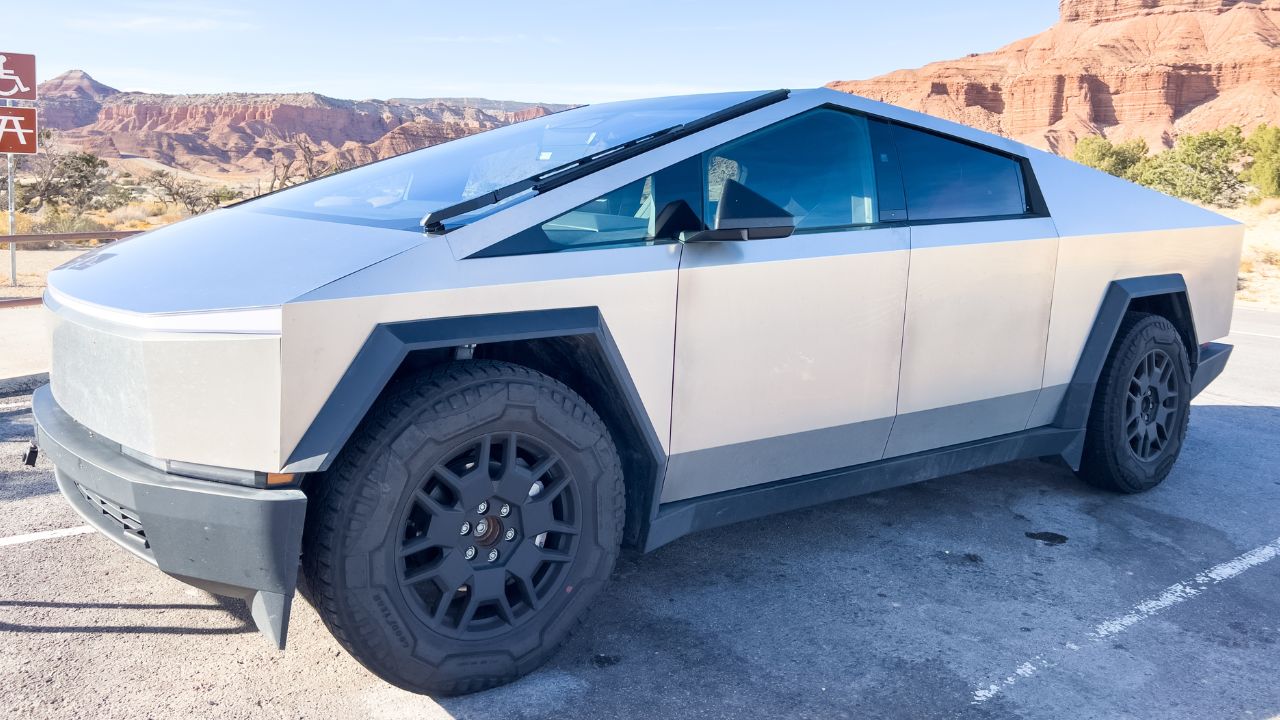
We took Tesla’s much-anticipated Cybertruck off the beaten path to see how it holds up under extreme conditions. From rocky trails to muddy pits, we pushed the vehicle to its limits. Our findings reveal the strengths and weaknesses of this futuristic truck in an off-road setting.
Design and Build
Exterior Durability
The Cybertruck’s stainless steel exoskeleton is one of its most talked-about features. Its robust design is intended to withstand scratches, dents, and impacts. During our off-road test, the exoskeleton proved resilient against branches and the occasional rock strike. However, the angular design, while striking, made maneuvering through tight spots a bit challenging. The sharp lines can catch on natural obstacles, requiring careful navigation.
Despite these challenges, the exoskeleton maintained its integrity without noticeable damage, highlighting the durability Tesla promises. This design choice may not suit everyone, especially those used to more traditional truck shapes, but it certainly turns heads and offers a different kind of toughness.
Suspension and Ground Clearance
The Cybertruck is equipped with an adaptive air suspension system, which we found to be quite effective in handling uneven terrain. It adjusts seamlessly to the surface, providing a smoother ride than expected on rocky paths. The system’s ability to raise the vehicle also improved the truck’s capability in clearing larger obstacles, proving advantageous in off-road settings.
Ground clearance was another highlight, especially when tackling large rocks and deep ruts. The adjustable suspension allowed the Cybertruck to elevate itself, reducing the risk of undercarriage damage. However, its performance did not significantly surpass that of seasoned off-road rivals like the Jeep Wrangler or Ford F-150, which are known for their off-road prowess.
Performance in Challenging Terrains
Rocky Trails
On rocky trails, the Cybertruck’s electric powertrain delivered impressive torque distribution, ensuring steady traction and stability. It powered through inclines and uneven surfaces with ease, showcasing the potential of electric vehicles in off-road environments. However, we did encounter some issues with the tires, which seemed to struggle with sharper rocks, indicating that more rugged tires might be beneficial for serious off-road enthusiasts.
While the suspension generally handled the rocky paths well, it occasionally felt taxed, especially when navigating particularly jagged terrain. These findings suggest that while the Cybertruck is capable, those venturing onto more extreme trails might need to consider additional upgrades or precautions.
Mud and Water Crossings
The Cybertruck’s capabilities were put to the test in muddy conditions and water crossings. Thanks to its waterproofing and sealing, it managed water engagements effectively, with no significant mechanical or electrical challenges. The truck’s design allows for a confident approach to moderate water depths, a feature that enhances its versatility for adventurous drivers.
However, like many vehicles, prolonged exposure to water and mud can pose risks. We observed that the Cybertruck’s electronics remained unharmed, but the necessity for regular maintenance checks cannot be overstated. This is especially true when considering the experiences of other vehicles in similar tests, as noted in recent durability tests.
Comparative Analysis and Future Prospects
Comparison with Traditional Off-Road Vehicles
When compared to traditional off-road vehicles like the Ford F-150 and Jeep Wrangler, the Cybertruck holds its own in several areas, particularly in terms of raw power and innovative technology. Its electric powertrain offers a unique advantage in torque and environmental impact. However, there’s room for improvement in terms of tire durability and handling in extreme conditions.
In terms of off-road performance, each has its strengths. While the Cybertruck excels in tech features and futuristic design, traditional trucks still lead in raw off-road capability and reliability, largely due to decades of development specifically for those terrains.
Potential Improvements and Innovations
Looking forward, there are several enhancements Tesla could implement to improve the Cybertruck’s off-road performance. Upgraded tires tailored for harsher terrains would be a significant step. Additionally, fine-tuning the suspension system for even more varied landscapes could elevate its capability further.
These potential improvements not only promise better performance but also pave the way for future innovations in electric off-road vehicles. As Tesla continues to evolve its designs, the implications for the future of electric trucks are promising, possibly setting new standards in the industry.