
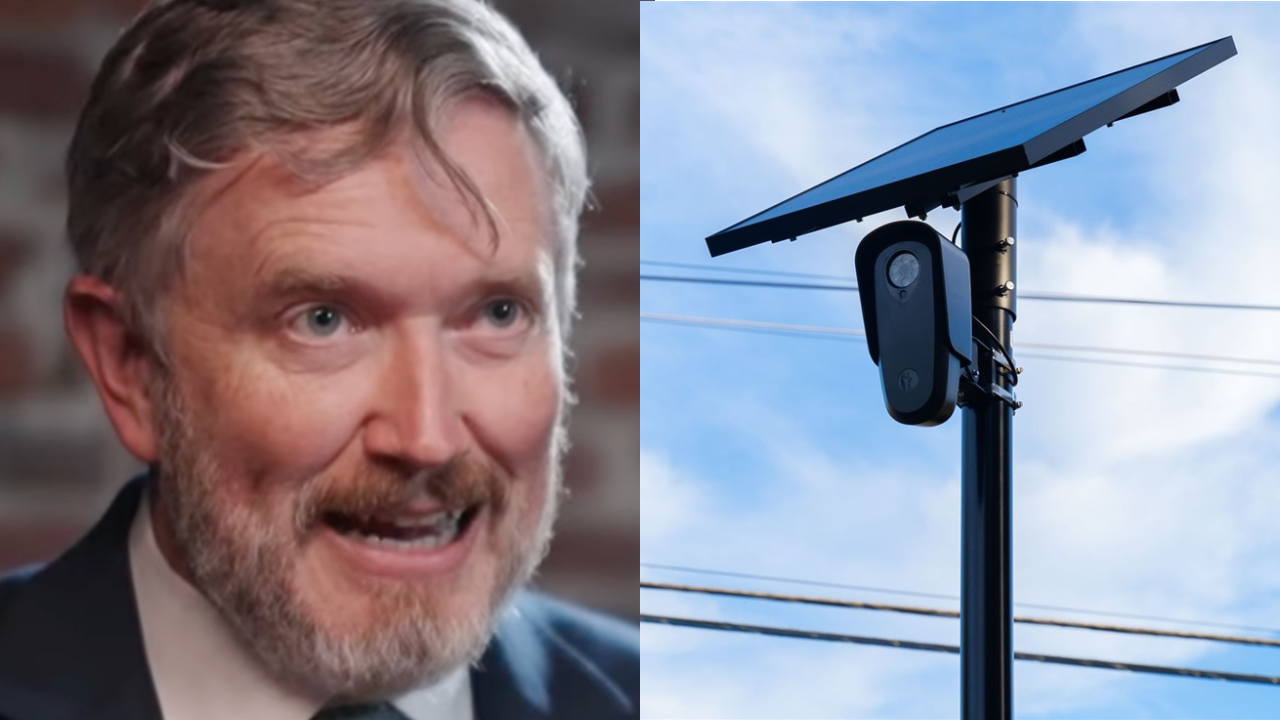
Rep. Thomas Massie of Kentucky announced plans to introduce legislation withholding federal money from municipalities and police departments that deploy Flock Safety and similar automated license plate reader cameras, framing the effort as a Fourth Amendment protection against mass surveillance.
“I’ll soon be sponsoring a bill to withhold federal money from municipalities and police departments that deploy Flock (and other style) cameras to surveil law abiding citizens,” Massie wrote on X, accompanying the post with a modified Gadsden flag image showing a coiled snake with a surveillance camera for a head and the text “don’t flock me.”
Flock Safety and similar companies sell solar-powered, pole-mounted cameras that photograph every passing vehicle’s license plate along with attributes like make, model, color and visible damage, uploading the data to a searchable cloud database used by thousands of local police departments. The network processes tens of billions of scans monthly, allowing investigators to reconstruct vehicles’ travel patterns over time and across jurisdictions.
Massie’s announcement follows a bill introduced four days earlier by Rep. Tim Burchett of Tennessee that already contains a similar federal funding restriction. Burchett’s Protection Against Mass Surveillance Act, H.R. 9800, would bar federal agencies from purchasing, deploying, operating, accessing or contracting for automated license plate recognition systems, including Flock Safety cameras specifically, along with facial recognition and other biometric identification tools. The bill also states that “a State, local, or Tribal government may not use Federal funds to purchase, deploy, operate, access, or contract for” the same covered systems, and would require deletion of improperly obtained data and bar its use in court, according to the bill’s official Congress.gov page. Burchett called the technology “unconstitutional,” saying “these law enforcement intelligence agents, they gotta have tools to address these threats, but taking our constitutional rights is not on the table.”
Massie has a longer record on the issue. In April, he and Rep. Lauren Boebert introduced the Surveillance Accountability Act, H.R. 8470, which would require a warrant based on probable cause for government searches that significantly impinge on privacy, including access to third-party data, facial recognition systems and automated license plate readers, and would explicitly bar the warrantless creation of persistent location databases from ALPR systems. The bill also creates a private right of action for Fourth Amendment violations and was referred to the House Judiciary Committee, according to the official press release from Massie’s office.
“The Surveillance Accountability Act requires government employees to first obtain a warrant based on probable cause before searching Americans’ personal information, even if the information sought is stored on a phone, in the cloud, or held by a third party,” Massie said at the time. “Warrantless searches are unconstitutional, and this does not change when the data the government seeks is in digital formats or held by a third party.”
Boebert argued the surveillance concern extends beyond government use of the data. “It is my constitutional duty to protect citizens’ Fourth Amendment rights, and therefore, when any government, local, state, federal, is contracting or has an agreement with these private companies to receive that data, it is an infringement on your Fourth Amendment rights,” Boebert said.
Flock Safety has defended its systems, saying its cameras collect information about vehicles rather than people, that search results do not display the identity of drivers or passengers, and that the company does not use facial recognition. Local law enforcement agencies using the technology have credited it with helping recover stolen vehicles and make arrests. Police in Mt. Juliet, Tennessee, said the system contributed to 342 arrests in the first half of 2026.
Critics, including privacy groups and civil libertarians across the political spectrum, have raised concerns about data sharing with federal agencies including immigration enforcement, misuse by individual officers, and limited local control once data enters the broader network. Dozens of cities and counties have canceled or declined to renew Flock contracts over the past year, and a Knox County Commission meeting on a planned rollout of more than 200 Flock cameras was canceled earlier this month amid similar concerns.
The Fourth Amendment to the U.S. Constitution, which underpins the arguments Massie, Boebert and Burchett have made against the technology, protects against “unreasonable searches and seizures” and generally requires warrants to be supported by probable cause, according to the National Archives’ official transcript of the Bill of Rights.
No formal bill text from Massie had been introduced or referred to a committee as of his July 25 post, which stated only that he would “soon” be sponsoring the legislation.
Massie and Boebert have previously worked together on other legislative pushes, including forcing a vote on the release of Justice Department files related to Jeffrey Epstein.