
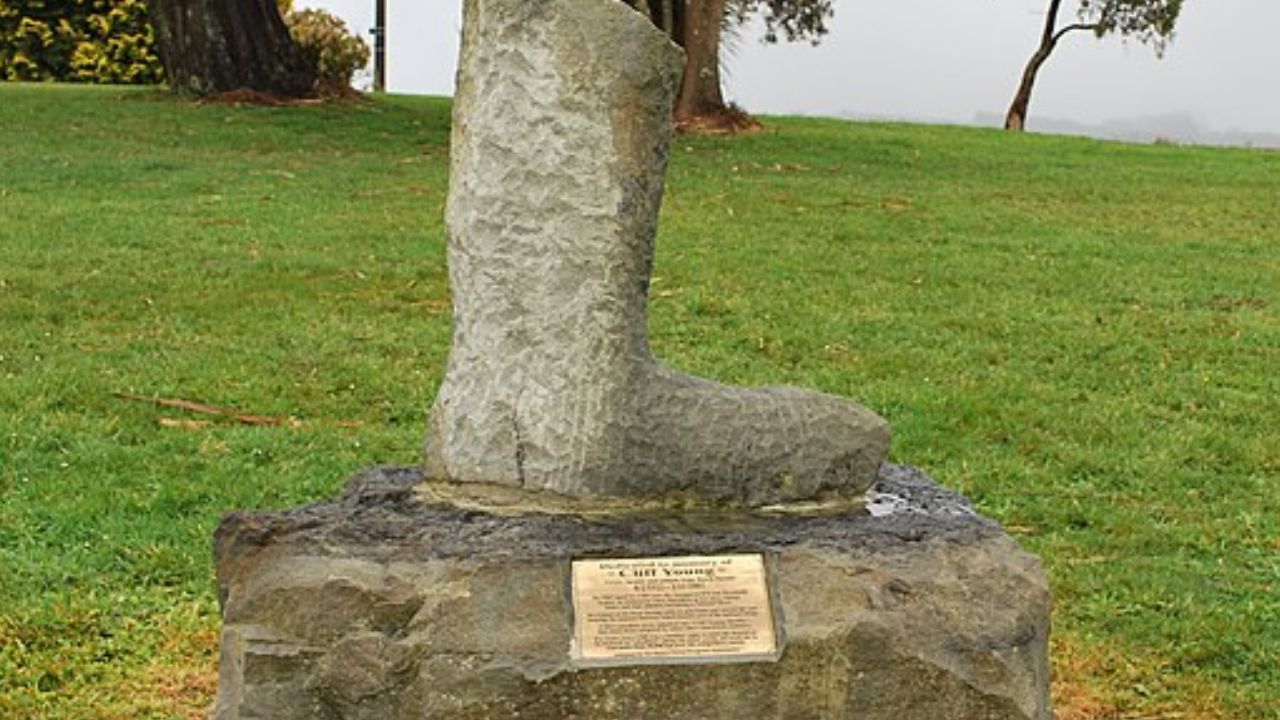
In 1983, an unassuming 61-year-old potato farmer named Cliff Young captured the world’s attention by entering and unexpectedly winning the inaugural Westfield Sydney to Melbourne Ultramarathon. His unlikely victory in one of the world’s most grueling races remains an inspiring testament to human endurance and determination against seemingly insurmountable odds.
The Man Behind the Legend
Cliff Young was born in 1922 and grew up on a sprawling farm in Beech Forest, a small rural community in Victoria, Australia. His upbringing in the rugged Australian countryside instilled in him a lifelong familiarity with hard work and perseverance. Young’s family farm, covering over 2,000 acres, was home to thousands of sheep. In an era before the convenience of modern farming equipment, Young often had to herd sheep on foot, chasing them across vast expanses of land during harsh weather conditions. This challenging environment was where Young’s journey towards extraordinary endurance began, even though no one, including Young himself, would have guessed it at the time.
Young was an unusual character in many ways. With his distinctive shuffling gait—a style that seemed more akin to a leisurely stroll than a competitive run—he became an endearing figure to the public. His modest demeanor and unpretentious personality struck a chord with everyday Australians, who saw in him a reflection of their own aspirations and struggles. Young’s attire during the race, which consisted of overalls and work boots, further underscored his unorthodox approach to running. Far from the sleek gear of professional athletes, Young’s outfit symbolized his roots and resistance to conforming to expectations.
What led Young, a complete amateur in the realm of competitive running, to participate in such an extreme event at an age when most people would be considering retirement? The answer lay partly in his intrinsic motivation and the belief that age should not be a barrier to pursuing one’s dreams. Young had been inspired by stories of endurance and adventure, and his own experiences on the farm had given him a taste of what it meant to push beyond perceived limits. When he heard about the inaugural Westfield Sydney to Melbourne Ultramarathon, he saw it as an opportunity to test himself against the odds, driven by a deep-seated desire to challenge convention and prove that anything is possible with determination.
The Ultramarathon Challenge
The Westfield Sydney to Melbourne Ultramarathon was a grueling event that tested the limits of human endurance. Spanning over 875 kilometers (approximately 544 miles), the race was designed to push even the most seasoned athletes to their breaking points. It quickly earned a reputation as one of the longest and toughest foot races in the world. Competitors faced a daunting journey from Sydney, with its bustling cityscape, to the vibrant metropolitan heart of Melbourne, traversing varied terrain that included highways, rugged countryside, and urban streets.
Young was up against some of the best professional athletes in the world, many of whom had years of experience in long-distance running. These competitors had trained rigorously, equipped with the latest in athletic gear and coached by experts in sports science. The race conditions were unforgiving, with weather that ranged from scorching daytime temperatures to chilly nights. The runners had to contend with exhaustion, blisters, and the mental challenge of maintaining focus over several days of non-stop running.
In stark contrast to the seasoned competitors, Young’s strategy was both simple and radical: he would run continuously, without stopping for sleep, until he reached the finish line. This approach was unheard of at the time, as the conventional wisdom among ultrarunners was to follow a more structured routine that included periods of rest. Young’s method seemed reckless to many, yet it was rooted in his unique experiences on the farm, where he had grown accustomed to working for extended periods without rest. His “shuffle” not only conserved energy but also allowed him to keep moving when others were forced to stop and recuperate.
The Unlikely Victory
As the race unfolded, Young’s progress became a fascinating spectacle. While he started off slowly, his relentless pace began to close the gap between him and the leading pack. Each day, he made up ground, inching closer to the frontrunners who had initially dismissed him as merely a quirky sideshow. The turning point came when Young, defying all expectations, overtook the leaders during the final stretch of the race. His unconventional approach had paid off, leaving competitors and spectators alike stunned by his unexpected lead.
Young’s performance shattered preconceived notions about age, endurance, and the nature of competition. His victory was a testament to the idea that the human spirit can transcend physical limitations and societal expectations. As he crossed the finish line, Young was greeted by a wave of applause and admiration. The nation celebrated not just his victory, but the spirit of perseverance and humility that he embodied. Young’s triumph was more than a win in a race; it was a victory for every underdog who dares to dream beyond the boundaries of conventional thinking.
The emotional climax of Young crossing the finish line first was a moment etched into the annals of sporting history. Against all odds, he had claimed victory, demonstrating that determination and grit could outdo even the most polished athletic prowess. His achievement was not just a personal triumph but a collective win for those who had cheered him on, believing in the power of resilience and the potential within each person’s journey.
Defying the Odds
Young’s extraordinary stamina and resilience were products of both physical and mental endurance. His years of farm work had equipped him with a unique kind of physical toughness, but it was his mental fortitude that truly set him apart. Young approached the race with a mindset conditioned by years of overcoming challenges on the farm, where persistence often meant the difference between success and failure. This mental resilience allowed him to push through physical pain and fatigue, maintaining focus on his goal despite the seemingly insurmountable odds.
The public’s reaction to Young’s victory was overwhelmingly positive. His story captured the imagination of people not just in Australia but around the world. Media outlets were quick to cover the race, with articles and reports highlighting Young’s humble background and incredible achievement. He became an overnight sensation, a symbol of what could be achieved through sheer willpower and determination. Young’s victory was seen as a beacon of hope and inspiration, proving that age and experience were not the sole determinants of success.
Young’s win also had a lasting impact on the sport of ultrarunning. His unconventional strategy forced athletes and coaches to reevaluate their approaches to training and competition. The idea that continuous movement, albeit at a slower pace, could be more effective than the traditional run-rest cycle inspired a new generation of runners to experiment with their techniques. Young’s legacy challenged existing perceptions of ultra-distance running and opened the door to innovative training methods that continue to influence the sport today.
Legacy and Inspiration
Cliff Young’s impact on future generations of runners and athletes is profound. His victory in the ultramarathon sparked a wave of interest in ultra-distance running and endurance sports, encouraging many to pursue their own athletic endeavors. Young’s story became a source of motivation for those who had previously doubted their abilities, demonstrating that success is possible regardless of age or experience level. His achievement resonated with a broad audience, inspiring people to challenge their own limits and strive for greatness in their chosen fields.
One of the most enduring aspects of Young’s legacy is the “Young Shuffle,” his distinctive running style that became a subject of study for athletes seeking to enhance their endurance. This technique, characterized by its energy-efficient motion, allowed Young to maintain a steady pace over long distances. Today, the “Young Shuffle” is embraced by ultrarunners around the world as a viable strategy for conserving energy during prolonged events. Young’s influence extends beyond the realm of sports, as his life story continues to impart valuable lessons about perseverance, humility, and the power of unconventional wisdom.
Young’s journey offers broader life lessons that extend beyond the track. His story emphasizes the importance of perseverance in the face of adversity, the value of remaining humble despite success, and the transformative power of believing in oneself. Young’s victory serves as a reminder that the most significant achievements often come from unexpected places, and that true success is measured not just by the outcome but by the journey and the lessons learned along the way. As generations continue to draw inspiration from Cliff Young, his legacy endures as a testament to the unyielding spirit of human potential.