
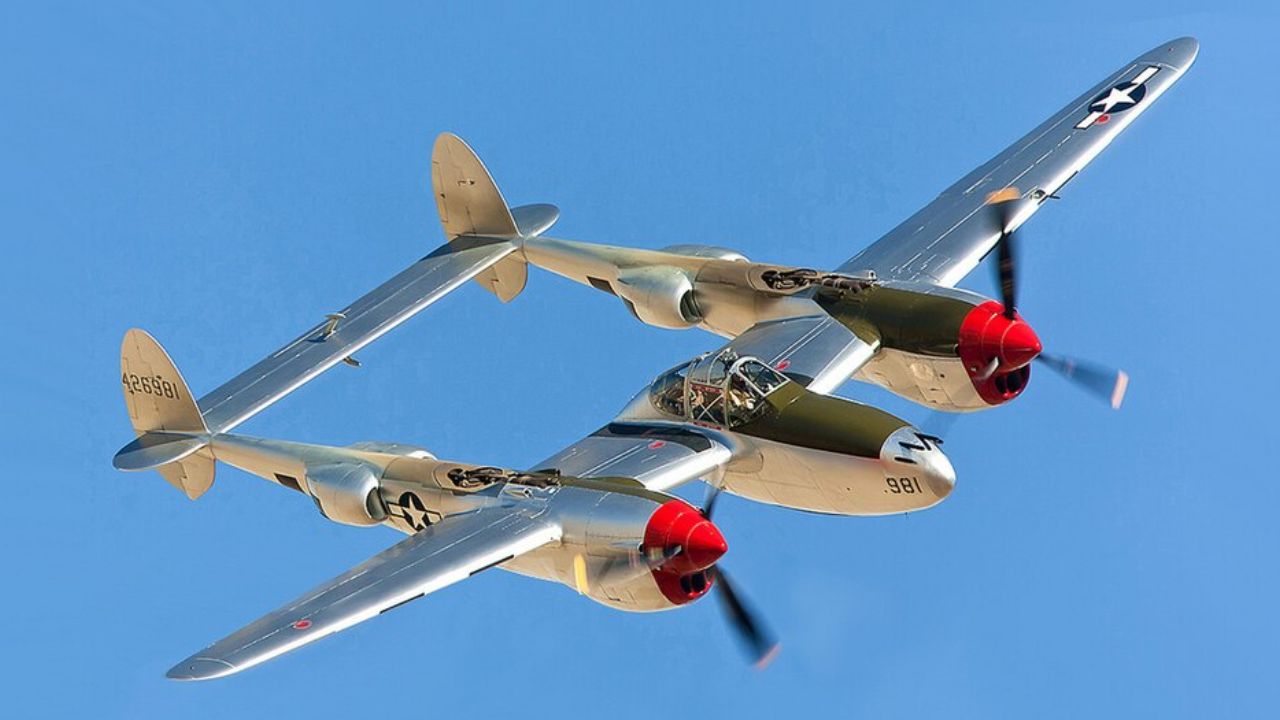
The P-38 Lightning, created by Lockheed, emerged as a groundbreaking aircraft during World War II, celebrated for its unique twin-boom design and remarkable performance. This aircraft’s journey through the European and Pacific theaters of war highlights its pivotal role in shaping Allied strategies. By delving into its innovative features and operational history, we gain a deeper understanding of the P-38’s contribution to the Allied victory across different fronts.
The Birth of a Legend: Development and Design
The P-38 Lightning’s origin is a tale of innovation and ambition. At a time when the concept of air superiority was rapidly evolving, Lockheed’s chief engineer, Clarence “Kelly” Johnson, and his team dared to think differently. Their goal was to create a high-altitude interceptor with exceptional speed and firepower, resulting in the P-38’s iconic twin-boom design. This radical approach was not just for aesthetics; it served a functional purpose. The twin-boom structure housed the engines, while the central nacelle contained the cockpit and armament, offering a balanced and robust platform that was both innovative and practical.
Technologically, the P-38 was ahead of its time. It was the first American fighter to employ turbo-superchargers, allowing it to maintain performance at high altitudes where other aircraft struggled. This feature, combined with its powerful Allison V-1710 engines, enabled the P-38 to become the first fighter to exceed 400 mph in level flight. However, the road to perfection was fraught with challenges. Initial models faced issues such as compressibility problems during dives and engine reliability concerns. Through rigorous testing and modifications, including the introduction of dive flaps and improved engines, the P-38 evolved into a formidable combat aircraft.
The P-38 in the European Theater
In the European theater, the P-38 Lightning carved out a distinct niche for itself. Its versatility allowed it to perform a variety of roles, but it particularly excelled in reconnaissance and interception missions. The P-38’s high speed and long range made it ideal for photo-reconnaissance, gathering critical intelligence that shaped Allied strategies. Its ability to fly higher and faster than many enemy aircraft also made it a formidable interceptor, capable of engaging German fighters and bombers with deadly precision.
The P-38’s contribution to achieving Allied air superiority cannot be overstated. It played a pivotal role in several key battles, including the destruction of German fighter forces during Operation Overlord and the subsequent push into occupied Europe. The aircraft’s effectiveness was amplified by the prowess of pilots like Major Richard Bong, America’s leading ace with 40 confirmed victories, and the 82nd Fighter Group, which utilized the P-38 to devastating effect. These pilots and units not only demonstrated the P-38’s capabilities but also boosted morale among Allied forces, knowing they had a reliable and powerful tool in their arsenal.
The P-38 in the Pacific Theater
The Pacific theater posed a different set of challenges for aircraft, but the P-38 adapted remarkably well. The tropical environment and vast distances between islands required modifications, such as improved cooling systems and additional fuel capacity, to ensure the P-38 could operate effectively. Its range and twin-engine reliability made it particularly suited for the long over-water flights necessary in this theater, a feat that few other fighters could match at the time.
The P-38 became an integral part of the island-hopping campaigns, providing essential air cover and support for ground and naval operations. It was instrumental in pivotal battles such as the Battle of Guadalcanal and the New Guinea campaign, where its presence helped secure air superiority and protect advancing Allied forces. One of the most legendary missions conducted by the P-38 was the interception of Admiral Isoroku Yamamoto’s plane in 1943. This bold operation, which relied heavily on the P-38’s range and speed, resulted in the downing of the architect of the Pearl Harbor attack, delivering a significant blow to Japanese morale and command.
Unique Features and Versatility
The P-38 Lightning was more than just a fighter; it was a multi-role aircraft that could adapt to a variety of missions. Its design allowed it to excel in roles beyond traditional dogfighting. Equipped with a potent combination of four .50 caliber machine guns and a 20mm cannon concentrated in its nose, the P-38 delivered devastating firepower. This configuration not only increased accuracy but also eliminated the need for convergence adjustments, giving pilots an edge in aerial combat.
Beyond air-to-air engagements, the P-38 was effective in ground attack roles, capable of carrying bombs and rockets for strafing and bombing missions. Its versatility extended to close air support, where it provided critical assistance to ground troops. The psychological impact of the P-38 on enemy forces was significant. Its distinctive silhouette and reputation for speed and power often struck fear into opponents, contributing to its effectiveness as a combat aircraft.
Legacy and Influence on Future Aviation
After World War II, the legacy of the P-38 Lightning continued to influence aviation and military strategy. Its innovative design and technological advancements laid the groundwork for future aircraft development. The lessons learned from the P-38’s performance and versatility informed the design of subsequent fighters and contributed to the evolution of air combat tactics in the post-war era.
The stories of P-38 veterans and the preservation of remaining aircraft serve as a testament to its enduring impact. Efforts to restore and display P-38s in museums worldwide keep the memory of this remarkable aircraft alive, allowing future generations to appreciate its historical significance. The P-38 Lightning remains a symbol of American ingenuity and a reminder of the critical role it played in securing Allied victory during World War II.