
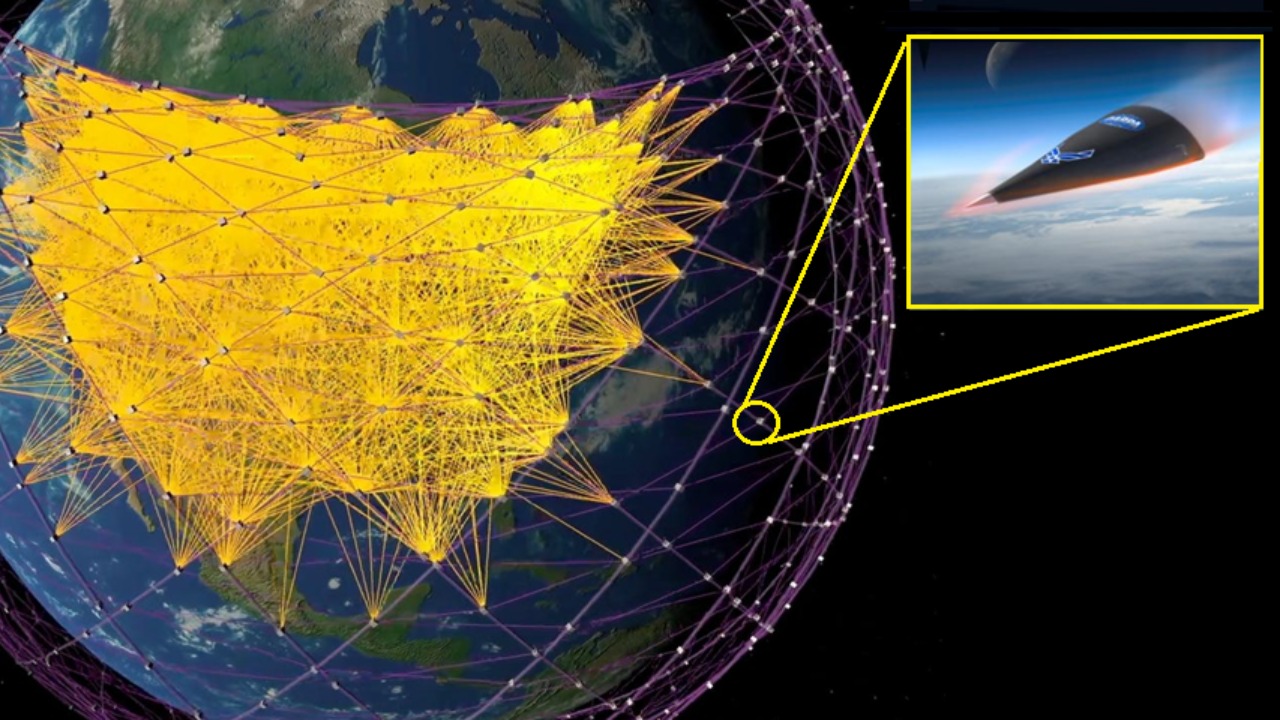
The Pentagon is quietly betting that a new Space Data Network will determine whether its Golden Dome missile shield becomes more than an expensive aspiration. The network is meant to stitch together sensors, satellites, aircraft and interceptor batteries into a single data fabric that can react at machine speed rather than at a human pace.
As Golden Dome’s projected cost rises to $185 billion and expectations grow for protection of the United States against everything from ballistic salvos to hypersonic weapons, pressure on that space backbone is intense.
From vision to architecture in orbit
The Golden Dome is described as a proposed multi layer missile defense system for the Unite States, with Washington’s mission framed as a layered shield of sensors, satellites and interceptors that can operate across multiple domains.
Concept material portrays the Golden Dome as a way to expand U.S. superiority in space and missile defense, with industry partners positioning it as an opportunity that would drive new constellations and ground infrastructure.
Lockheed Martin, for example, promotes its role as part of a multi-layer architecture that blends ground-based interceptors, space sensors and advanced command systems.
At the political level, President Trump previously branded the idea as the “Golden Dome for America,” a national missile system he said should protect the homeland and allies, with the administration signaling that the Golden Dome would be brought in front of Congress in April as a flagship security project.
The Space Data Network as digital backbone
Inside that broad vision sits the Pentagon’s Space Data Network, or SDN, a planned mesh of space and ground links that will carry targeting data from sensor to shooter.
Reporting on Space Data Network planning describes it as the communications pathway that must move information from missile warning and tracking sensors to interceptor launchers and command centers with minimal latency.
Gen Michael Guetlein has repeatedly argued that Golden Dome will succeed or fail based on whether data can be integrated and moved from missile warning and tracking sensors to interceptors through the SDN, rather than through bespoke and high cost efforts that cannot scale.
In that construct, the SDN is not a side project but the core nervous system that allows the Golden Dome to function as a single integrated shield rather than a patchwork of isolated systems.
How NDSA and SDA feed the network
The Space Development Agency, described as The SDA, is already building the National Defense Space Architecture as a proliferated constellation of satellites that can provide global coverage.
An official explainer on National Defense Space describes how The SDA is aiming to stick to its mandate and move as quickly as possible over the next few years to get a functional architecture on orbit, with a “trains on time” mentality that emphasizes rapid spirals.
That architecture is expected to host large numbers of tracking satellites and data transport nodes that will feed directly into the Space Data Network, providing the sensor coverage Golden Dome needs for early detection and continuous tracking.
At the same time, oversight bodies such as GAO have warned that SDA’s missile tracking satellite program faces considerable risk, with GAO stating that SDA operates under the U.S. Space Force and is pressing ahead with successive satellite procurements while potentially overestimating how quickly industry can refresh technology and add capacity.
Those concerns highlight a tension between the desire for speed and the need for reliability in the very satellites that will populate the SDN and support Golden Dome’s sensor layer.
Money, timelines and industrial stakes
Financially, the Pentagon has increased funding for its Golden Dome missile defense system by $10 billion, bringing the total to roughly $185 billion, a figure that appears in both a social media briefing and formal budget discussions.
One briefing on $185 in planned spending describes how The Pentagon raised the cost estimate to accelerate development of space capabilities and advanced airborne tracking systems under the Golden Dome construct.
Gen Michael Guetlein has linked that $185 billion figure directly to a need to speed up work on the Airborne Moving Ta related capabilities and the broader sensor to shooter chain that Golden Dome will rely on.
Industry views the program as a long term anchor, with companies across launch, space hardware and command software seeking positions in the architecture that will sit under the Golden Dome construct.
Lockheed Martin’s Golden Dome missile defense materials, for instance, emphasize layered interceptors and integrated command systems that would plug into the SDN and the National Defense Space Architecture rather than operate as standalone assets.
Operational stakes for the Pentagon
Operationally, the Pentagon’s own experience with sensor to shooter networks has reinforced why the Space Data Network matters.
In earlier conflicts, The US Space Force relied on early warning satellites to support intercepts of Iranian ballistic missiles, but data had to move through a patchwork of links that were never designed for rapid targeting loops.
Planners now argue that the SDN will provide the communications pathways for integrating and moving data from missile warning and tracking sensors to interceptors in near real time, with one analysis stressing that Guetlein and other leaders are aligning around that requirement.