
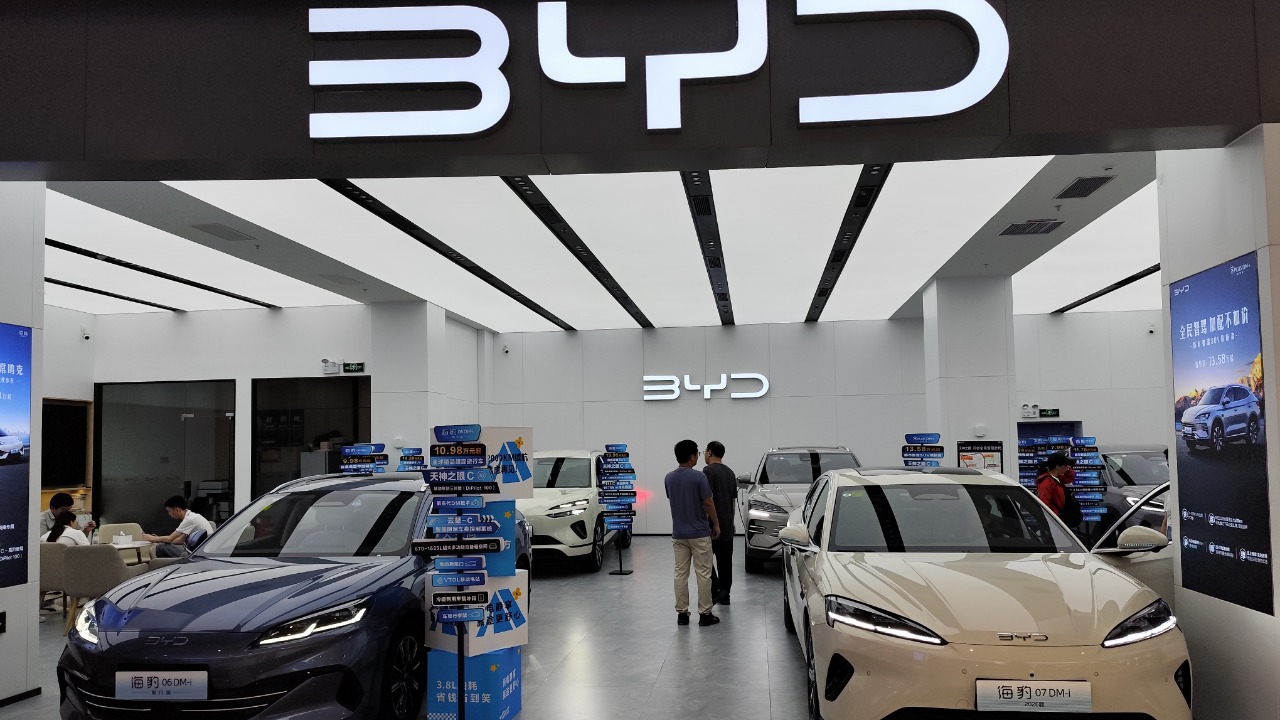
China’s fast-rising automakers are racing to secure a manufacturing foothold just south of the United States border, and Mexico has become their preferred gateway. BYD and Geely are now competing to acquire an existing plant in the country, a move that would give either company immediate production capacity inside North America and a faster route into the region’s car market.
The contest centers on a factory that has been building vehicles for Nissan and Mercedes Mexico and is nearing the end of its current life cycle. Whoever wins the bidding will inherit an industrial asset that can be retooled for electric or hybrid models, while Mexico itself faces a strategic choice about how far it wants to open the door to Chinese capital and technology.
Why BYD and Geely want a Mexican base
Speed is the clearest motivation for both BYD and Geely. Rather than spend years seeking permits, negotiating incentives, and constructing a new facility from scratch, each company is trying to buy a plant that already has an installed annual capacity of 230,000-unit output, along with a trained workforce and logistics links. For a Chinese manufacturer that wants to ship more cars into the United States, Canada, and the broader North American market, that kind of ready-made infrastructure is far more attractive than a greenfield site.
There is also a clear regulatory logic. BYD had earlier looked at building a new factory in Mexico, but grew frustrated with the level of red tape involved in getting a fresh project approved, which made an acquisition route more appealing. Mexican states have been competing among themselves to attract Chinese investment, and the chance to host a large-scale operation from BYD or Geely gives local officials a powerful story to tell about jobs and exports, even as the federal government weighs the diplomatic implications of deeper ties with Chinese automakers in a North American context.
The COMPAS plant and the Aguascalientes advantage
The facility at the center of the bidding is the Nissan Mercedes-Benz operation in Aguascalientes, a city in central Mexico that has built its reputation around the auto industry. This plant has been part of a joint venture that produced vehicles for Nissan and Mercedes Mexico, and it is scheduled to cease its current production run by around May 2026, rather than already sitting idle, which makes it a live industrial asset instead of a derelict shell. Reports describe BYD (SEHK:1211) as a key finalist to acquire this Nissan Mercedes-Benz plant in Aguascalientes, Mexico, with the deal framed as a way to reshape the company’s growth story in the region and adapt to tariffs and regional trade rules linked to North American supply chains.
The location itself is a major draw. Aguascalientes has become a manufacturing hub, with road and rail links that connect it efficiently to the United States border and to Mexican ports, and the broader region of Aguascalientes, Mexico, has developed a deep pool of automotive suppliers and technical talent. The specific plant site, identified in mapping data as a major industrial complex at this Aguascalientes facility, offers rail spurs, highway access, and existing utility connections that would be expensive and time-consuming to replicate elsewhere. For BYD or Geely, taking over such a location would mean they can focus capital on new products and technology rather than on basic construction.
A competitive field, not a joint Chinese bid
Although BYD and Geely are often mentioned in the same breath, the reporting makes clear that they are rivals in this process, not partners. BYD and Geely are among the finalists bidding for the Nissan Mercedes Mexico plant, and they are competing alongside other players rather than mounting a joint bid. One account describes how BYD, Geely, and VinFast are all fighting over the same Mexican factory, underscoring how intense the race has become to secure an industrial beachhead in the country and how much value global carmakers now attach to Mexican production.
Further reporting explains that BYD, Geely, and VinFast are all seeking control of the Nissan Mercedes Mexico site, with BYD, Geely, and VinFast bid dynamics framed as part of a wider contest to supply vehicles to the United States under regional trade rules. A separate analysis of how BYD and Geely, the finalists, stresses that each company has its own strategy for the plant and that they remain direct competitors, even if they share similar goals in seeking a North American presence.
What a Chinese-owned plant would mean for North America
If either BYD or Geely secures the plant, the implications for North America will be far-reaching. For decades, U.S., European, and Japanese automakers have dominated Mexican production, mostly building U.S.-bound vehicles, and a successful Chinese bidder would visibly break that pattern. Analysts describe the bidding as part of a broader story of how Chinese brands are knocking on North America’s door, with one assessment of China Knocks, North the plant arguing that local manufacturers see both threat and opportunity in the arrival of new players.
Mexican officials, meanwhile, are trying to balance the lure of fresh capital with the politics of trade. One detailed account of how BYD, Mexico, and other stakeholders are approaching the deal notes that states are eager to attract Chinese investment even as national policymakers watch tensions around tariffs and local content rules. Another report describes how the potential buyer list includes Chinese automakers BYD and Geely bidding on Aguascalientes Nissan operations alongside other Chinese brands, suggesting that Mexico’s role as a bridge into the United States market will only grow more contested in the years ahead.