

Military vehicle programs rarely aim to improve the family SUV. But the logic of defense procurement—fund difficult problems, test systems hard, and keep iterating until they work—has repeatedly helped certain technologies mature. Over time, some of those ideas and components have shown up in civilian cars, trucks, and crossovers as safety features, durability improvements, and driver-assistance tools.
This is not a story about “weapons in cars.” It’s about dual-use engineering: rugged prototypes, shared suppliers, and demanding test standards that can accelerate reliability and manufacturing readiness. For many features, the “first inventor” is hard to pin down—aviation, motorsports, and commercial R&D often progressed in parallel—but military requirements have frequently helped push systems toward real-world robustness.
1) GPS navigation: from defense infrastructure to everyday routing

GPS is the clearest example of a defense-origin capability becoming a civilian essential. Once the system became reliable and widely available for non-military use, navigation shifted from standalone receivers to integrated vehicle systems and, later, smartphone-based routing that still benefits from vehicle integration in many models. For civilians, GPS enables routing, emergency location, and fleet tracking; for logistics, it helps optimize scheduling and dispatch.
The bigger takeaway is that dual-use infrastructure can create broad spillovers. It also creates dependencies: when positioning becomes a default input for transportation and services, disruption and interference matter in ways most drivers never think about.
2) Run-flat tires: mobility after damage becomes a consumer convenience feature

Run-flat concepts map naturally to military mobility needs: a vehicle that can keep moving after tire damage is harder to immobilize. As materials and sidewall designs improved, the same idea translated to civilian use, where the “threat” is more likely a puncture on a highway shoulder than hostile action. In consumer terms, run-flats can reduce the urgency of roadside tire changes and are sometimes paired with eliminating a spare to save space and weight.
The trade-offs remain. Run-flats can cost more and may ride differently than conventional tires, a recurring theme in dual-use transfer: designs optimized for survivability or continuity of movement are not automatically optimal for comfort or price.
3) Disc brakes: maturation driven by harsh-use requirements

Disc brakes are a case where origin stories span multiple sectors, but military and aviation adoption helped build confidence in performance under heat and load. Users operating under demanding duty cycles tend to push for predictable braking and repeatable results in harsh conditions, which can harden designs and the testing culture around them. As manufacturing scaled and costs fell, disc brakes became mainstream across civilian vehicles.
For readers watching defense-to-commercial pathways, this is as much about qualification and validation as it is about hardware. Once a component proves itself in punishing environments, suppliers can translate that credibility into broader commercial adoption.
4) Turbocharging: power density shaped by high-demand users

Turbocharging also has multiple lineages, with aviation and performance engineering playing major roles. But defense use helped normalize the idea of extracting more power from smaller displacement engines and maintaining performance across challenging environments. In ground-vehicle terms, forced induction can support heavy loads and improve drivability where naturally aspirated engines may feel strained. As durability, control, and emissions integration improved, turbocharging spread widely in civilian cars to deliver downsized efficiency without giving up everyday pull.
The broader point is de-risking: when demanding users accept higher costs to meet performance and reliability targets, suppliers learn quickly. Later, commercial buyers benefit from lower failure rates and better-engineered components as the technology scales.
5) ABS, traction control, and ESC: mobility logic meets mass-market safety

Anti-lock braking, traction control, and electronic stability control are tightly aligned with a core military need: maintain control on inconsistent surfaces and under unpredictable loads. While regulators and the commercial auto industry were central to mass deployment, defense users have long emphasized controllability in mud, sand, snow, and uneven terrain. Shared Tier-1 ecosystems—including suppliers such as Bosch, Continental, and ZF—help proven sensors and control approaches move across domains.
This is a two-way dynamic. Militaries can benefit when commercial sensor and controller components are mass-produced and easier to sustain; civilian drivers benefit when harsh-environment expectations push systems toward more consistent real-world performance.
6) Night-vision and thermal imaging: better low-light awareness
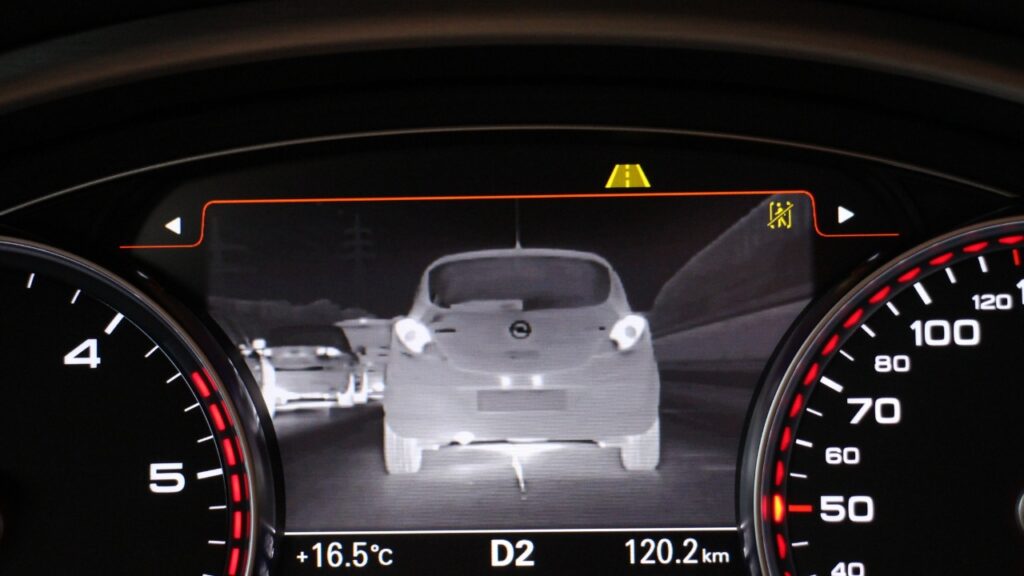
Night-vision and thermal imaging are closely associated with military operations, but consumer versions have emerged as driver-assistance aids. In civilian vehicles, they are typically positioned as safety features—helping a driver spot pedestrians, animals, or other hazards beyond headlight range—rather than as tactical tools. The transfer is often less about raw sensor capability and more about packaging, cost reduction, and interfaces that make low-light information usable for non-experts.
It’s important not to overstate equivalence: consumer systems are generally built to different price points and requirements. Still, once sensors and processing scale in commercial markets, costs can fall in ways that may indirectly benefit other users, including fleet and government buyers.
7) Heads-up displays (HUDs): aviation-inspired attention management

Heads-up displays have a clear aviation lineage, where keeping eyes forward while reading key data is a safety imperative. Automotive HUDs apply the same idea to speed, navigation prompts, and driver-assistance cues. The value proposition is straightforward: fewer glances down can reduce workload and help drivers keep attention on the road.
HUDs also illustrate how human-factors engineering becomes a competitive feature once the interface is practical—legible, well-placed, and reliable across lighting conditions.
8) Crashworthy seating and restraint concepts: survivability thinking crosses over

Military survivability work has placed heavy emphasis on protecting occupants from shock and impact, especially as operational realities highlighted the consequences of extreme events. Civilian crash safety has its own deep history, but military programs have helped reinforce the idea of designing the cabin as an energy-management system—seats, restraints, and mounting strategies working together rather than as isolated parts.
Translation is not automatic. The loads and vectors involved in military incidents can differ from highway crashes, so adapting concepts to civilian vehicles requires careful engineering and validation. When it does translate, the result is often a more systematic approach to occupant protection, sometimes balanced against weight and complexity.
9) Onboard diagnostics and fleet health monitoring: readiness logic becomes everyday reliability

Military fleets prioritize readiness, which makes diagnostics and condition-based maintenance valuable. That philosophy shows up in civilian vehicles as onboard diagnostics, fault codes, and increasingly sophisticated health monitoring that supports preventive service and faster troubleshooting. For consumers, it can mean fewer “mystery failures” and more targeted repairs; for commercial fleets, it supports uptime and more predictable operating costs.
This is also about standardization. When diagnostics are consistent and maintenance information is actionable, organizations can plan service and parts inventories more efficiently—an approach that matters for defense logistics and for civilian fleet operations alike.
10) Autonomy and driver-assist precursors: from defense concepts to ADAS building blocks

Autonomy has been a long-running defense interest, including public-facing DARPA work that influenced the broader robotics ecosystem. Civilian vehicles reflect a related, more constrained path: advanced driver-assistance systems (ADAS) that help with lane-keeping, speed management, and emergency warnings or braking. The crossover is rarely a single “military feature” dropped into a showroom model; it’s more often shared building blocks—sensors, perception software, and validation approaches—adapted to consumer safety expectations and regulatory requirements.
What happens next will depend less on novelty than on verification, supply chains, and trust. As automakers and suppliers industrialize sensing and compute at scale, costs can fall and availability can improve. At the same time, the dual-use blur raises practical questions about cyber hardening, export controls, and how safety-critical software is tested when similar components serve both civilian convenience and military mobility.
Why this matters now: dual-use is an industrial pipeline, not trivia
Across these examples, the common pattern is acceleration: defense-funded engineering and harsh-user feedback can help technologies mature until they are reliable, manufacturable, and cost-effective enough for mass-market vehicles. The actors are familiar—defense institutions such as DoD and DARPA, NATO Europe’s defense ecosystems, Israel’s innovation base, and a global OEM/Tier-1 supply chain that includes firms like Bosch, Continental, and ZF.
As vehicles become more software-defined, the most valuable spillovers are increasingly about sensing, diagnostics, interfaces, and robust control rather than a single piece of hardware. That makes standards, cybersecurity, and supply-chain assurance more central to the dual-use story—because the same pipeline that spreads benefits can also spread dependencies.