
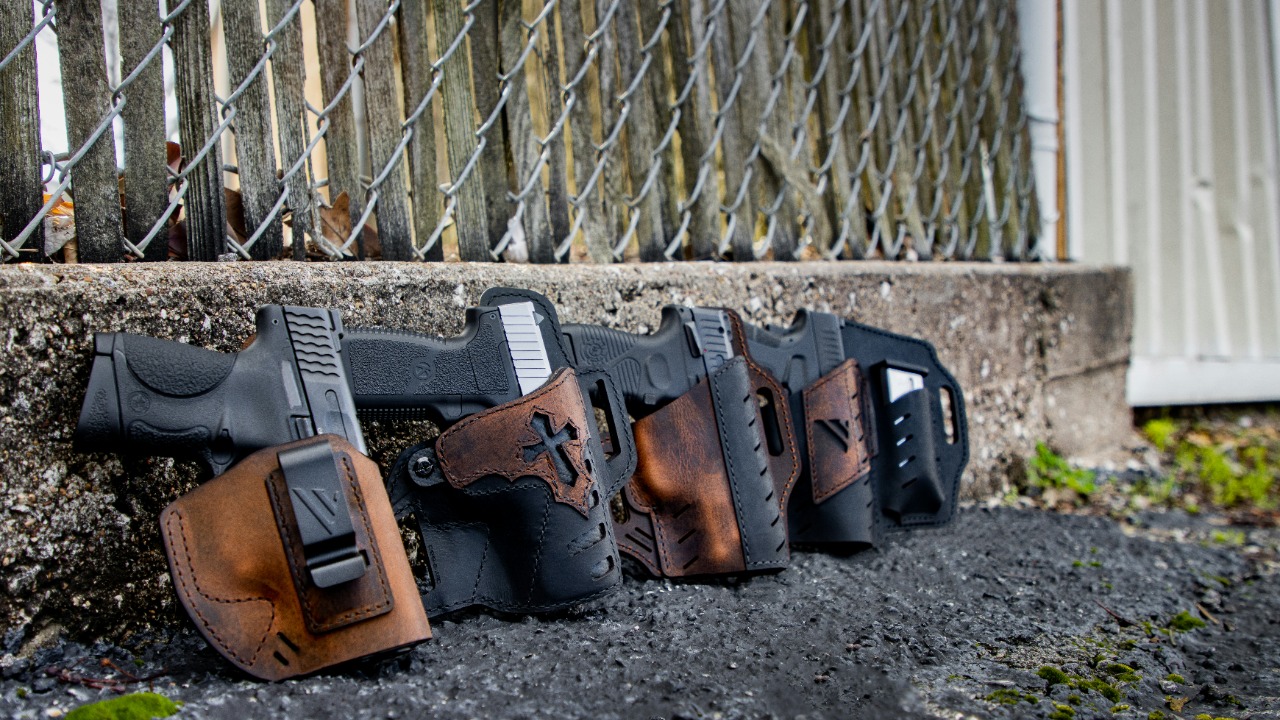
Defensive pistols that “hit above their weight” combine deep concealment with the kind of capacity, controllability, and accuracy usually reserved for larger duty guns. The best examples give up little in performance while fitting into smaller holsters, lighter belts, and tighter cover garments. For armed citizens and off-duty professionals alike, these compact and micro-compact handguns have turned size into an advantage instead of a compromise.
The 10 pistols below stand out because they deliver full-size capability in smaller footprints, from high-capacity micro 9s to compact workhorses that have become benchmarks for concealed carry. Each model earns its place not on hype, but on how effectively it balances size, shootability, and real-world defensive utility.
Micro-compacts that rewrote the capacity rules
The modern surge in tiny pistols with big-gun capacity starts with the SIG Sauer P365 family. The original P365 proved that a slim, easily concealed 9 mm could carry 10+1 or 12+1 rounds without feeling like a brick, and later variants like the XL and X-Macro pushed that concept further with longer slides, improved shootability, and capacities that climb to 17+1 while staying within a belt-friendly footprint. That combination of small size, high round count, and controllable recoil is why the P365 line is still treated as the reference point for micro 9 performance.
That impact shows up clearly in expert roundups of Best Micro 9 mm pistols, where the Sig Sauer P365 is singled out as an Editor choice and its optics-ready version is pegged at $449, underscoring how mainstream this once-radical format has become. The same trend is tracked in broader surveys of the “Micro” 9 landscape, which note how early trailblazers like The Glock 26 helped define the category and paved the way for today’s higher-capacity designs that fit where older single-stack compacts once ruled. In that context, the P365 series is not just another small gun, it is the platform that forced competitors to rethink what a defensive pistol of this size could carry and how well it could shoot.
Springfield Hellcat and the rise of high-capacity pocket power
If the P365 kicked the door open, Springfield Armory’s Hellcat charged through it by focusing aggressively on capacity and sighting systems in a similarly tiny package. The Hellcat is built around a staggered magazine that holds 11+1 rounds flush and 13+1 with an extended mag, giving it one of the highest standard capacities in the micro-compact segment while still fitting into pockets and minimalist inside-the-waistband rigs. That round count, paired with a short barrel and compact grip, makes it a natural choice for deep concealment that does not feel undergunned.
Factory literature underscores that positioning, describing how the Hellcat line sits within Springfield’s AR Series, Hellcat Series, and Echelon family while promoting a 3.5 inch class of defensive pistols and even tying the brand to promotions like an ENTER FOR CHANCE to WIN a 1911 DS PRODIGY 3.5″ COMPACT AOS GEAR PAC valued at $1,667, a reminder that the company is leaning hard into the concealed-carry market. Within that ecosystem, the Hellcat is explicitly framed as a micro-compact handgun that reaches a 13 round count with its extended magazine, a figure that would have sounded like science fiction in the era of single-stack pocket 9s. For shooters who want a tiny footprint with near-compact capacity, that is exactly the kind of performance that belies the pistol’s size.
Compact workhorses that shoot like full-size guns

Not every defensive pistol that outperforms its dimensions is a micro. Some of the strongest contenders sit in the compact class, where slightly larger frames and barrels translate into better control, longer sight radius, and higher capacity while still remaining concealable for most body types. The Glock 19 is the classic example: a mid-size 9 mm that carries 15 rounds in a standard magazine, offers a full firing grip for most hands, and fits into holsters that disappear under a loose T-shirt or light jacket. That balance is why it is so often recommended as a do-it-all handgun for both carry and home defense.
Motorcycle and travel-focused coverage aimed at everyday riders captures that reputation succinctly, describing The Glock 19 as the “gold standard” for concealed carry and emphasizing how this compact 9 mm pistol is renowned for its reliability and versatility for both concealed carry and home defense. That kind of praise is not limited to Glock, however. In the broader compact category, the Walther PDP Compact has emerged as a standout for shooters who prioritize ergonomics and trigger quality. Expert lists of THE QUICK LIST of compact 9 mm handguns highlight the Walther PDP Compact as a Best Value pick, pointing to its “Performance Duty Trigger,” aggressive grip texture, and accuracy that rivals larger duty pistols. Both the Glock 19 and PDP Compact show how a slightly larger footprint can deliver full-size performance while still qualifying as practical everyday carry guns.
Subcompacts that tame recoil and reward practice
Below the compact tier, subcompact pistols occupy a tricky middle ground: small enough to conceal more easily than a Glock 19 or PDP Compact, but large enough to offer better control than the tiniest micro 9s. Historically, these guns were notorious for sharp recoil and limited capacity, which made them harder to shoot well under stress. Ammunition development has changed that calculus. As demand for small defensive pistols grew, ammunition makers began tailoring loads that expand reliably at lower velocities and manage pressure in ways that are less punishing on small frames.
Technical explainers on subcompact performance note that, as these firearms became more popular, ammunition manufacturers responded by designing loads that would function reliably without being more abusive on the subcompact frames, a shift summed up with the simple observation that “Luckily” the market adapted to the guns people were actually carrying. That evolution has made models like the Smith & Wesson M&P 9 Shield Plus and H&K VP9SK far more viable as primary carry pistols. The Shield Plus, for example, jumps to 10 or 13 rounds in a slim frame, while the VP9SK brings the excellent ergonomics and trigger of the full-size VP9 into a shorter slide and grip. Both reward practice with controllable recoil and accuracy that belies their abbreviated dimensions, especially when paired with modern defensive loads built with subcompact barrels in mind.
Micro 9 innovators and high-performance outliers
Beyond the headline names, a cluster of micro and subcompact pistols has quietly expanded what shooters can expect from small defensive guns. The Glock 43X, for instance, combines a slimline frame with a 10 round magazine and the same basic operating system that has made larger Glocks so ubiquitous, giving concealed carriers a thinner alternative to the Glock 19 that still feels familiar in the hand. Canik’s METE MC9 and TP9 Elite SC bring that company’s reputation for crisp triggers and solid reliability into the subcompact space, with the added advantage of magazine compatibility with larger models, which lets users carry a shorter mag for concealment and a longer one as a backup.
Other designs push innovation in different directions. The Beretta PX4 Storm Compact uses a rotating barrel system that redirects recoil forces and reduces muzzle flip, making it unusually soft-shooting for its size and a favorite among those who are recoil sensitive but still want a compact 9 mm. At the higher end of the market, the Staccato CS applies a 2011-style double-stack, single-action platform to concealed carry, packing 15+1 rounds into a relatively compact, metal-framed pistol built for speed and precision. These guns sit alongside the better-known micro 9s in overviews of How the world of Micro 9 pistols has evolved, which trace the line from early benchmarks like The Glock 26 to today’s crop of high-capacity, optics-ready, and even compensated carry guns. Together, they show that “punching above size” can mean softer recoil, better triggers, or competition-grade performance, not just more rounds in the magazine.
Why these 10 pistols matter for real-world defense
What unites the SIG Sauer P365 family, Springfield Hellcat, Glock 43X, Walther PDP Compact, Canik METE MC9 and TP9 Elite SC, Beretta PX4 Storm Compact, Smith & Wesson M&P 9 Shield Plus, Glock 19, Staccato CS, and H&K VP9SK is not brand loyalty or marketing, but a shared focus on delivering big-gun capability in smaller, more carryable packages. Each model offers a different blend of capacity, ergonomics, recoil management, and price, from the relatively affordable P365 at $449 to the premium Staccato CS. For some shooters, the priority will be maximum capacity in the smallest footprint, which points toward the P365 variants and Hellcat. For others, a slightly larger compact like the Glock 19 or Walther PDP Compact will feel more confidence inspiring because of the fuller grip and longer sight radius.
Choosing among them ultimately comes down to honest assessment of how a pistol will be carried and shot. Those who favor appendix carry under light clothing may gravitate toward the thinnest micro-compacts, while those who want a single handgun to cover concealed carry and home defense might lean toward the mid-size compacts that already serve as benchmarks in expert lists. Either way, the current generation of micro, subcompact, and compact 9 mm pistols has erased much of the old trade-off between concealability and performance. Thanks to higher capacities, improved triggers, better recoil systems, and ammunition tailored to short barrels, these 10 defensive pistols prove that a small gun no longer has to feel like a compromise when lives are on the line.