
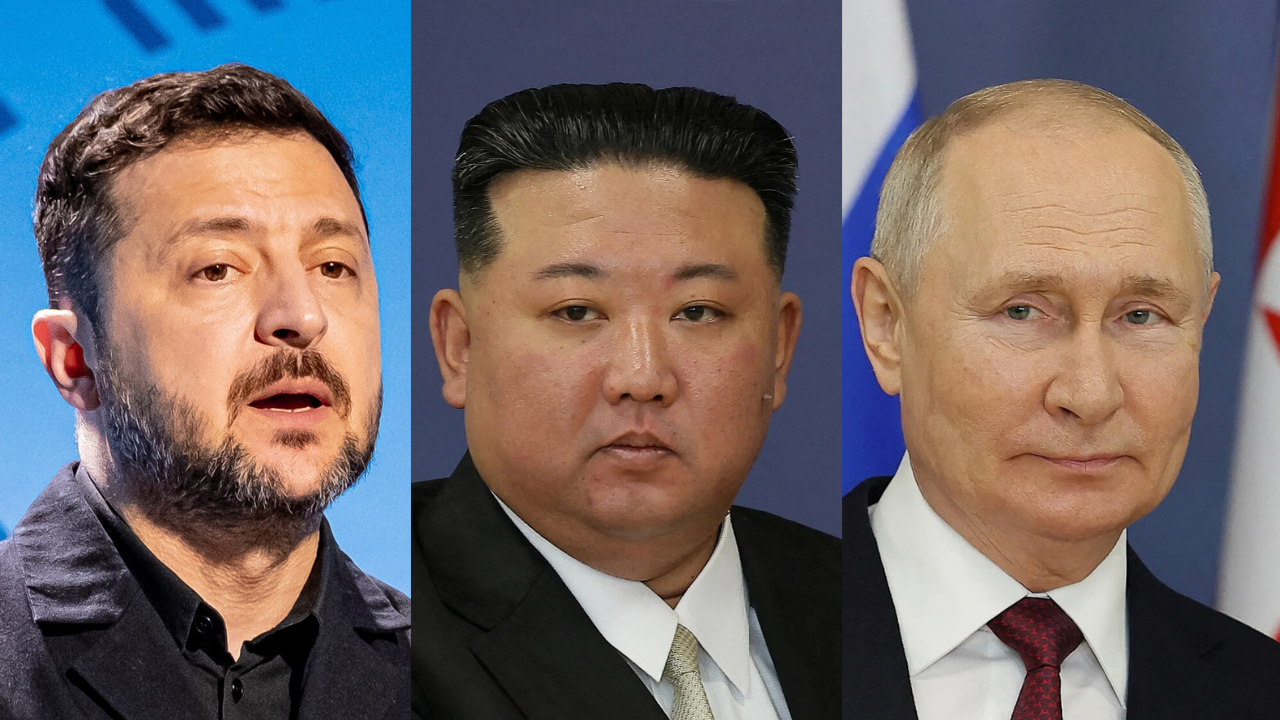
Ukrainian President Volodymyr Zelenskyy warned on Monday that Russia can no longer sustain its war against Ukraine without reinforcements from North Korea, saying Moscow is preparing to deploy an additional contingent of North Korean troops and has received new ballistic missiles from Pyongyang. The warning, posted to X on August 10, 2026, and repeated in Zelenskyy’s evening address to the nation, framed the deepening Russia-North Korea military partnership as a threat that extends far beyond Ukraine’s borders, reaching into East Asia and the broader Pacific region.
In the post, published to his official X account at 1:02 PM, Zelenskyy stated the full message as follows:
“For the first time in its history, Russia cannot wage war without reinforcements from North Korea. It is now preparing to deploy an additional North Korean contingent on its territory. It has also received additional ballistic missiles from North Korea. Everyone around the world must understand what this means. This is not only about the lives of people in Ukraine, and not only about the threats we face. North Korea’s ballistic missiles and other weapons are being improved through its collaboration with Russia. The more North Korean strikes there are here in Ukraine, in Europe, the more their missiles and soldiers are used, the more they correct their shortcomings and blind spots, the greater the danger will later be for Japan, the Republic of Korea, the Philippines, and other countries in the region. That is why, when we speak about the need for joint action, for coordination and mutual support, when we speak about the need to help us strengthen our air defense, we are also, in fact, speaking about taking away North Korea’s appetite and any interest in coming here – to our land and into our skies – with its weapons in order to learn how to wage war. Everyone across the globe who respects human life must stand together in taking action to protect people. From the evening address.”
The Evening Address
Zelenskyy delivered the same warning as part of a broader evening address published on the website of the President of Ukraine. He opened the address by describing a meeting held earlier that day with Ukraine’s Commander-in-Chief, the Chief of the General Staff, the Minister of Defense, the commanders of the Unmanned Systems Forces and the Airborne Assault Forces, and representatives of the Security Service of Ukraine, during which “additional priorities” were set and tasks for August were adjusted for Ukraine’s long-range strike campaign.
During the address, Zelenskyy announced that Ukrainian forces had struck an oil refining facility in Tobolsk, in Russia’s Siberia region, at a distance of “more than 2,500 kilometers” from Ukraine, calling it “another achievement by our Ukrainian Defense Forces” and “a very significant achievement by our Ukrainian warriors.” He said the strike demonstrated that the region was now “within reach of our deep strikes” and stated plainly: “There will be more Ukrainian deep strikes, which should demonstrate to Russia and the Russians that peace is necessary.”
Zelenskyy also referenced internal Russian polling data, saying “we have Russia’s internal polling data showing that the number of people who want this war to end is already increasing,” and stated that this shift in Russian public sentiment “must become even more apparent” so that Putin, his administration, and Russia’s security services understand that “peace is the only option.”
The Tobolsk Strike
Ukraine’s General Staff confirmed that its forces, in coordination with Special Operations Forces deep-strike units, struck the ZapSibNeftekhim petrochemical complex in Tobolsk, in Russia’s Tyumen Oblast, on August 10. The facility is described as Russia’s largest petrochemical plant in western Siberia and is located roughly 2,200 kilometers from the Ukrainian border, though Zelenskyy cited a distance exceeding 2,500 kilometers. The strike reportedly targeted the plant’s Central Gas Fractionation Unit, which processes millions of tons of feedstock annually and produces materials — including butadiene and maleic anhydride — used in Russia’s military-industrial complex, including in the production of composite materials for drone manufacturing.
The Tobolsk strike came the same night Ukrainian drones also hit the Taneco oil refinery in Nizhnekamsk, in Russia’s Tatarstan region, where at least 13 people were reported killed. The dual strikes were part of what Ukraine has described as a sustained, months-long campaign against Russian oil and petrochemical infrastructure aimed at limiting the revenue Moscow uses to finance its war effort.
North Korea’s Expanding Military Role
Zelenskyy’s warning about an “additional North Korean contingent” follows remarks he made in the days prior, in which he said Russia had made a decision to bring between 30,000 and 50,000 North Korean personnel onto Russian territory. Speaking in a national telethon interview on August 8, Zelenskyy said North Korean forces “appear on the territory of the Russian Federation from time to time,” adding that discussions had escalated “at first” from hundreds of personnel, “then thousands, and now a decision has been made for 30,000 to 50,000 North Koreans to be deployed on the territory of Russia.”
Zelenskyy did not disclose the specific intelligence basis for the figures or provide a timeframe for the deployment, though he urged Japan and South Korea to provide additional air defense assistance to Ukraine, arguing that doing so would help curb the growth of North Korean military capability being developed through participation in the war.
Background: The Moscow-Pyongyang Alliance
North Korea’s military relationship with Russia has expanded significantly since Russian President Vladimir Putin and North Korean leader Kim Jong Un signed a mutual defense pact in June 2024. Under that agreement, Russia deployed North Korean troops during a 2024 counteroffensive that pushed Ukrainian forces out of Russia’s Kursk region, an operation in which South Korea’s National Intelligence Service has told lawmakers approximately 600 North Korean soldiers were killed fighting on Russia’s behalf.
South Korean intelligence officials have separately told lawmakers that Pyongyang has continued sending additional personnel to Russia’s Kursk Oblast in waves throughout the conflict, including construction and demining units, and that the exchange has flowed in both directions — with Moscow providing North Korea with economic cooperation, air defense missiles, and radio-jamming equipment in return for troops and munitions.
Analysts tracking North Korea-Russia defense cooperation have noted that the reported 30,000-to-50,000 figure has not been independently confirmed and could reflect either a Ukrainian intelligence assessment or an effort by Kyiv to press Western allies for greater military support. Separately, Japanese broadcaster NHK reported that a Russian diplomatic source said Putin and North Korean Foreign Minister Choe Son Hui had discussed the possible deployment of approximately 20,000 additional North Korean troops.
Regional Security Concerns
Zelenskyy’s warning that North Korean forces are gaining combat experience and refining weapons systems through their involvement in the war has been echoed by security officials in the region. South Korean officials have said that any additional deployment would significantly increase the number of North Korean troops who have gained direct combat experience, while raising concerns that Russian military technology transferred to Pyongyang in exchange could accelerate improvements to North Korea’s own arsenal. South Korea’s government has said it is “closely monitoring trends in North Korea-Russia military cooperation.”
Foreign policy analysts have separately called for the United States and its allies to respond to the deepening partnership with expanded sanctions targeting Russia, North Korea, and their enablers, including through congressional action such as the Sanctioning Russia Act, along with requirements for the Pentagon to regularly report on Russia-North Korea security cooperation to Congress.
Diplomatic Outreach and Domestic Response
In the same address, Zelenskyy said he had spoken that day with the Crown Prince of Saudi Arabia and that a Ukrainian delegation would travel to the region, describing aspects of the relationship as “already developing well” and noting that additional contacts with other Middle Eastern and Gulf countries were expected.
Zelenskyy also addressed the domestic situation in Odesa, where repair crews worked throughout the day to restore power following Russian strikes on energy infrastructure. He said that as of the evening, nearly 70,000 families remained without electricity, and that Russian strikes had also hit critical infrastructure in the Sumy, Dnipro, Zaporizhzhia, and Kharkiv regions. He thanked “every person in the repair crews, the energy companies, and the State Emergency Service of Ukraine” involved in the response.
Zelenskyy closed the address by thanking international media, journalists, and independent observers for continuing to report on developments in the war, and reiterated his call for coordinated international action, stating that “everyone across the globe who respects human life must stand together in taking action to protect people” against the risks posed by the expanding Russia-North Korea military relationship.