
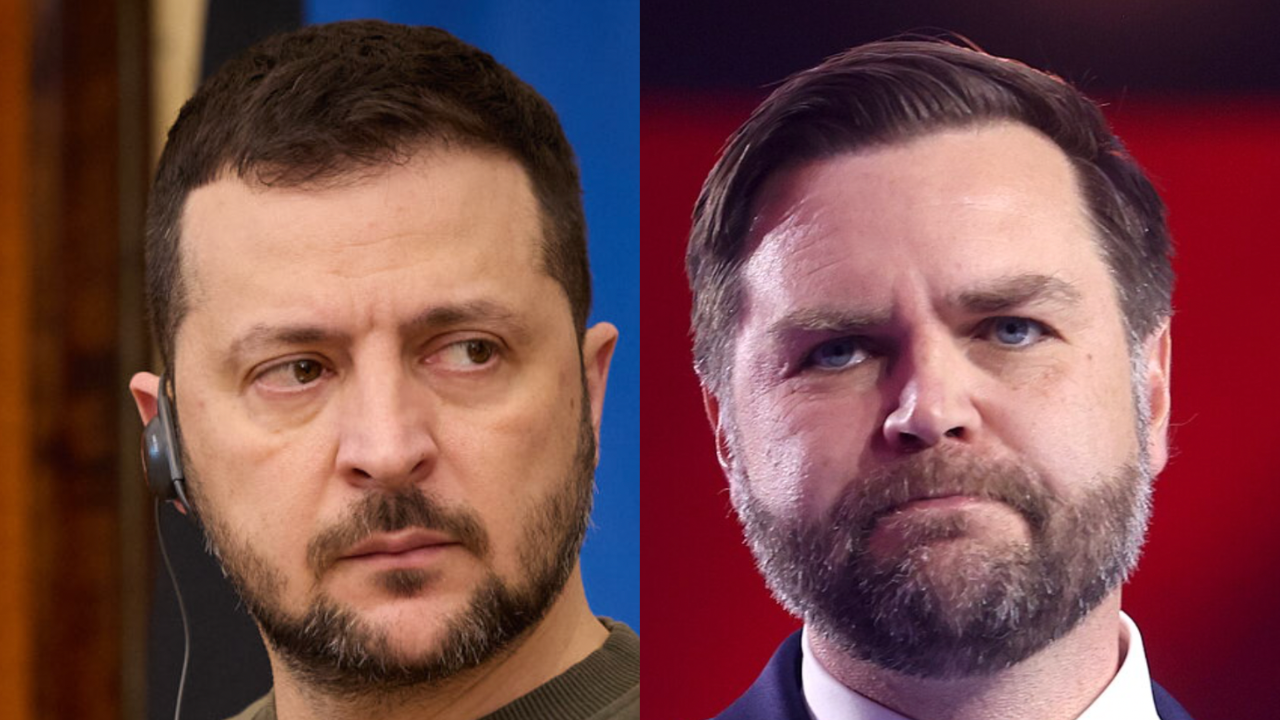
Ukrainian President Volodymyr Zelenskyy said Wednesday that Vice President JD Vance’s opposition to U.S. military aid for Ukraine amounts to helping Russia, warning that America’s shift in focus to the Middle East has weakened pressure on Moscow and risks prolonging the war.
“If vice president is proud that he is not helping us, it means that he is helping Russians,” Zelenskyy said in an exclusive interview with Newsmax’s Shelby Wilder, conducted at the former Chernobyl nuclear power plant on Sunday and aired Wednesday on “National Report.” “And I’m not sure that it’s strengthening the United States.”
The remarks came in direct response to a question from Wilder, who noted that U.S. support to Ukraine dropped by 99 percent in 2025, and that Vance had recently said he was most proud of ending military aid to Ukraine. Zelenskyy pushed back on Vance’s framing squarely.
“I’m not agree with the vice president,” Zelenskyy said. “We are open, and we are not enemies. Russia is enemies, and they are close, and they will be always enemies with the United States — cold war, hot war, no war, but they are not allies. To have Russians as friends, I’m not sure that is strong positions.”
U.S. Sanctions Relief Is Felt on the Battlefield
Zelenskyy told Newsmax that while U.S. weapons packages to Ukraine continue and he is grateful for them, the easing of economic and diplomatic pressure on Russia — particularly the relaxation of oil sanctions tied to the Middle East conflict — is allowing the Kremlin to sustain its war effort.
“The United States can put pressure with more sanctions, but they now lift it, yes, because of the Middle East, and we feel this,” he said. “Russia doesn’t feel the pressure, and for them it’s OK to continue this way of war.”
Zelenskyy said he hopes the administration reverses course. “I hope that America will bring back all the sanctions,” he said, adding that Treasury Secretary Scott Bessent had suggested the relief was temporary. “I hope that they will put it again.”
He also said Ukraine has resisted pressure from unspecified partners to halt strikes on Russian energy infrastructure in deference to global energy concerns stemming from the Middle East situation. “Nobody proposed an energy ceasefire to us,” he said. “We are open for this, but if Russia will attack us, we will respond in any way.”
Ukraine’s Battlefield Position Is Its Strongest in Months
Despite the pressure, Zelenskyy offered a relatively confident assessment of Ukraine’s military situation on the ground. “They are not in a strong position, Russia. They are not winning,” he said. “We are in the best position during the last 9–10 months, I mean, about the battlefield — but in any way, it’s better to stop the war.”
He stressed, however, that military progress alone is insufficient without sustained political and economic pressure from Washington. “I’m afraid that if we will have just talks, Russia will not feel the most important thing that America can give us — pressure on them,” he said. “Russia doesn’t respect weakness.”
Ukraine Has Provided Support to U.S. Operations
Zelenskyy disclosed that Ukraine has provided assistance to countries beyond Europe at Washington’s request, including to American military bases, though he left the specifics deliberately vague. “Some different institutions in the United States also asked us to support, and of course, we are partners, and we decided to do it,” he said. “If the United States thinks that they didn’t ask us, OK.”
The Case for the Alliance
Throughout the interview, Zelenskyy returned to the argument that supporting Ukraine is in America’s own strategic interest — not simply an act of charity. “Our union between the United States and Ukraine is the quickest way how to make the strongest forces in the world,” he said. “Big investment from the United States and Europeans at the very beginning of the war helped us technologically increase and be unique now — one of the strongest armies, technologically strongest armies in the world.”
“I’m sure that the United States is a great partner for Ukraine, and Ukrainians can also strengthen the United States,” he said. “In business, people say it’s win-win, so why not to win?”
The interview was conducted on Sunday at the site of the Chernobyl nuclear power plant, marking 40 years since the 1986 disaster. The same day, the U.S. State Department announced it would contribute up to $100 million toward repairs to the plant’s damaged protective confinement structure, which was struck by a Russian drone last year and is estimated to require approximately $575 million to fully restore.