
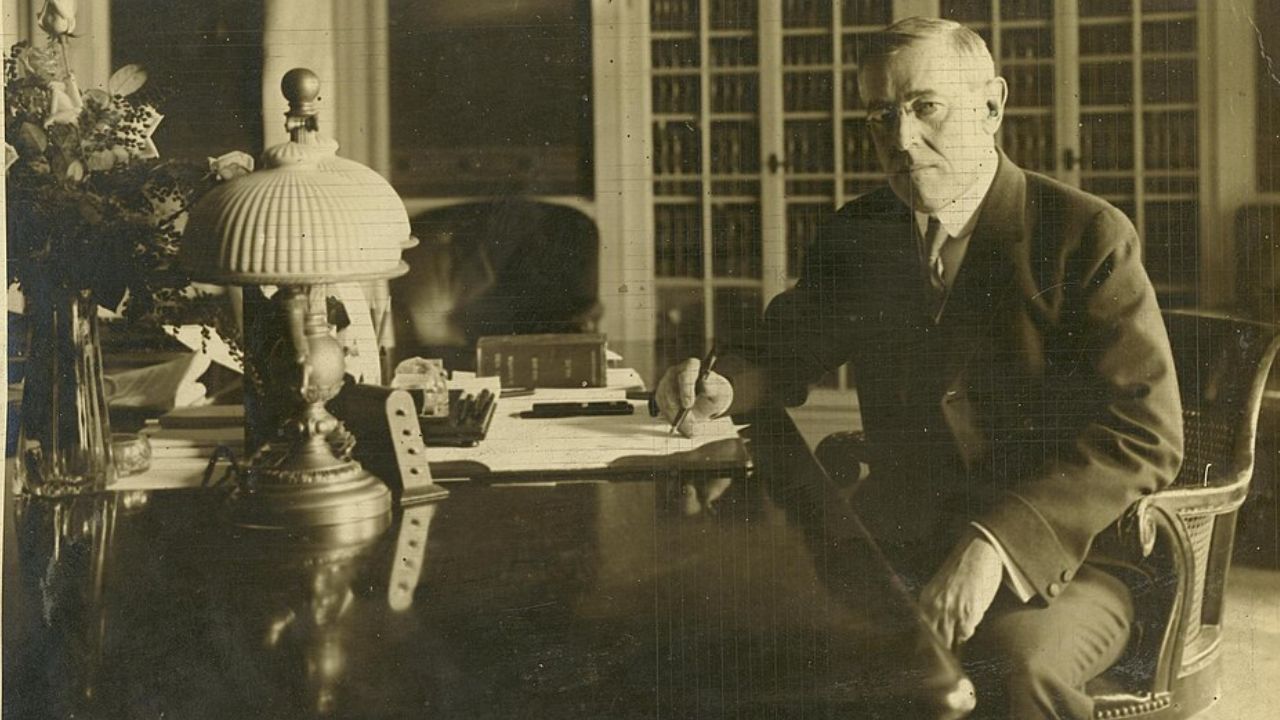
When Americans think about World War I, they often picture muddy trenches in France and massive battles an ocean away. But back home, the country was wrestling with a different question: should the United States get involved at all? In the middle of that debate stood President Woodrow Wilson, a former college professor with a careful speaking style and a big belief that ideas could shape history. Like him or not, Wilson ended up steering the U.S. from uneasy neutrality into full-scale war—and then tried to steer the world toward a new kind of peace.
Wilson didn’t “win” the war single-handedly, of course. But he did guide the country through the political, economic, and emotional whiplash that came with it. He managed alliances, rallied public support, built the machinery for mobilization, and tried to define what the war was supposed to mean. And that last part—meaning—might be the most Wilsonian thing of all.
A president who tried to keep America out
When war broke out in Europe in 1914, Wilson’s first instinct was to keep the United States on the sidelines. Many Americans agreed. The country had strong ties to Britain and France, but it also had millions of citizens with German and Irish roots, and a general sense that Europe’s conflicts were Europe’s business.
Wilson famously called on Americans to be “neutral in thought as well as in action,” which is a tall order even on a quiet Tuesday. But neutrality didn’t mean the war couldn’t reach across the Atlantic. U.S. businesses traded with Allied nations, American banks made loans, and German submarines made the ocean suddenly feel a lot smaller.
Pressure builds: submarines, ships, and public opinion
The turning point wasn’t a single moment so much as a mounting pile of them. Germany’s use of unrestricted submarine warfare—meaning U-boats could attack ships without warning—made American leaders furious and American travelers nervous. The 1915 sinking of the British passenger liner Lusitania, which killed more than 100 Americans, shocked the public and tested Wilson’s patience.
For a while, Wilson tried to manage the crisis through diplomacy, warning Germany and pushing for limits. But events kept escalating. By early 1917, Germany resumed unrestricted submarine warfare, gambling it could starve Britain into surrender before the United States could respond. Around the same time, the Zimmermann Telegram—Germany’s proposal encouraging Mexico to join a war against the U.S.—added gasoline to an already smoky fire.
From neutrality to war: Wilson’s decision in 1917
In April 1917, Wilson asked Congress for a declaration of war against Germany. His message framed the conflict not just as a defense of American rights at sea, but as a larger mission: the world had to be made “safe for democracy.” That phrase stuck because it gave the war a moral storyline, not just a strategic one.
It’s worth remembering that Wilson had just won reelection in 1916 with the slogan “He kept us out of war.” Politics can change fast when submarines start sinking ships. Wilson’s shift didn’t mean he suddenly wanted war; it meant he believed the costs of staying out had become greater than the costs of joining in.
Building a war effort almost from scratch
Once the U.S. entered the war, Wilson’s administration had to turn a relatively small peacetime army into a force that could matter in Europe. The Selective Service Act created the draft, bringing millions of men into military service. Training camps sprang up, and the country scrambled to supply uniforms, rifles, ships, and food at a scale it hadn’t attempted before.
To coordinate the home-front surge, the federal government expanded its role in the economy. Agencies like the War Industries Board helped manage production and prioritize military needs. The government also took control of railroads for a time to keep supplies moving—an early example of Washington saying, “Yes, we’re going to organize this chaos now.”
Winning hearts at home: propaganda and persuasion
Wilson understood that wars aren’t fought only with soldiers; they’re fought with public support, too. The Committee on Public Information, led by George Creel, became the government’s megaphone, pushing posters, pamphlets, films, and speeches to rally Americans. “Four Minute Men” gave short pro-war talks in movie theaters—because apparently even a silent film intermission wasn’t safe from politics.
That publicity machine helped unify many people behind the war effort, but it also helped create an atmosphere where dissent was treated as disloyalty. The Espionage Act of 1917 and Sedition Act of 1918 cracked down on anti-war speech and criticism of the government. Wilson didn’t invent wartime censorship, but under his watch, civil liberties took a real hit, and historians still argue about how necessary—or excessive—that was.
American troops arrive, and the war’s momentum shifts
American forces, known as the American Expeditionary Forces, arrived in Europe under General John J. Pershing. At first, U.S. troops were limited in number, but their presence carried huge psychological weight. Fresh soldiers and fresh supplies signaled that the Allies had new energy, while Germany faced increasing shortages and exhaustion after years of fighting.
By 1918, American units played key roles in major offensives, including the Meuse-Argonne campaign, one of the largest battles in U.S. military history. The war ended with an armistice on November 11, 1918. Wilson, who had pushed hard to define the war as a fight for principles, now tried to define the peace the same way.
The Fourteen Points and a peace built on ideas
In January 1918, Wilson laid out his vision in the Fourteen Points. It called for things like open diplomacy, freedom of the seas, reduced armaments, and national self-determination—along with a brand-new international organization to help prevent future wars. That organization would become the League of Nations, Wilson’s signature project.
Wilson personally traveled to Europe to take part in the peace talks at Versailles, an unusual move for a U.S. president at the time. He was treated like a celebrity by many Europeans who hoped his ideals could prevent another catastrophe. But the negotiations were messy, and the final Treaty of Versailles included harsh penalties on Germany, which didn’t exactly scream “lasting reconciliation.”
The League of Nations fight: Wilson’s last big battle
Back in the United States, Wilson faced fierce opposition in the Senate, especially from Republicans who worried the League would pull America into foreign conflicts without clear control. Wilson refused to compromise on key parts of the treaty, convinced that the League was essential. He took his case directly to the people on a cross-country speaking tour—an exhausting effort that ended with him suffering a severe stroke in 1919.
In the end, the Senate never ratified the treaty, and the U.S. didn’t join the League of Nations. It’s one of history’s sharpest ironies: Wilson helped design the new world order but couldn’t bring his own country along for the ride. Still, his vision echoed later in institutions like the United Nations, and his idea that global peace needed global cooperation didn’t disappear.
Wilson’s complicated legacy in wartime leadership
Wilson guided America through World War I by making the biggest calls—when to enter, how to mobilize, and what the war should represent. He expanded federal power dramatically, shaped public opinion with modern messaging, and pushed a bold plan for peace that aimed higher than “we won, now go home.” Those are the headlines of his leadership.
But the fine print matters, too. His administration’s restrictions on dissent, and the broader climate of suspicion and intolerance that grew during the war years, left real scars. Wilson’s wartime leadership is remembered as ambitious and world-shaping, but also as a reminder that even noble goals can come with uncomfortable trade-offs.