

The Tomahawk cruise missile is the military equivalent of that one power tool that never gets retired, no matter how many shiny gadgets arrive in the toolbox. Decades after its debut, it still gives commanders a reliable way to hit hard, from far away, without risking pilots or betting everything on unproven tech. The result is a weapon that behaves less like a relic of the Cold War and more like a very modern hammer that keeps finding new nails.
The long-range workhorse that refuses to age
Strategists keep reaching for the Tomahawk because it solves a brutally simple problem: how to hit important targets deep inside hostile territory while staying comfortably offshore. The Tomahawk is an intermediate-range, subsonic cruise missile that launches from Navy ships and submarines, then flies at low altitude for hundreds of miles to strike with precision, which makes it ideal for opening salvos and carefully calibrated punishment strikes. It was first introduced in the 1980s, yet it still fills a sweet spot between lumbering bombers and short-range rockets, giving commanders a dependable way to reach into defended airspace without sending in crews or betting on perfect air superiority.
That staying power is not an accident, it is the result of a deliberate design philosophy that treated the missile as a platform to be upgraded rather than a disposable product line. The Tomahawk was built to meet the need for a medium to long range, low altitude missile with diverse capabilities, and its modular design has allowed repeated refreshes of guidance, propulsion, and warheads without throwing away the basic airframe. Over time, The Tomahawk has shifted from nuclear roles to conventional precision strike, and Its history has seen several transitions that kept it relevant instead of relegated to museum duty.
Block upgrades: how a 1980s missile learned 2020s tricks
If the Tomahawk were a car, it would be the classic model that keeps getting new engines, better electronics, and a fresh coat of paint while the chassis stays familiar. The Block IV generation added smarter navigation and the ability to loiter and re-target in flight, turning a one-way missile into something closer to a roaming problem solver. The Block V project, which began in 2020, builds on that by extending the service life of the missile and improving its performance so the same basic weapon can stay in frontline service for many more years instead of being scrapped for something entirely new.
The latest Block V configuration does not just stretch the calendar, it upgrades the brain and the brawn. Block V adds extended range, hardened electronics, improved maritime strike capability, and an open architecture that makes future software and sensor improvements easier to bolt on. Each upgrade has focused on software, sensors, and smarter flight control rather than simply swapping in bigger warheads, which means The Tomahawk keeps getting better at finding and hitting the right target in complex environments. That constant program of updates to the modular design is how the Tomahawk has managed to stay relevant for 49 years, turning what could have been a Cold War antique into a living, evolving system.
Precision, payload, and the art of quiet destruction
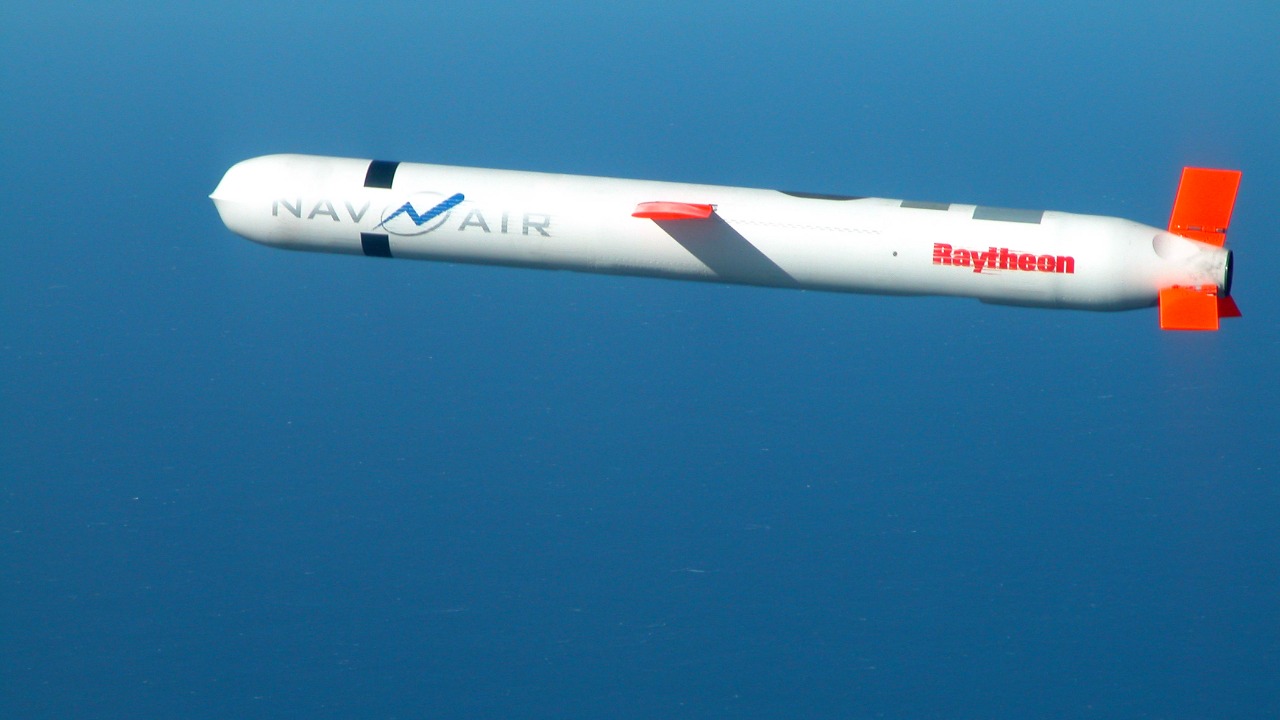
Part of the Tomahawk’s enduring charm, at least from a planner’s perspective, is that it delivers damage with the calm efficiency of a seasoned contractor who shows up, does the job, and leaves before anyone has time to complain. The missile can carry a 450 kg conventional warhead or multiple payloads in its most recent versions, giving it enough punch to crater runways, shred air defenses, or wreck hardened facilities without resorting to nuclear options. Its ability to fly at high subsonic speeds while hugging the terrain, guided by advanced navigation technologies, lets it slip under radar coverage and arrive with unpleasant surprise rather than noisy fanfare.
That combination of accuracy and survivability has made the Tomahawk a cornerstone of modern Western arsenals, particularly for the opening phases of conflicts when air defenses are still very much alive. In combat operations, more than 2,300 Tomahawks have been fired, including during Operation Odysse, which underscores that this is not a boutique weapon pulled out for rare occasions but a routine tool of long-range strike. The missile’s ability to fly low and hit bases hundreds of miles away turns it into a quiet but persistent threat for any adversary that relies on fixed infrastructure, from airfields to command bunkers, and it does so without the political and operational complications of sending in manned bombers or ground forces.
From Iran to Ukraine: a global calling card
When the United States wants to send a message without starting a full-scale war, the Tomahawk often ends up writing the first line. The weapon has been used in air strikes on Iran’s nuclear facilities, where its long range and precision allowed the United States to hit sensitive sites while keeping launch platforms at a safe distance. In those operations, Tomahawk missiles gave planners a way to calibrate force, inflicting serious damage on high value targets while limiting collateral effects and avoiding the risks that come with piloted aircraft over heavily defended territory.
The missile’s reputation is now shaping debates far beyond the Middle East. Analysts argue that putting Tomahawks into Ukrainian hands would be a battlefield game changer, because the missile’s ability to fly low and strike bases hundreds of miles away would suddenly put Russian logistics hubs and command centers at risk far behind the front lines. According to Navair, more than 2,300 Tomahawks have already been used in combat, so this is not an experimental capability but a proven one that could upend assumptions about which rear areas are safe. The Tomahawk is a long range cruise missile, first introduced in the 1980s and manufactured in large numbers, and its potential transfer to Ukrainian forces is treated as a serious strategic variable rather than a symbolic gesture.
Allies, Indo-Pacific tensions, and the coalition hammer
The Tomahawk is no longer just an American calling card, it is becoming a shared language among allies who want credible long-range strike without reinventing the wheel. Japan’s decision to equip its warships with Tomahawks marks a major leap in offensive power, especially in the Indo-Pacific where distance and dispersed islands make range a currency of influence. Navy surface ships and submarines that carry these missiles can coordinate with U.S. Navy platforms and build readiness together, turning individual fleets into a more integrated strike network that can reach across the Pacific with consistent, interoperable firepower.
That shared capability matters in a region where potential adversaries are investing heavily in anti-access and area denial systems. By fielding Tomahawks, partners like Japan gain the ability to hold distant targets at risk, from missile batteries to logistics hubs, without relying solely on aircraft that must fight through dense air defenses. The dual role of the missile, which can hit both land and maritime targets, stands to be particularly useful in the Indo-Pacific, where contested sea lanes and island bases blur the line between naval and land warfare. In effect, every allied ship or submarine that carries Tomahawks becomes another mobile launch pad that complicates an adversary’s planning and strengthens collective deterrence.
Why the hammer still matters in a directed-energy age
On paper, the Tomahawk should be feeling its age in a world that is increasingly obsessed with hypersonic weapons and directed energy systems that promise to zap threats at the speed of light. Directed energy weapons are touted for precise, scalable, and cost effective engagement, with the ability to handle multiple threats such as drone swarms and incoming missiles simultaneously. They are the sleek new gadgets of the defense world, marketed as the answer to everything from cheap quadcopters to high end cruise missiles, and they are steadily moving from lab slides to operational concepts.
Yet even as those technologies mature, the Tomahawk keeps its place in the toolkit because it solves a different problem: delivering heavy, one way punishment at long range against fixed or high value targets. Directed energy excels at defense and at swatting small or fragile threats, but it does not replace the need for a 450 kg warhead arriving uninvited at a hardened bunker or a critical air base. The Tomahawk aimed to fulfill the need for a medium to long range, low altitude missile with diverse capabilities, and that mission has not gone away just because new toys have appeared. As long as militaries need to break things decisively at distance, a reliable cruise missile that can be launched from ships and submarines, upgraded through software and sensor improvements, and integrated into allied fleets will remain a strategic hammer that commanders are reluctant to put back on the shelf.