
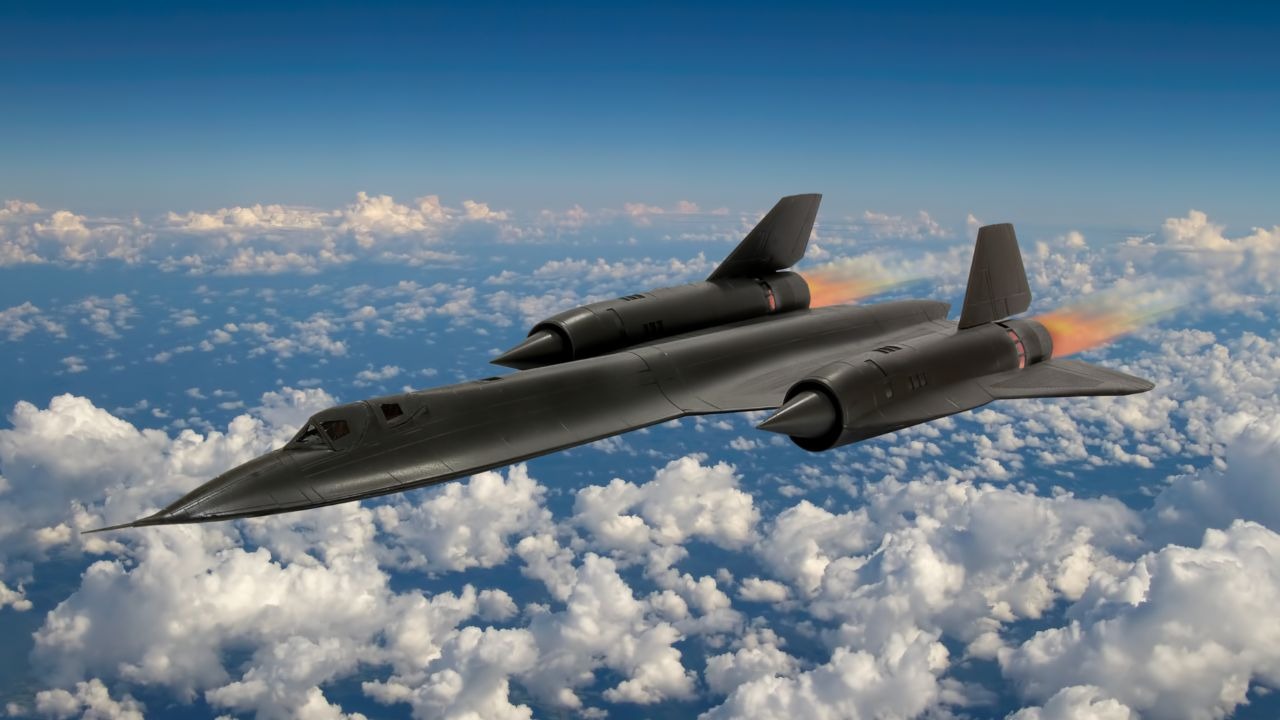
The SR-71 retired decades ago, yet its silhouette still lurks in the back of every air defense planner’s mind like a recurring stress dream with titanium skin. The aircraft proved that if you fly high enough, fast enough, and cleverly enough, entire national air defense systems can be reduced to very expensive background scenery. That uncomfortable lesson has not gone away, it has simply migrated into modern debates over hypersonic aircraft and missile defense.
Today’s planners are staring at new designs that promise to do what the Blackbird did, only faster and with better computers, and they know the old playbook did not work the first time. The SR-71 is not just a Cold War trophy, it is a reminder that speed, altitude, and smart electronic trickery can still bend the rules of engagement in ways that radar operators and missile crews hate.
The original nightmare: speed as a defense system
From the beginning, the SR-71 was built on a rude idea: if you are fast enough, you do not need to dodge, you just leave. The aircraft’s main defensive move against surface-to-air missiles was not some exotic shield, it was to light the afterburners, climb, and run away, a tactic described bluntly as simply accelerating to outfly the missile. That approach turned the usual logic of air defense on its head, because the Blackbird treated missile launches as performance reviews rather than mortal threats.
That philosophy was not theoretical. Accounts of SR-71 operations describe crews watching missile warning lights, then smoothly adding power and altitude until the threat fell behind, a pattern echoed in pilot stories that the aircraft’s best protection was its ability to outrun anything fired at it. The design leaned into this, pairing high altitude with sustained high Mach performance so that even sophisticated systems struggled to generate a firing solution before the jet had already streaked past.
Why Soviet interceptors never got their kill shot
On paper, Soviet interceptors like the Mig-25 and Mig-31 were built to be Blackbird hunters, yet the scoreboard tells a different story. A detailed look at SR-71 operations notes that a Mig-25 or Mig-31 has never fired a missile at an SR-71, and Pilots who actually flew the routes report that these aircraft never posed a serious threat to the reconnaissance missions. The interceptors could sprint, but only briefly, and that short burst window was a poor match for a target that lived in the thin air above and could stay fast for the entire flight.
The performance gap was not just about raw speed, it was about endurance and survivability. Reports on the Mig-25 describe how the jet was so fast that it could melt its own engines if pushed too far, with top speed figures that looked impressive until turbine blades started to overheat, warp, or even ignite when pilots tried to hold them. In practice, that meant the Foxbat could dash, but not live in the same regime as the SR-71, which was designed to cruise there. The result was a kind of aerial comedy in which interceptors strained to reach a firing position while the Blackbird treated them as brief blips on the scope before disappearing over the horizon.
Missiles that could not quite catch the ghost
Surface-to-air missile crews did not fare much better, and that is where the story really starts to haunt modern planners. Discussions of why the Soviet Union did not lean harder on systems like the S-200 against the SR-71 point to a simple, uncomfortable reality: the aircraft’s combination of speed, altitude, and predictable but hard-to-exploit routes made it a terrible target. Even when a missile could theoretically reach the altitude, the engagement envelope was so narrow that by the time tracking and guidance lined up, the Blackbird was already exiting the danger zone.
Western analysis of the aircraft’s defensive concept reinforces that its primary tactic was to outrun missiles rather than outsmart them, although it carried electronic countermeasures as well. The logic was brutally straightforward. If a radar site lit up and a launch was detected, the crew would add power, climb, and let physics do the rest. That approach still echoes in modern air defense debates, because it exposes a structural problem: if a target can compress the engagement window to a few seconds, even the best missile battery starts to look like a very expensive weather station.
Stealth, sensors, and the art of not being where the radar thinks
Speed was only half the SR-71’s magic trick. The aircraft also dabbled in early stealth and electronic mischief, which made it even harder to pin down. At a 50th anniversary airshow, Col. Stan Dennison described how the SR71 (SR-71 Blackbird) was really the first airplane to have a stealth technology built into it, even if he called it primitive compared with later designs. That shaping and materials work did not make the jet invisible, but it did complicate radar returns just enough to make tracking a Mach 3 target a little more miserable.
On top of that, the Blackbird carried electronic countermeasures that echoed the broader use of systems like the ALQ-71 Electronic Countermeasures (ECM) Pod Carried by fighter aircraft. Those pods were designed to jam enemy radars and confuse tracking, and the SR-71’s own suite followed the same philosophy, adding noise and deception to a target that was already hard to hit. The result was a layered defense: reduced radar signature, aggressive jamming, and the ever-present option to simply accelerate away, a combination that still reads like a wish list for modern high-speed reconnaissance concepts.
From A-12 experiments to modern hypersonic ambitions

The SR-71 did not appear out of nowhere, it grew out of a culture of experimentation that still shapes how militaries think about speed. Earlier programs like the A-12, originally used by the CIA for reconnaissance, were pushed into interceptor prototypes armed with air-to-air weapons, a reminder that designers were already exploring how to blend surveillance with offensive capability. Research methods around that family of aircraft treated high speed as a flexible tool, not just a way to take pictures and leave.
That lineage is visible in today’s fascination with hypersonic successors. Concepts for the SR-72, often nicknamed Darkstar, promise to move from the Blackbird’s high supersonic regime into true hypersonic flight. Reporting on the high-speed SR-72 notes that it can, according to some estimations, outrun some missiles and weapons systems, largely because of a turbine-based combined cycle (TBCC) engine that would let it operate efficiently across a wide speed range. Public discussions of the 72 program are still thin, and some coverage points out that very little is definitive, but the ambition is clear: take the SR-71’s basic survival logic and push it into a new speed bracket.
Why satellites did not erase the Blackbird’s lesson
When the United States Air Force retired the SR-71 Blackbird, the official story leaned heavily on cost and the rise of space-based surveillance. After retiring the SR-71, the U.S. has leaned heavily on satellites for global surveillance, operating under the assumption that orbital sensors could cover what high-speed aircraft once did. For a while, that looked efficient, at least on paper, because satellites do not need tanker support and they do not complain about long missions.
The problem, as modern analysts keep pointing out, is that satellites are predictable and increasingly vulnerable. The same assessment that notes the post-71 reliance on space also warns that adversaries are now developing ways to jam, blind, or destroy those birds. That vulnerability has revived interest in platforms that can appear over a target quickly, collect data, and vanish before defenses can react, which is exactly the niche the SR-71 once filled. In other words, the Blackbird’s retirement did not close a chapter, it created a capability gap that hypersonic projects are now trying to fill.
The SR-72 “Darkstar” and the return of the planner’s headache
Modern talk about the SR-72 Darkstar has turned the old Blackbird anxiety into a sequel. Technical write-ups describe how the high-speed SR-72 plane can, according to some estimations, outrun some missiles and weapons systems, again by leaning on sheer velocity and altitude. The turbine-based combined cycle engine at the heart of these concepts is meant to handle everything from takeoff to hypersonic cruise, which would give planners a platform that can cross continents in the time it takes a ground crew to refill a coffee pot.
Cultural fascination has only amplified that unease. Features on the mysterious SR-72 point out that While the “Darkstar” featured in “Top Gun: Maverick” is not a real aircraft, its real-world counterpart has been discussed enough to suggest serious interest. The mix of Hollywood myth and sparse technical detail leaves air defense communities in an awkward place: they have to plan for a class of target that might exist, might not, but is clearly technologically plausible given what the SR-71 already did. That uncertainty is its own form of pressure, because it forces investment in sensors and interceptors that can handle a threat profile still wrapped in secrecy.
Why the Blackbird still shapes the next generation of defenses
For air defense planners, the SR-71 is less a nostalgic icon and more a case study in what happens when the offense gets a generational leap. Internal debates about how the Blackbird was used note that Soviet air to air missile technology, while impressive, never posed a consistent threat to the aircraft, and that the platform’s potential was never fully exploited. But those same discussions underline the core problem: even advanced systems struggled to generate reliable engagement opportunities against a target that combined speed, altitude, and electronic trickery.
That history now informs everything from interceptor design to integrated air defense networks. Efforts to field faster, more agile missiles and to fuse radar data across larger regions are, in part, attempts to avoid a repeat of the SR-71 era, when national systems watched an intruder streak across their screens with little they could do about it. The Blackbird proved that a well-designed aircraft could turn entire air defense architectures into spectators. As hypersonic projects like the 72 move from concept art to hardware, the old Blackbird is still in the room, reminding planners that if they cannot close the engagement window, they are just tracking contrails and hoping for the best.