
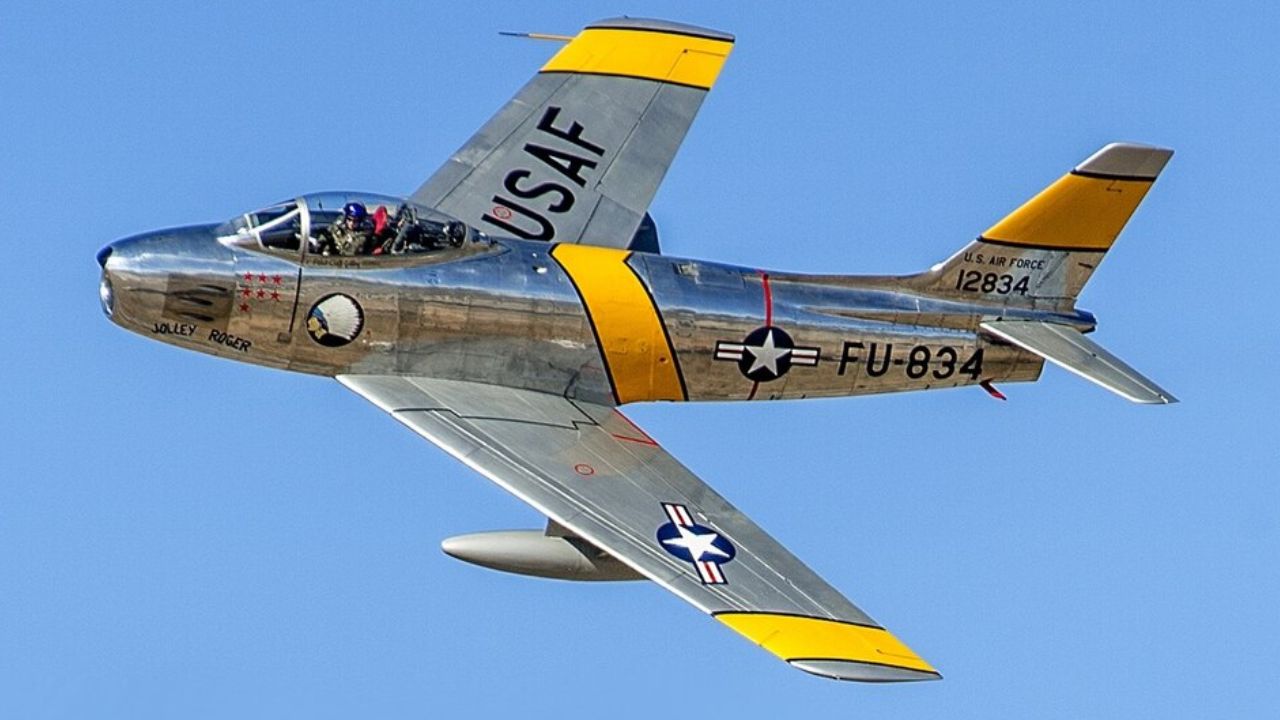
The F-86 Sabre, a legendary aircraft from the Korean War era, is often hailed as one of the most iconic jet fighters in aviation history. Its innovative design, superior performance, and significant impact on aerial combat have cemented its place in the annals of military aviation. Various factors contributed to the F-86 Sabre’s esteemed reputation, solidifying its status as a respected figure in aviation history.
Design and Innovation
The F-86 Sabre’s innovative design is most famously characterized by its swept-wing design, a feature that significantly enhanced its aerodynamic performance. By angling the wings back, the aircraft reduced aerodynamic drag, allowing it to achieve higher speeds and maneuverability. This design was inspired by captured German research from World War II, which the United States adapted to meet the demands of jet-powered flight. The Sabre’s swept wings allowed it to outperform many of its contemporaries, establishing it as a dominant force in the skies.
In addition to its revolutionary wing design, the F-86 Sabre was equipped with a powerful jet engine that was ahead of its time. The General Electric J47 engine provided the necessary thrust to propel the aircraft to speeds exceeding 600 mph, making it one of the fastest fighters of its era. This advancement in jet propulsion technology was a game-changer, setting a new standard for fighter aircraft performance and enabling the Sabre to engage effectively with high-speed adversaries.
The F-86 was also outfitted with advanced armament and targeting systems, which played a crucial role in its combat effectiveness. It was typically equipped with six .50 caliber M3 Browning machine guns, which offered a potent offensive capability in dogfights. Furthermore, the Sabre incorporated a radar-ranging gunsight, which improved accuracy and allowed pilots to make precise shots even at high speeds. This combination of speed, firepower, and innovation gave the F-86 a competitive edge, making it a formidable opponent in any aerial engagement.
Combat Performance in the Korean War
The F-86 Sabre’s combat performance during the Korean War was nothing short of remarkable. It achieved air superiority against adversaries, particularly the Soviet-made MiG-15, which was its primary rival. The Sabre’s superior speed, maneuverability, and firepower allowed it to dominate the skies, effectively countering the MiG-15’s advances. The aerial duels between these two aircraft became legendary, showcasing the Sabre’s prowess and cementing its reputation as a fearsome fighter.
One of the most impressive aspects of the F-86 Sabre’s performance in the Korean War was its kill-to-loss ratio. The Sabre achieved a staggering 10:1 kill ratio, underscoring its effectiveness in combat. Notable engagements, such as those involving ace pilots like Joseph McConnell and James Jabara, highlighted the Sabre’s capabilities and further solidified its esteemed status. These victories not only boosted morale among allied forces but also demonstrated the tactical advantages the Sabre provided.
The F-86 Sabre’s influence extended beyond its individual successes; it also played a pivotal role in shaping air combat tactics and strategies. Its performance necessitated changes in pilot training and engagement tactics, emphasizing the importance of speed and agility in dogfights. The lessons learned from the Sabre’s engagements influenced future military aviation doctrine, ensuring that its legacy would endure long after the conflict had ended.
Pilot Experience and Legacy
Pilots who had the privilege of flying the F-86 Sabre often spoke highly of their experiences, praising the aircraft for its handling characteristics and performance. The Sabre was known for its responsive controls and stability, making it a favorite among aviators. Pilots like Francis “Gabby” Gabreski, one of the top US fighter aces, often shared stories of their encounters with the Sabre, highlighting its ability to outmaneuver opponents and deliver decisive blows in combat. Personal accounts from these pilots provide a firsthand perspective on what made the Sabre such a respected aircraft.
The F-86’s design also facilitated pilot training and adaptation, contributing to its popularity among air forces. Its straightforward cockpit layout and advanced systems allowed pilots to quickly become proficient, reducing the learning curve and enabling them to focus on honing their combat skills. This ease of adaptation was a significant factor in the Sabre’s widespread adoption and success in various air forces around the world.
The long-lasting impact of the F-86 Sabre can be seen in its influence on subsequent aircraft design and pilot training programs. The lessons learned from the Sabre’s performance and handling were incorporated into future generations of jet fighters, such as the F-4 Phantom and F-15 Eagle. Its legacy continues to be celebrated in aviation history, with many considering the Sabre a benchmark for assessing the success and innovation of later fighter aircraft. For more on the Sabre’s legacy, check out this article on American fighter aircraft.
Global Influence and Variants
The F-86 Sabre’s influence extended beyond the United States, as it was adopted by various air forces around the world. Countries such as Canada, Australia, and Japan incorporated the Sabre into their fleets, recognizing its capabilities and benefits. This international adoption helped to spread the Sabre’s influence globally, fostering stronger military partnerships and alliances during the Cold War era. The Sabre’s presence in numerous air forces also facilitated the sharing of tactics and experiences, further enhancing its reputation as a world-class fighter.
Throughout its service, the F-86 Sabre underwent several modifications and variants, each tailored to meet specific military needs. Notable variants included the F-86D “Sabre Dog,” which featured an all-weather capability and a redesigned nose to house radar equipment. Another variant, the F-86F, offered improved performance and armament, making it even more effective in combat situations. These variants demonstrated the versatility of the Sabre’s design, allowing it to adapt to various mission profiles and extend its operational lifespan.
The F-86 Sabre played a crucial role in strengthening international military alliances, particularly during the tense years of the Cold War. By equipping allied nations with a capable and reliable fighter, the Sabre helped to bolster collective defense efforts and deter potential aggressors. Its widespread use and success in various conflicts made it a symbol of military cooperation and technological advancement, further solidifying its place in history. Learn more about the greatest fighter aircraft of all time in this comprehensive list.
Comparison with Contemporaries
The rivalry between the F-86 Sabre and the Soviet MiG-15 is one of the most famous in aviation history. Both aircraft were among the first generation of jet fighters, and their encounters during the Korean War highlighted their respective strengths and weaknesses. The Sabre’s superior speed and maneuverability gave it an edge in dogfights, while the MiG-15’s higher service ceiling and heavier armament presented significant challenges. This rivalry pushed the boundaries of aerial combat and drove technological advancements in both the United States and the Soviet Union.
The F-86 Sabre set a new standard for future generations of jet fighters, influencing designs such as the F-4 Phantom and F-15 Eagle. Its emphasis on speed, agility, and advanced weaponry became defining characteristics of successful fighter aircraft. The lessons learned from the Sabre’s design and performance were incorporated into subsequent models, ensuring that its legacy would continue to shape military aviation for decades to come. For a deeper dive into America’s most powerful fighter jets, check out this article.
The historical significance of the F-86 Sabre is undeniable. Its contributions to military aviation, both in terms of technological innovation and combat performance, have left a lasting impact. The Sabre remains a benchmark for assessing the success and legacy of jet fighters developed in its wake, serving as a reminder of the remarkable achievements of early jet-age engineering. For insights into top fighter aces and their aircraft, explore this article on Gabreski.