
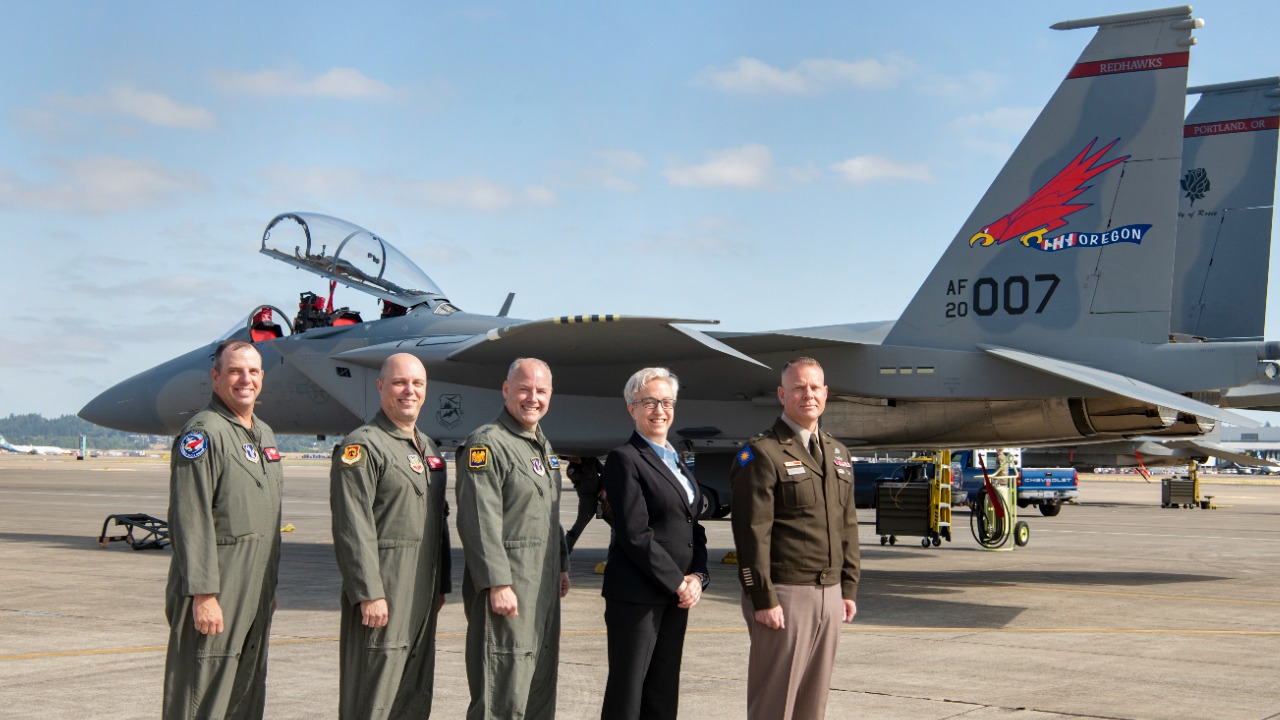
The F-15EX Eagle II takes one of the most successful fighter designs in history and rebuilds it around a digital core, turning a Cold War workhorse into a front-line asset for high-end conflict. Instead of replacing the classic Eagle, the new variant uses its size, speed, and proven reliability as a foundation for modern sensors, open-architecture computing, and a weapons load that outclasses any other U.S. fighter.
By pairing a familiar airframe with cutting-edge avionics, electronic warfare, and hypersonic-capable hardpoints, the F-15EX gives the Air Force a way to expand combat power quickly without waiting for an entirely new platform. It is less a nostalgia project than a pragmatic answer to contested skies, where capacity, connectivity, and adaptability matter as much as stealth.
From Cold War Eagle to digital Eagle II
The F-15 story begins in the aftermath of the Vietnam War, when the Air Force sought an air superiority fighter that could dominate Soviet designs and secure control of the skies. That requirement produced the original F-15 Eagle, a twin-engine jet optimized for speed, climb rate, and maneuverability, and it went on to define air superiority from the late Cold War onward, a legacy often described as a “Legacy Born” in the “Cold War” with roots in the “Vietnam War” and the Air Force’s push for air dominance. Over decades of upgrades, the Eagle family expanded into the F-15E Strike Eagle, adding a second crew member and deep strike capability while preserving the basic airframe that proved so structurally robust.
The F-15EX Eagle II builds directly on that lineage, but it is not a simple refresh of 1970s hardware. Reporting on the program describes the Eagle II as a “Modern Marvel” derived from the F-15E “Strike Eagle,” configured as a two-seat multirole platform that can handle both air-to-air and air-to-ground missions with equal confidence. The airframe’s size and power remain, yet the cockpit, mission systems, and computing backbone are fundamentally new, giving the jet a digital brain that can keep pace with rapidly evolving threats while still flying a design the Air Force already knows how to maintain and operate.
Open architecture and advanced avionics at the core
The most important change in the F-15EX is not visible from the ramp. Inside the jet, an open systems architecture turns the Eagle II into a kind of airborne smartphone, where software, sensors, and weapons can be added or swapped far more quickly than on legacy fighters. This “plug-and-play” computing backbone is designed to accept new code, new data links, and new mission apps without redesigning the entire aircraft, which is critical as electronic warfare techniques, networking standards, and weapons interfaces evolve on short timelines. Analysts describe this approach as a way to “future-proof” the jet, allowing it to integrate emerging capabilities instead of being locked into the technology of its production year.
Layered on top of that architecture is a suite of modern avionics that transforms how crews perceive and fight. The Eagle II features a digital glass cockpit that consolidates information into large, reconfigurable displays, reducing pilot workload and making it easier to manage complex missions. Its AN/APG-82(V)1 active electronically scanned array radar provides long-range detection, tracking, and targeting, while the Eagle Passive/Active Warning and Survivability System (EPAWSS) delivers a sophisticated electronic warfare package for sensing and jamming threats. Reporting on the F-15EX highlights these “advanced digital systems,” “modern sensors (AESA radar),” and “enhanced electronic warfare” as central to its value, giving the aircraft situational awareness and survivability that the original Eagle simply could not match.
Payload, performance, and the ‘missile truck’ role

Where the F-15EX most visibly departs from stealth fighters is in its unapologetic focus on payload. The Eagle II can carry up to 22 air-to-air missiles, a figure that makes it the most heavily armed U.S. fighter in terms of missile count. Reporting on the jet notes that the F-15EX “can carry as many as 22 air-to-air missiles or a varied range of air-to-ground ordnance,” and other analyses emphasize that it “hauls an unmatched weapons” load, including the capacity for “missiles or future hypersonic weapons.” This capacity allows the F-15EX to act as a “missile truck,” launching large salvos of air-to-air weapons or precision-guided munitions while stealth aircraft focus on penetrating the most heavily defended zones.
The airframe’s performance remains formidable. The Eagle II retains the F-15 family’s high speed, with reporting describing it as a “Mach 2.5” class fighter, and its large wings and powerful engines give it the ability to carry heavy loads without sacrificing range. Conformal fuel tanks extend its reach, while the strengthened structure supports the weight and stress of modern weapons. One technical summary notes that “While the Advanced Eagle’s strengthened structure makes it heavier than earlier F-15 variants, the digital fly-by-wire control system” improves handling and makes the jet more tolerant of “asymmetric loads.” That combination of structural reinforcement and digital flight controls lets the F-15EX carry large, unevenly distributed payloads, including future hypersonic weapons, without compromising safety or maneuverability.
Survivability, electronic warfare, and hypersonic reach
Critics sometimes frame the F-15EX as a non-stealth throwback, but its survivability package is far more sophisticated than that label suggests. The EPAWSS suite equips the Eagle II with advanced threat detection, electronic support measures, and jamming capabilities designed to confuse or degrade enemy radars and missiles. Paired with the AN/APG-82(V)1 radar and modern data links, this allows the jet to operate in contested airspace with a level of confidence that older fourth-generation fighters cannot match. Google AI Mode summaries emphasize “enhanced electronic warfare” and “advanced EW” as key to allowing the F-15EX to “operate where non-stealth jets can’t,” underscoring that survivability is being pursued through electronic dominance as much as through low observability.
Range and weapons flexibility further expand that survivability envelope. Conformal fuel tanks give the Eagle II extended legs, reducing its dependence on vulnerable tankers and allowing it to launch weapons from standoff distances. The airframe’s payload capacity and strengthened structure are already being aligned with “next-generation hypersonic weapons,” giving the F-15EX a strategic strike role that leverages its speed and altitude. Reporting on the Eagle II highlights its ability to carry “missiles or future hypersonic weapons” and notes that it “adds significant strategic punch” when configured for such missions. In practice, that means the same jet that can escort bombers or defend airspace can also deliver long-range, high-speed strikes against critical targets, all while using its electronic warfare suite to complicate enemy defenses.
Training, cost, and the debate over a ‘Big Fighter Mistake’
Beyond performance, the F-15EX is designed to be a pragmatic choice for a force under budget and time pressure. Because it is derived from the F-15E Strike Eagle, the Air Force can leverage existing infrastructure, maintenance practices, and pilot experience. Analyses of the program point to “Training and Compatibility Advantages,” noting that units already familiar with the Eagle family can transition to the Eagle II more quickly than they could to an entirely new platform. This continuity reduces the time and money needed to field combat-ready squadrons, a significant factor as the service tries to expand capacity while also investing in next-generation stealth and unmanned systems.
That pragmatism has not silenced critics. One prominent analysis labels the F-15EX Eagle II “The Air Force’s Big Fighter Mistake,” arguing that investing in a non-stealth platform risks diverting resources from more survivable designs. Yet even that critique acknowledges that the Eagle II is “one of the most notable” examples of a “tested and reliable fighter jet,” and other reporting stresses its role as a “cost-effective complement to stealth fighters” rather than a replacement. The Google AI Mode overview underscores that the F-15EX “leverages existing F-15 infrastructure, training, and maintenance, making it cheaper to operate and sustain than building entirely new platforms,” and that it is “designed to work with stealth aircraft,” overwhelming defenses after stealth jets clear the way. The debate, in other words, is less about whether the Eagle II is capable and more about how much of the future fighter budget should be devoted to capacity versus pure stealth.
How Eagle II reshapes the legacy airframe’s future
What ultimately sets the F-15EX apart is how it turns a legacy design into a flexible, software-driven platform. The open systems architecture means the Eagle II can absorb new sensors, weapons, and algorithms over time, from improved electronic warfare techniques to advanced manned-unmanned teaming tools. Instead of redesigning the jet for each new capability, engineers can update software and integrate new hardware modules, keeping the aircraft relevant as threats evolve. This approach aligns with descriptions of the F-15EX as “future-proofed” and capable of integrating “future tech without redesigning the jet,” a crucial attribute in an era when software and data links change faster than airframes.
At the same time, the Eagle II preserves the core strengths that made the original Eagle a legend: speed, range, and payload. It blends those attributes with “advanced digital systems,” “open architecture for rapid upgrades,” and “massive payload capacity” to create a fighter that can serve as both a frontline shooter and a networked node in a larger combat web. In practice, that means the F-15EX can escort stealth aircraft, act as a high-capacity missile carrier, provide electronic warfare support, or deliver hypersonic strikes, all while drawing on a maintenance and training ecosystem the Air Force already owns. Rather than retiring the F-15’s legacy, the Eagle II extends it into the digital age, turning a proven airframe into a versatile, adaptable tool for air dominance in the decades ahead.