
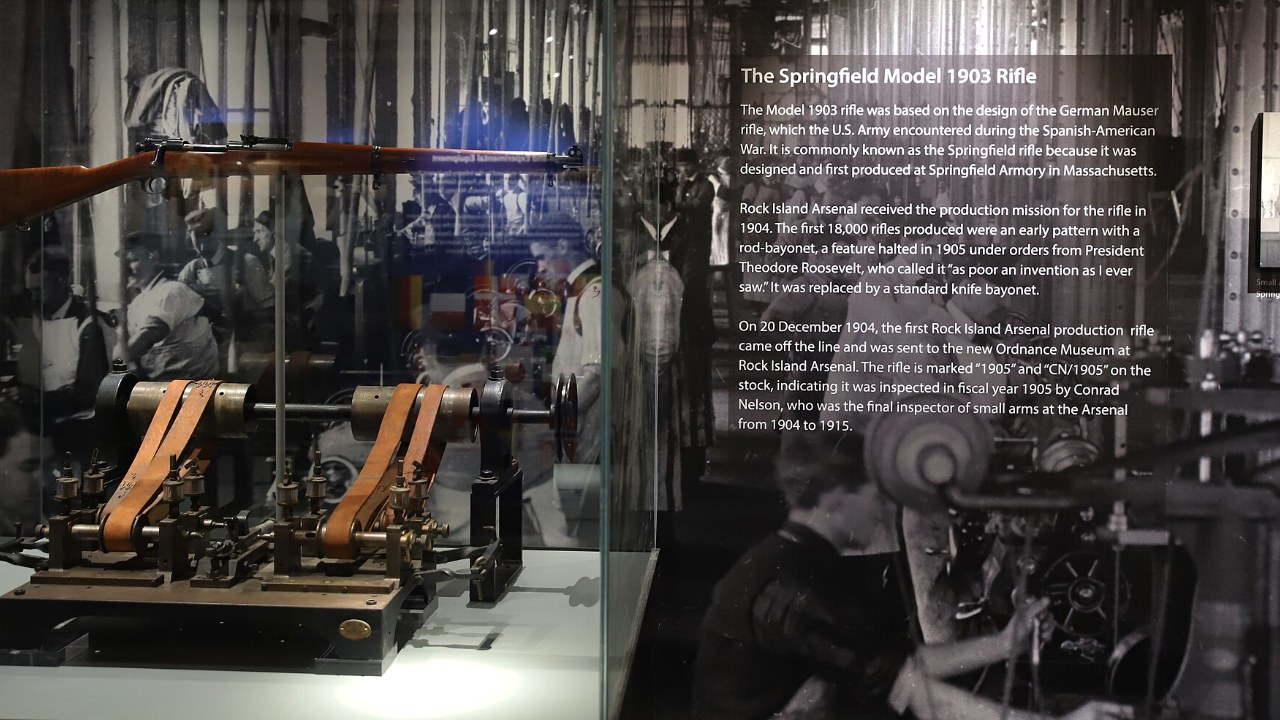
Measured against the rifle issued to Spanish soldiers in 1898, the Krag-Jorgensen carried by U.S. Army regulars came up short, and the Army set out to replace it. The answer was a new bolt-action rifle built on the German Mauser action, the M1903 Springfield, which Springfield Armory produced from 1903 to 1936. More than one million came off the Massachusetts armory’s lines in that time.
The Krag was not an old design when it was judged. It had been in production for only a few years, and it marked the Army’s move to smokeless powder and a smaller-caliber cartridge. Its shortfall showed up in the one test that counted, against another army’s rifle in the field.
The National Park Service’s history of the 1903 Springfield rifle, published by Springfield Armory National Historic Site, states the finding plainly: “The United States found that the Krag-Jorgensen rifle did not perform as well as the rifle issued to the Spanish soldiers.” The replacement, according to the site, was “based on the German Mauser action” and “became one of the most famous weapons ever produced by a national armory and remained in production for more than a third of a century.”
The Krag: the Army’s first smokeless repeater
The Krag came from Norway. The NRA National Firearms Museum’s catalog entry for a U.S. Springfield Model 1898 Krag says it was named for Norwegian Royal Artillery officer Ole Hermann Johannes Krag and civilian Erik Jorgensen, and was the first small-caliber, smokeless-powder repeating long arm the U.S. Army adopted. The museum notes it was chambered for the .30-40 (.30 Army) cartridge and used a five-shot box magazine.
The museum dates Krag production at Springfield Armory and Rock Island Arsenal from 1892, and notes the rifle first saw combat with U.S. troops in the Spanish-American War.
The Krag did not vanish overnight. Springfield Armory National Historic Site’s Krag serial-number table, which the park labels approximate and numbers by fiscal year, runs through fiscal 1904, ending at serial 477,762. Production of the old rifle overlapped with the first year of the new one.
M1900 to M1903: four models in four years
The armory’s own paper trail connects the war to the new rifle. A 2012 National Park Service finding aid for the armory’s Chief of Ordnance records, prepared by History Associates Incorporated, notes that the regular Army carried Krag-Jorgensens, “which were adopted by the U.S., and manufactured by the Armory beginning in 1892.” It then states: “Deficiencies with the Krag-Jorgensens that were noticed during the Spanish American War led directly to the development and adoption of the Model 1903.”
The NPS history traces the replacement through a run of experimental models. “The M1900 was an experimental model designed to match the performance of European weapons employed in the Spanish-American War of 1898.” Problems with the M1900 were answered in the M1901, which “incorporated an action very similar to the Mauser and used a rimless cartridge.” Only minor changes to the M1901 produced the version approved for production, the M1902.
One more change defined the final rifle. According to the park, “experiments with the M1902 determined that, with some modifications, a 24 inch barrel on the rifle was as effective as the 30 inch barrel.” The shorter barrel meant infantry and cavalry could carry the same weapon, “removing the necessity of producing two versions of the same weapon.” That rifle became the M1903.
More than a million from Springfield
Production figures come from the park. “Between 1903, when production began, and 1936, Springfield Armory turned out more than one million M1903 rifles with many modifications,” the NPS history says, adding that “an additional one-third million rifles were produced at the Rock Island Arsenal in Illinois.”
Rock Island’s share started later. An Army history of the arsenal, Arsenal of Democracy: A History of RIA from WWI to WWII, says the U.S. Army “recommended replacing the Krag rifle with a new rifle – the Springfield M1903,” and that production at the arsenal began in December 1904. By the time the United States entered World War I, according to the same account, 843,000 rifles had been produced at Rock Island and Springfield.
World War I pushed the numbers hardest. The 2012 finding aid records that when the United States entered the war in 1917, production increased again dramatically, and “the Armory produced over 265,000 bolt-action M1903 rifles for American troops during the war.” The finding aid calls the rifle “one of the most accurate weapons ever made.”
The Park Service’s summary of the Springfield ’03 rests on three words: it is “known around the world for its accuracy, reliability, and ruggedness.” The rifle that answered the Krag’s failure in 1898 stayed in production at Springfield Armory until 1936.
Top image: An M1903 Springfield rifle display at the Rock Island Arsenal Museum. Image Credit: RIAMuseum — CC BY-SA 4.0 / Wikimedia Commons
This article was produced with the assistance of AI and reviewed by Combat Rated editors prior to publication.