
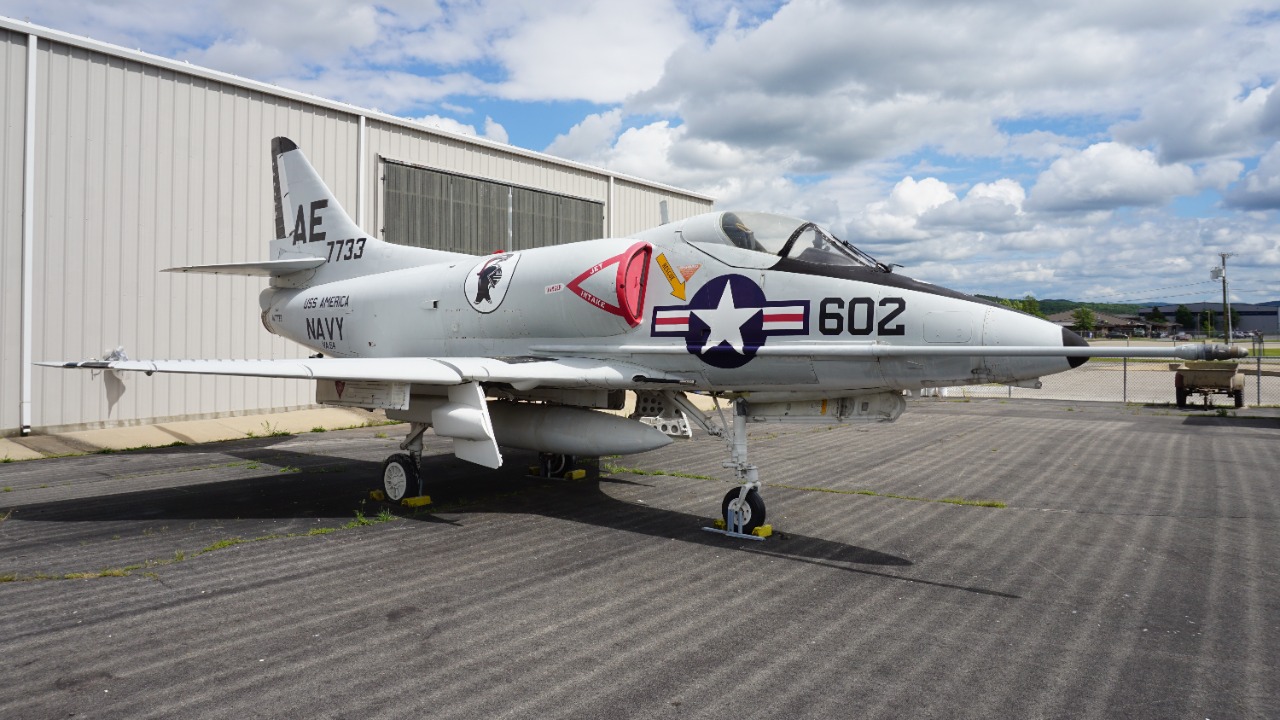
The Douglas A-4 Skyhawk was conceived as a compact attack jet for aircraft carriers, yet it went on to earn a second life as one of the most effective “enemy” aircraft in Western air combat training. Its small size, agility and rugged simplicity allowed instructors to mimic the performance and tactics of Soviet-style fighters at a fraction of the cost of flying front-line jets. That combination turned the Skyhawk into a long-running fixture of aggressor squadrons and private adversary fleets that continues to shape fighter training today.
From minimalist attack jet to ideal sparring partner
The Douglas A-4 Skyhawk began as a single-seat, subsonic, carrier-capable light attack aircraft designed to deliver conventional and nuclear weapons from U.S. Navy decks. Douglas engineers pursued an aggressively minimalist approach, producing a jet so compact that it did not need folding wings to fit on a carrier elevator, while still carrying a meaningful bomb load and retaining enough fuel for combat radius. According to technical histories of the Douglas A-4 Skyhawk, the aircraft first flew in the mid 1950s and entered U.S. Navy and Marine Corps service soon after, serving extensively as a fighter-bomber in the Cold War and in conflicts such as Vietnam.
That same design philosophy, which emphasized low weight, ease of maintenance and high agility, later made the Skyhawk a natural fit for adversary training. Analyses of the type note that the A-4 was deliberately kept small and nimble, with a tight turning radius and responsive controls that allowed it to simulate the handling of lighter, less sophisticated fighters. Reporting on the aircraft’s training role explains that these traits aligned closely with the performance envelope of expected Soviet opponents, which meant instructors could use the Skyhawk to give frontline pilots realistic dogfighting practice without exposing more advanced and expensive airframes to the wear and risk of constant close-in maneuvering.
How the Skyhawk fit the aggressor squadron revolution
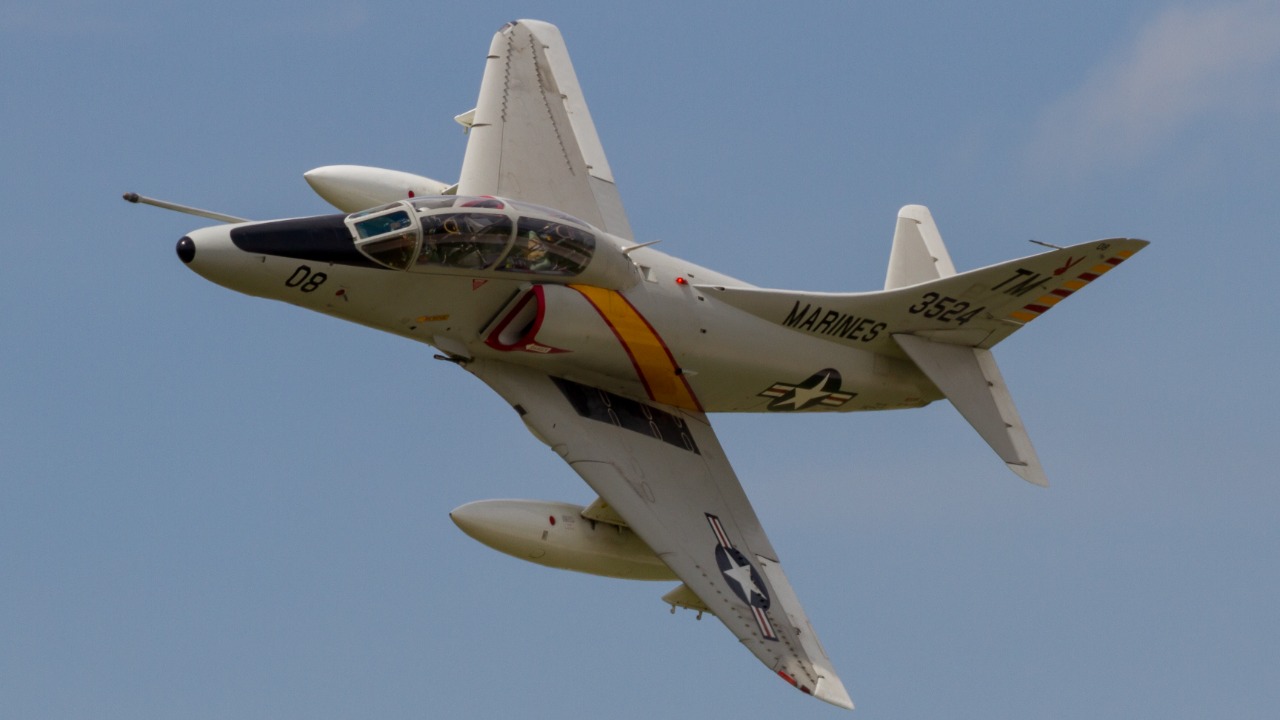
The modern concept of dedicated aggressor squadrons, which fly aircraft painted and flown as notional enemies, took shape in the late 1960s as U.S. forces sought to improve air combat performance. The United States Navy Fighter Weapons School, better known as Top Gun, was an early pioneer in formalizing the use of dissimilar aircraft to replicate adversary tactics and capabilities. Historical accounts of the aggressor squadron concept describe how instructors deliberately chose jets that differed from front-line fighters, so that trainees would confront unfamiliar silhouettes, energy profiles and maneuvering styles that resembled those of potential opponents.
Within that shift, the A-4 quickly emerged as a workhorse of Navy adversary units. The Skyhawk’s compact size and subsonic speed allowed it to stand in for older, agile fighters that relied on tight turns and low-speed handling rather than raw thrust. Analyses of its training role emphasize that the aircraft’s small radar and visual signature, combined with its ability to sustain high angles of attack, made it a credible surrogate for early-generation Soviet designs that U.S. pilots expected to face. By flying the Skyhawk aggressively in scripted scenarios, instructors could force students to refine basic dogfighting skills, energy management and situational awareness against a nimble opponent that punished mistakes.
Design traits that made the A-4 a convincing “bad guy”
Several specific features of the Skyhawk’s design helped it excel as a stand-in enemy aircraft. The jet’s small planform and relatively low weight gave it strong instantaneous turn performance and quick roll rates, which are critical in visual-range engagements. Commentaries on the Skyhawk highlight that it was “tiny but mighty,” able to carry a useful weapons load while remaining highly maneuverable, a combination that mirrored the design logic behind many Cold War fighter-bombers. In training, this allowed the A-4 to replicate the kind of quick, nose-pointing moves that pilots might encounter from smaller adversary jets, forcing them to respect its threat even if it lacked the raw speed of a modern fighter.
At the same time, the Skyhawk’s simplicity and ruggedness made it ideal for the high sortie rates required of aggressor units. Maintenance crews could turn the aircraft around quickly between missions, and its systems were robust enough to withstand repeated high-g maneuvers and hard carrier-style landings. Technical histories of the A-4 Skyhawk note that this durability contributed to a remarkably long service life, with upgraded variants continuing to fly decades after the original design. For training organizations, that longevity translated into predictable operating costs and reliable availability, both of which are essential when building complex air combat syllabi around a particular aircraft type.
Why instructors valued its strengths and limits
Naval aviators who flew the A-4 in adversary roles have been clear that the aircraft was never a perfect analog for a true air superiority fighter. One U.S. Naval Aviator, reflecting on the type, stressed that the A-4 was designed as an attack aircraft and not a fighter, with its primary strength in air-to-ground missions rather than air-to-air combat. In that account, the pilot explained that while the Skyhawk was agile enough to serve as an adversary aircraft, Its overall performance left it short of the best dedicated fighters in pure dogfighting terms.
Paradoxically, those limitations actually enhanced its value as a training tool. Because the Skyhawk could not simply out-climb or out-accelerate modern fighters, instructors had to rely on tactics, positioning and surprise, which mirrored the way real-world opponents might try to offset technological disadvantages. Analyses of its adversary role argue that this forced students to respect every opponent, even one flying an older jet, and to avoid complacency based on presumed performance gaps. By exploiting the A-4’s strengths in low-speed maneuvering and small visual profile, while accepting its lack of cutting-edge sensors or missiles, aggressor pilots could present a realistic and challenging threat that sharpened the skills of F-14, F-16 and F/A-18 crews preparing for combat.
A legacy carried on by private aggressor fleets
Even after the U.S. Navy and Marine Corps retired the A-4 from front-line service, the aircraft found a new home in civilian-operated adversary companies that contract with militaries around the world. Today, the Skyhawk in civilian hands has remained effective, with several firms holding contracts with NATO nations to provide aggressor services using upgraded A-4 variants. These aircraft often receive modern avionics, electronic warfare suites and datalink systems so they can better replicate contemporary threats while retaining the underlying airframe’s agility and low operating costs.
One prominent example is Top Aces, a company that has invested in making its Skyhawks some of the most advanced of their kind. Reporting on the firm’s fleet notes that The Skyhawk is far from new, having first taken to the air in the 1950s, yet it has developed a reputation for reliability and low cost that remains attractive for the aggressor role. More recent coverage of Top Aces’ expansion describes how the company has added an A-4N Skyhawk that previously served with the Israeli Air Force, integrating new systems that enable it to engage modern fighters in simulated air combat in the aggressor role. According to that reporting, these upgrades were demonstrated in exercises where the enhanced A-4N successfully challenged front-line jets, underscoring how a design rooted in the early Cold War still underpins sophisticated training for today’s pilots.