
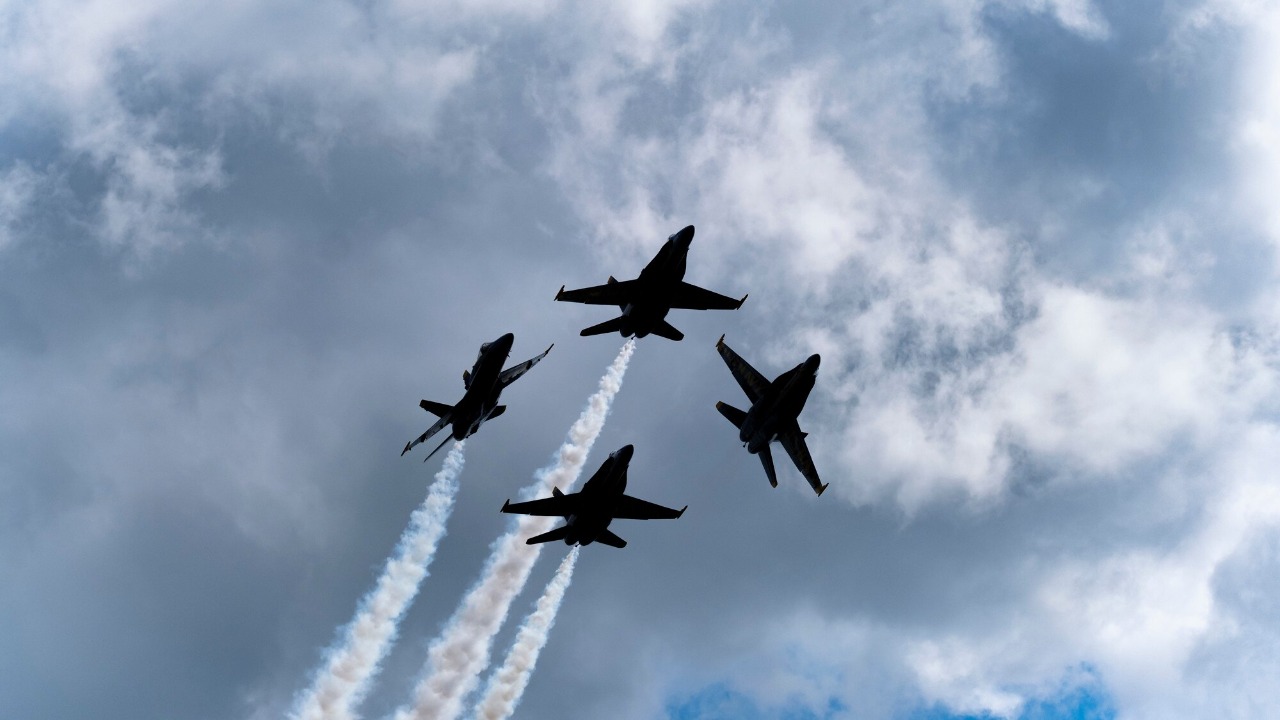
Fighter jets ripping across the sky above Washington can feel like a scene from a disaster film, yet for residents of the capital region it is increasingly part of the soundscape of modern security. The same roar that rattles windows also signals how tightly guarded the nation’s political center has become, from routine drills to rare emergencies. Understanding why those aircraft appear without warning is essential context for anyone who lives, works, or travels under this heavily managed airspace.
When I hear that sudden thunder over the Potomac, I know it can mean very different things: a carefully scripted exercise, a ceremonial flyover, or a real-world scramble in response to a threat. The pattern of activity around Washington reflects a system that is constantly balancing public reassurance, operational secrecy, and the unforgiving physics of high‑performance jets.
How Washington’s airspace became uniquely guarded
To grasp why fighter jets might streak over Washington with little notice, I start with the airspace itself, which is among the most constrained anywhere in the world. After the security overhauls that followed earlier attacks, flight paths were reshaped so that only rigorously vetted pilots can operate close to the White House and the Capitol, and even routine routes into local airports are tightly choreographed. That layered system is designed to protect the White House, the Capitol, and thousands of federal workers, but it also means any anomaly can trigger a rapid military response overhead.
Within that framework, helicopters and fixed‑wing aircraft linked to national security enjoy privileged access, which further raises the stakes when something goes wrong. Investigators examining a deadly crash over the Potomac have noted that they (Military helicopters) occupy the most tightly controlled and monitored airspace in the world, only a few miles south of the Whi, which underscores how little margin for error exists near central Washington. In that environment, a fighter jet overhead is not an improvisation, it is the visible edge of a system that is constantly scanning for anything that does not belong.
Training drills that sound like an emergency
Most of the time, the roar of jets over the capital is not a crisis but a rehearsal. At PETERSON AIR FORCE BASE, Colo, officials have described how NORAD has conducted exercise flights over West Virginia, Baltimore, Washington DC and surrounding regions to practice intercepting aircraft that stray into restricted zones or might pose an airborne terrorist threat. Those missions are deliberately flown at altitudes and speeds that give crews realistic practice, which is exactly why residents can suddenly hear and see fighters even on an otherwise quiet afternoon.
In some cases, the training is scheduled for hours when the public least expects it. Earlier this year, officials warned that for a live‑fly air defense drill called FALCON VIRGO would involve The North American Aerospace Defense Command, or NORAD, sending jets over Northern Virginia in the middle of the night, with aircraft visible from the ground. Similar notices have explained that if you are up late or an early riser, you might see or hear fighter jets over the DC region as part of a defense exercise, even though nothing unusual is happening on the ground.
Real‑world scrambles, sonic booms, and surprise flyovers
Not every roar is a drill, and the rare moments when fighters go supersonic leave a deep impression. When an unresponsive aircraft flew near Washington DC on a Sunday, US fighter jets scrambled at supersonic speed to intercept it, and the resulting Washington DC sonic boom startled residents across the region. Analysts later explained that such booms occur when an object flies faster than sound, and that the sharp crack people heard was a byproduct of the urgency to reach the unresponsive pilot before the aircraft could threaten sensitive sites.
Those shock waves are rare enough that each one becomes a case study. Coverage of that incident noted that the sonic boom was described as a rare sound with a long history in military aviation and an uncertain future as regulators weigh noise against security. There was no way that was not going to send alarmed people scurrying to windows, yet as one local analysis put it, there is a wide spectrum of reactions, from fear that something terrible has happened to pure appreciation of the display of power.
Even subsonic flights can disrupt daily life when they intersect with crowded airspace. When a small craft entered restricted DC airspace, WASHINGTON Flights at Arlington, Virginia, and Reagan National Airport for a time were affected while F‑16 jets and a Coast Guard helicopter responded. On another occasion, two F‑15 fighters under the operational control of NORAD were scrambled from Homestead AFB to investigate a potential issue, a reminder that even routine intercepts can send a sudden roar across otherwise calm neighborhoods.
Ceremonial flyovers, Air Force One, and what residents should know
Alongside drills and emergencies, Washington also hosts a steady calendar of ceremonial flyovers that can sound just as dramatic. Military flyovers involve aircraft conducting low‑altitude flights over stadiums, monuments, and parade routes, with key takeaways noting that these events both honor public occasions and provide training opportunities for pilots. In practice, that can mean a formation of jets roaring over the National Mall or a stadium in Maryland, leaving residents who were not tracking the schedule to wonder what prompted the sudden noise.
Some of the most eye‑catching displays are tied to elite demonstration teams and high‑profile flights. Residents recently traded messages about loud fighter jets only to learn that about those loud fighter jets everyone heard, it was the blue angels practicing over the city. On other days, the distinctive silhouette in the sky is Air Force One, a high‑tech, secure fortress whose defensive systems include Chaffs and other countermeasures, But the public mostly experiences it as another powerful jet circling the region. Given the density of ceremonial events, there are, after all, several reasons you might look up and see fighters or support aircraft over the Washington area on any given week.