
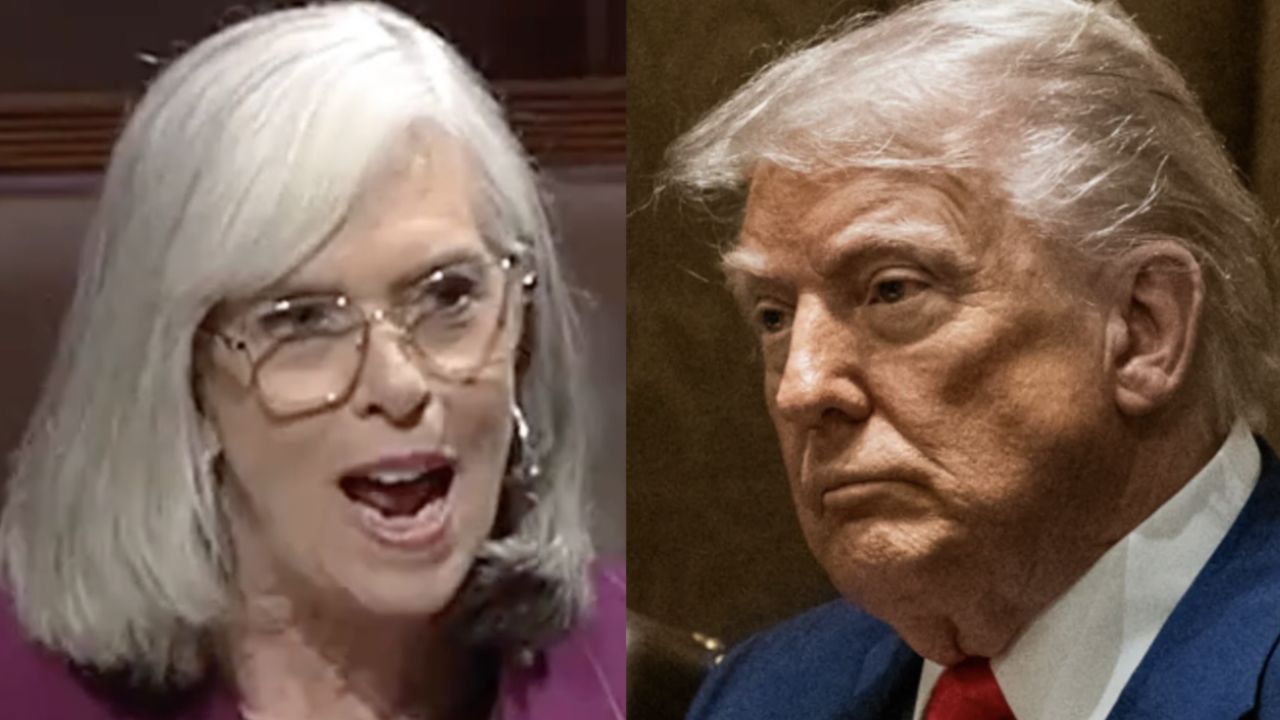
Thirty days before American voters decide control of Congress, the second-ranking House Democrat accused President Donald Trump of running a war with no exit and an economy that is failing the families paying for it. House Democratic Whip Katherine Clark (D-MA) posted a three-sentence message on X on Sunday, linking the seven-month-old U.S. war with Iran directly to rising prices at home and to the Republican Party’s standing with voters. Her post landed as the Pentagon sent a third aircraft carrier strike group toward the Middle East and Trump publicly floated renewed strikes after Election Day.
What Clark Said
Clark, who has served as House Democratic Whip since her colleagues elected her to the post in the fall of 2022, published the message at 11:56 a.m. on October 4, 2026. The full text of her post reads:
“Costs for groceries, gas, utility bills, and housing are all skyrocketing.
Trump’s reckless war continues with no end in sight.
The GOP’s economy is a massive failure.”
The post makes three claims in sequence. It first points to household costs across four categories: groceries, gas, utility bills and housing. It then ties those pressures to the Iran war, which Clark called “reckless” and open-ended. Finally, it widens the charge to the Republican economic record as a whole, a message that fits the Democratic strategy for the November 3 midterms, when every House seat is on the ballot.
How the War Began and Clark’s Early Response
The conflict traces to February 28, 2026, when U.S. forces and Israel launched strikes on Iran in an operation that CENTCOM announced as having begun with “partner forces.” Clark issued a statement the same day. “Donald Trump campaigned on the promise of ‘no new wars.’ Under the cloak of night, without congressional authorization or even a clear rationale, he broke that vow to launch a massive military operation against Iran,” she said. She added that “our Constitution is clear – the power to declare war lies with Congress,” and said that if Speaker Mike Johnson did not call the House into session, “House Democrats will force a vote.”
On March 5, House Republicans blocked passage of a bipartisan War Powers Resolution intended to halt the operation. Clark said in an official statement that “the American people need lower costs, not another endless war,” and that the conflict was “hiking gas prices by 22 cents” and had “already claimed the lives of six service members.” She accused Republicans of “allowing this reckless war to proceed without a strategy, objectives, or exit plan.”
A Spring and Summer of Cost Warnings
On March 30, Clark said in a televised interview that Trump was breaking “the three pillars of what he ran on,” starting with the promise to lower costs on day one. Citing reports of TSA agents unable to afford fuel to drive to work, she said the rise in gas prices, combined with housing, grocery and utility costs, was “a recipe for disaster.” She also warned that “we are soon going to be contending with an even higher cost of groceries as we have a fertilizer crisis also brewing in the Strait of Hormuz.”
On June 18, after Trump announced a deal to end the fighting, Clark struck a harsher tone. “Donald Trump lost a reckless war that he started, and the American people are paying the price,” she said, adding that “thirteen service members have lost their lives, and hundreds more are injured.” She criticized the agreement for lifting sanctions on Iranian oil sales and said it left “uncertainty around the future of shipping through the Strait of Hormuz.” She closed with a midterm message: “Democrats are ready to win back the House, lower costs, and be a check on this out-of-control administration.”
Talks Collapse as the Midterms Approach
The June agreement did not hold. Iranian Foreign Minister Abbas Araghchi has said the memorandum of understanding reached between the two countries in June “quickly unraveled.” On August 1, Trump wrote in a social media post that allied mediators had reached the parameters of a new deal that “would include the Immediate, Complete, and Total OPENING OF THE HORMUZ STRAIT, and an end to Iran’s nuclear threat.” He had announced halts to strikes on several earlier occasions. The strait, through which roughly one-fifth of the world’s oil normally passes, remains disrupted.
On September 26, after a three-hour meeting between U.S. and Iranian officials on the sidelines of the U.N. General Assembly, Trump said he had turned down Iran’s latest seven-point proposal to reopen the strait and restart nuclear talks. “They made a proposal, but I rejected it,” he told reporters. U.S. officials have said Trump privately expects the bombing campaign to resume after the November elections.
In recent public remarks, Trump has repeatedly addressed the political calendar. Describing Iran’s negotiating posture, he said: “They thought they were going to outwait me, you know, ‘we’ll outwait him, he’s got the midterms.’ I don’t care about the midterms.” In a separate television interview in early September, he said: “Midterms have nothing to do with my thinking.” This past week, he said Iran’s leadership “is ready to fold up” and that he believed the U.S. would win the war “right after the election,” if not before.
Military Buildup Continues in the Gulf
The military posture has grown rather than shrunk. The United States is sending a third carrier strike group, led by USS Theodore Roosevelt, along with the Makin Island amphibious group, to the Middle East. A U.S. official has said the forces could arrive by the end of October. Iran, for its part, has hardened its stance: on Sunday, Iranian parliament speaker and chief negotiator Mohammad Bagher Ghalibaf said the Strait of Hormuz will remain closed until Washington accepts Tehran’s seven-day plan, and Araghchi warned that Iran is “more prepared than before” should the U.S. strike again.
The Price Data Behind Clark’s Warning
Federal statistics show the cost pressures Clark described. The Bureau of Labor Statistics reported that the Consumer Price Index rose 3.4 percent over the 12 months ending in August and that the energy index climbed 16.3 percent over the same period. Food prices rose 2.7 percent over the year, with food at home up 2.2 percent. The bureau’s next CPI release, covering September, is scheduled for October 14, three weeks before Election Day.
Gasoline, the cost Clark has cited most often since March, remains well above year-ago levels. The Energy Information Administration reported the national average for regular gasoline at $4.319 a gallon on September 14, up $1.151 from a year earlier and 16 cents higher than the prior week. West Coast prices topped $5.46 a gallon, and California averaged $5.827.
What It Means for the Midterms
The politics have moved in Democrats’ direction. Polymarket currently puts the odds of Democrats winning the House at 93 percent, a figure that reflects the combined weight of inflation, the war and the president’s standing. Clark has been building toward that argument for more than a year. After House Republicans passed their tax and spending law in July 2025, she pledged that “House Democrats will spend every day of the next 16 months making sure moms, dads, seniors, and veterans know that Republicans took away their health care, raised their energy bills, and hiked their grocery costs.” The 16-month window she described closes on November 3.
Clark’s Sunday post compresses that message into a few sentences, and the facts around it are still moving. Iran’s strait closure, a third carrier group heading to the region, a Trump timeline that runs through the election, and a September inflation report due October 14 all land within the next 30 days. Whether the war and prices stay in the spotlight or are overtaken by other events, Democrats’ case, as Clark has framed it since February 28, is that the two are the same story, and that the people paying for it will vote on November 3.