
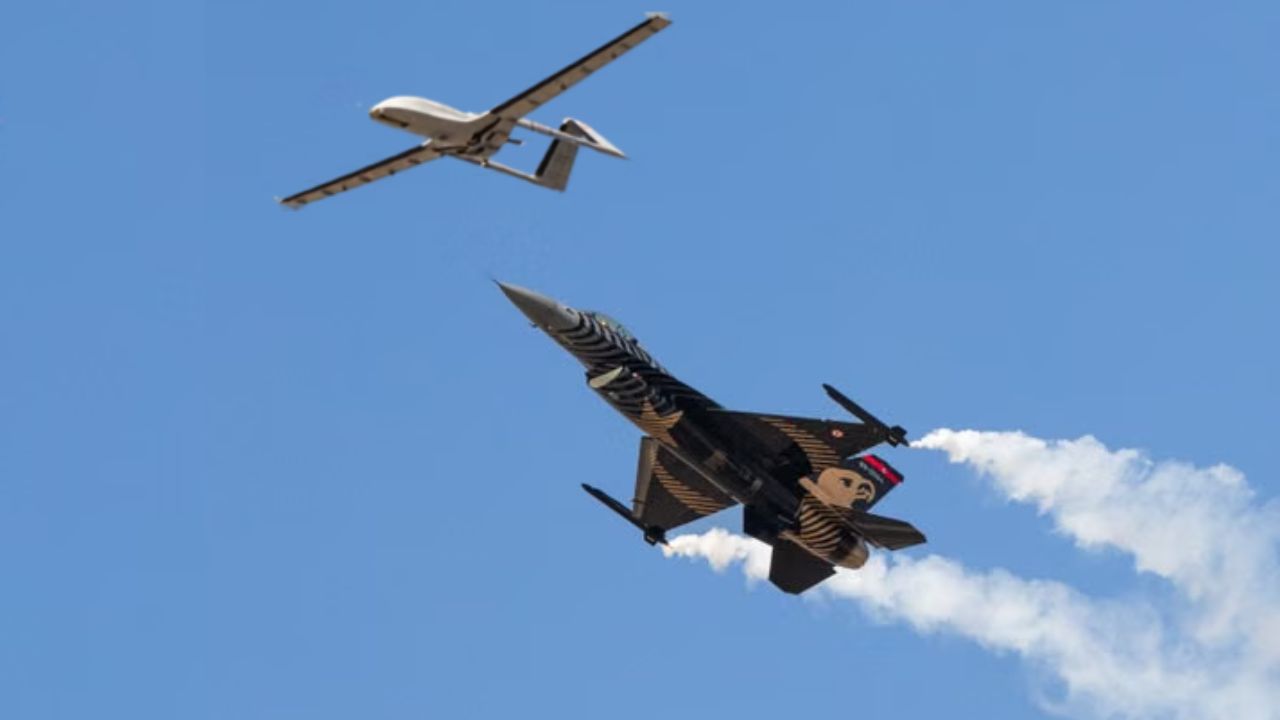
The next era of air combat is increasingly being planned around a concept that once sounded like science fiction: one crewed fighter operating alongside several AI-enabled “loyal wingman” drones. In U.S. terminology, these aircraft are often discussed as Collaborative Combat Aircraft (CCA) tied to broader Next Generation Air Dominance (NGAD) thinking, with related manned–unmanned teaming (MUM‑T) concepts also showing up in U.S. Navy discussions about future carrier air wings. The underlying shift is from “one aircraft, one pilot, one set of sensors and weapons” toward formations built as cooperating networks.
This is not a sudden jump to fully autonomous dogfights. The more realistic near-term goal is to add combat mass, widen sensor coverage, and complicate enemy targeting without requiring a pilot in every additional aircraft. The most important changes may be in how sorties are planned, controlled, sustained, and governed once uncrewed systems become routine members of the formation.
What changes in the sortie: one pilot, multiple aircraft
The operational picture many air forces are working toward is simple in outline: a crewed fighter launches as the command node for a small “pack” of semi-autonomous uncrewed aircraft. Those drones could be tasked to scout ahead, expand sensor coverage, jam or deceive enemy radars, act as decoys, or carry extra weapons so the crewed platform can preserve its own magazine or operate farther from the highest-threat areas. The pilot’s role shifts toward mission command—setting priorities, managing effects, and making rules-of-engagement decisions—rather than personally “flying” every element of the formation.
That shift drives cockpit workload and cockpit design as much as it drives tactics. If one pilot is expected to direct multiple uncrewed wingmen while also surviving in contested airspace, the interface cannot resemble traditional remote piloting. It has to support intent-based control: issuing tasks, constraints, and priorities, while letting onboard autonomy handle routine behaviors such as route management, basic formation keeping, sensor search patterns, and deconfliction. In most concepts, authority over weapons employment and escalation decisions remains with the human.
Who’s involved: U.S. momentum, allied parallels, and opaque competitors
The United States has been the most explicit about integrating loyal wingman-style aircraft into future fighter modernization. Public discussion commonly places the U.S. Air Force—particularly Air Combat Command—at the center of gravity for NGAD/CCA experimentation and planning. The U.S. Navy’s interest in manned–unmanned teaming for carrier air wings reflects similar logic: more distributed sensing and striking power without proportionally increasing the number of pilots exposed to the highest-risk parts of the battlespace. Specific airframes and procurement outcomes remain difficult to pin down from open information as programs and competitive efforts evolve.
Allied efforts point in the same direction. Australia has been closely linked in public reporting with Boeing’s MQ‑28 Ghost Bat as a prominent loyal wingman-style platform. European next-generation air combat initiatives, often discussed under FCAS/SCAF and GCAP, also emphasize a family-of-systems approach in which crewed fighters operate alongside uncrewed teammates, even if details differ and are not uniformly public.
Peer competitors are widely assumed to be pursuing comparable ideas, but transparency varies. Public information about Chinese and Russian analogs is less clear, and definitive claims about who is “ahead” are hard to support from verifiable data. The safer takeaway is that this is becoming an arms-race category—and that decisive advantage may come from software maturity, electronic-warfare resilience, and production capacity as much as from any single prototype.
Why it matters: combat mass, survivability, and the cost-exchange problem
Loyal wingman concepts aim to put more “useful capability” into contested airspace: more sensors, more jamming, more decoys, and more weapons carriage. For an adversary, that means more targets to detect, track, and classify—and more uncertainty about which platform is carrying the key sensor, the key weapon, or the key decision-maker. Even without assuming perfect performance, distributing roles across multiple cooperating aircraft can force inefficient defensive choices and buy survivability for the crewed platform, which is typically the most expensive and politically sensitive asset.
These concepts are often linked to a cost-exchange argument: if some uncrewed platforms are cheaper or “attritable,” commanders may be more willing to risk them to protect higher-value aircraft and pilots. But “attritable” does not mean “disposable,” and losses at scale still degrade inventories, readiness, and operational tempo. Unit price matters, but so does the ability to produce replacements and keep mission systems available.
That makes industrial capacity and sustainment part of the operational equation. A force built around distributed attrition only works if it can regenerate combat power fast enough. If production is slow or supply chains are brittle, the concept can look strong in demonstrations but prove hard to sustain in a prolonged fight.
The hard technical problem: contested networks and “degraded operations”
The central challenge is not simply building an unmanned aircraft that can fly. It is keeping a team effective when communications are jammed, intercepted, spoofed, or lost at the worst possible time. Human–machine teaming in air combat is fundamentally a command-and-control problem: who knows what, when, and with what confidence—and what the formation is allowed to do when those assumptions fail.
Autonomy levels matter because they determine how much the system depends on a clean, high-bandwidth link. Assistive autonomy can handle navigation, spacing, deconfliction, sensor management, and basic threat reactions, reducing both bandwidth demand and pilot workload. Pushing further—expecting drones to make consequential choices under link loss or high latency—runs into hard constraints around rules of engagement, identification, fratricide risk, and accountability, especially when weapons are involved.
This is why many designs emphasize “degraded operations,” where drones can remain useful with limited connectivity. Pre-briefed behaviors, mission-type orders, and onboard sensor fusion can allow an uncrewed aircraft to continue scouting, jamming, or acting as a decoy without constant human inputs. The balancing act is ensuring enough autonomy to fight through disruption while preserving human judgment where policy and law demand it.
Doctrine and training: the pilot as mission commander
Human–machine teaming pushes airpower doctrine toward distributed formations and “mosaic” kill chains: multiple platforms contributing pieces of the detect-to-engage sequence rather than relying on one exquisite aircraft to do everything. A team can be built with complementary roles—one aircraft focused on sensing, another on electronic attack, another on weapons carriage—while the crewed fighter orchestrates and provides oversight. Done well, this can add flexibility and reduce predictability, because the formation can adapt as priorities change or as aircraft are lost or degraded.
The tradeoff is cognitive load. Pilots must learn how to command effects, validate targeting information, manage uncertainty, and avoid information overload in a cockpit already saturated with data. The job becomes closer to tactical C2 under fire: making time-critical decisions while supervising automation whose internal logic may not be fully visible in the moment.
Integration also brings practical hazards that cannot be waved away. Airspace deconfliction, positive identification, and the risk of friendly interference become harder when multiple platforms are emitting, jamming, and sharing data in the same volume of sky. Even if the drones are capable on their own, integrating them into existing aircraft, tactics, and ROE will take time, experimentation, and iterative redesign. For that reason, it is premature to frame this as drones “replacing” pilots; in many concepts, the crewed platform remains the accountability anchor and the flexible decision-maker.
Readiness, basing, and sustainment: the enabling constraints
Loyal wingman forces will ultimately be judged by sortie generation. If the concept depends on launching a crewed aircraft with multiple uncrewed teammates, then maintenance capacity, spares, and mission-system availability must scale accordingly. Otherwise, commanders will routinely face formations that are smaller than planned because uncrewed aircraft are down for repairs or missing required payloads.
Basing concepts may shift as well. Dispersing aircraft across more locations, operating with smaller footprints, and generating sorties rapidly can complicate adversary targeting—but only if logistics, security, and communications can keep pace under cyber and electronic attack. Smaller platforms may ease some requirements, yet they also multiply the number of air vehicles to fuel, arm, repair, and protect.
Underlying all of this is the ability to update and harden software quickly and securely. In a competition where electronic resilience and autonomy behavior matter as much as aerodynamic performance, a force that cannot patch, reconfigure, and validate its systems at speed risks being out-adapted even with impressive hardware.
Policy and ethics: speed-of-war meets “meaningful human control”
Loyal wingman operations also force a clearer answer to a longstanding question: what does “human authorization” mean when engagements compress into seconds? Many concepts assume the human retains final authority for lethal force, but the meaning of “meaningful human control” can vary across countries and scenarios. As systems are asked to do more under degraded communications, debates over accountability, legality, and trust become sharper—especially if autonomy touches target selection, identification, or engagement decisions.
That tension is unlikely to be resolved by broad statements. It will be addressed, if at all, through specific ROE design, auditability of autonomous behaviors, and clear command responsibility when a machine behaves unexpectedly. Modern air combat pushes toward delegation to automation for speed; political and legal constraints push back toward human control.
Future air wars, then, may look less like isolated duels between individual fighters and more like fast-moving, contested networks of crewed and uncrewed aircraft trading sensing, jamming, decoying, and weapons effects. Success is unlikely to hinge on the sleekest drone alone. It will depend on keeping teams functional when links are disrupted, generating enough ready aircraft to create mass, and fielding autonomy that pilots, commanders, and policymakers trust when the battlespace is at its most uncertain.