
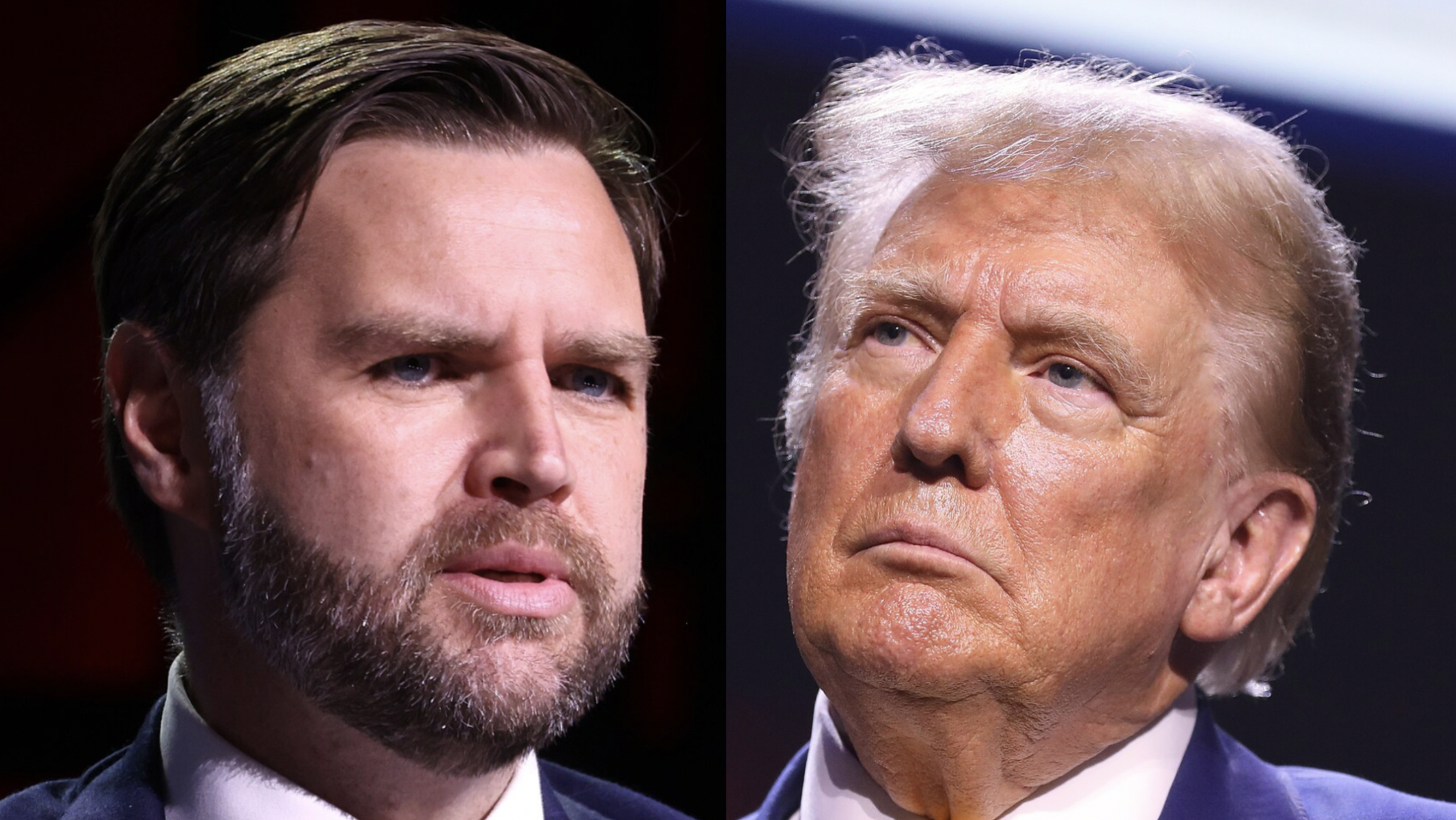
President Trump and Vice President JD Vance on Monday touted Iran’s agreement to allow International Atomic Energy Agency inspectors back into the country as a defining achievement of the first round of technical talks in Switzerland, with Trump declaring on social media that the move would ensure “Nuclear Honesty” from a regime that much of Washington has long viewed with deep distrust.
Vance, speaking to reporters at the Bürgenstock Resort following the conclusion of the negotiating session, identified the inspection agreement as the accomplishment American officials were most eager to highlight. “Number three, and this is probably what we’re most excited about as Americans, the Iranians have agreed to invite IAEA inspectors back into their country,” Vance said. “That is a major milestone for the American people and the first step in permanently denuclearizing or permanently ending a nuclear weapons program in Iran. And that’s exactly what we wanted to do. That’s exactly what we asked to happen. We made a lot of great progress on other nuclear talks.”
Vance tied the inspection commitment directly to the next phase of negotiations, describing it as the foundation for a longer technical process that will continue without him once he departs Switzerland. “That leads me to the final thing that we wanted to accomplish which is actually set up the process for the technical negotiations that will follow,” he said. “Our teams working with the Iranians, the Qataris and the Pakistanis made great progress yesterday. They will continue to work at the technical level with the teams here in Bergensstock. And then those technical negotiations are going to continue over the weeks and days to come.”
He added that the structure was designed to maintain political accountability even after the senior delegations disperse. “We wanted to set up a structure for that so that you could have proper political oversight,” Vance said. “But obviously, as much as this place is very beautiful, I can’t stay here for the next 60 days. I’m about to go back home to the United States. But the technical teams are going to be working with proper oversight to make sure that we’re accomplishing the objectives that matter for everybody.”
Pressed by reporters on the timeline for the inspectors’ return, Vance offered a candid, if informal, account of the overnight diplomacy required to set the visit in motion. “It’s funny. We were trying to call some of the inspectors last night around 2:00 in the morning. As you can expect, not many people were answering their phone at 2:00 in the morning,” he said. “I expect that will happen at the minimum this week, but we think even some of those conversations with the inspectors and with the IAEA could happen as soon as today, but I haven’t checked in with our team since we made that 2 a.m. phone call to some of those inspectors.”
Trump reinforced the announcement hours later in a post on Truth Social, framing the inspection commitment as proof that Iran’s nuclear activities would now be subject to outside verification. “Everybody is fully aware that Iran will agree to have Major Weapons Inspections in order to ensure ‘Nuclear Honesty’ long into the future,” Trump wrote shortly before noon on Monday.
The announcement carries particular weight given the trajectory of Iran’s relationship with the IAEA over the past year. Following U.S. and Israeli strikes on Iranian nuclear facilities in 2025, Tehran’s parliament passed legislation suspending cooperation with the agency, and IAEA inspectors were withdrawn from the country shortly afterward. Iran’s foreign ministry confirmed at the time that no IAEA inspectors remained on Iranian soil, and the agency’s Board of Governors has since adopted multiple resolutions urging Tehran to resume full cooperation, including one as recently as June 10. For an administration that has consistently emphasized verification as central to any nuclear agreement, restoring that access marks a significant, if preliminary, step.
The announcement was not entirely uncontested. Iranian officials disputed the characterization of the commitment in the hours following Vance’s remarks, with Tehran maintaining that it had not made any new nuclear-related commitments during the Bürgenstock talks beyond what had already been agreed. Vance, for his part, did not specify what level of access the inspectors would be granted once they arrive, and acknowledged that coordination between Iran, the United States and the IAEA over the timing and scope of any visit was still underway as of Monday.
The inspection commitment was one of four outcomes Vance attributed to the Bürgenstock round, alongside progress on reopening the Strait of Hormuz, the establishment of a Lebanon ceasefire deconfliction mechanism, and the creation of a structure for follow-on technical negotiations. Under the framework laid out in the Islamabad Memorandum of Understanding signed last week, the disposition of Iran’s stockpiled enriched uranium is to be resolved through a mechanism still to be mutually agreed upon, with a minimum standard requiring the material to be down-blended on-site under IAEA supervision — a process that would depend directly on the kind of inspector access Vance and Trump described on Monday.
Qatar and Pakistan, which mediated the Bürgenstock talks, said in a joint statement that the U.S. and Iranian delegations agreed to establish a dedicated committee to address nuclear monitoring and sanctions issues going forward, alongside the broader 60-day road map for reaching a final agreement. Whether that committee’s work translates into the kind of sustained, verifiable inspection regime Trump described as ensuring “Nuclear Honesty” is expected to be one of the central questions facing negotiators as technical talks continue in the weeks ahead.