
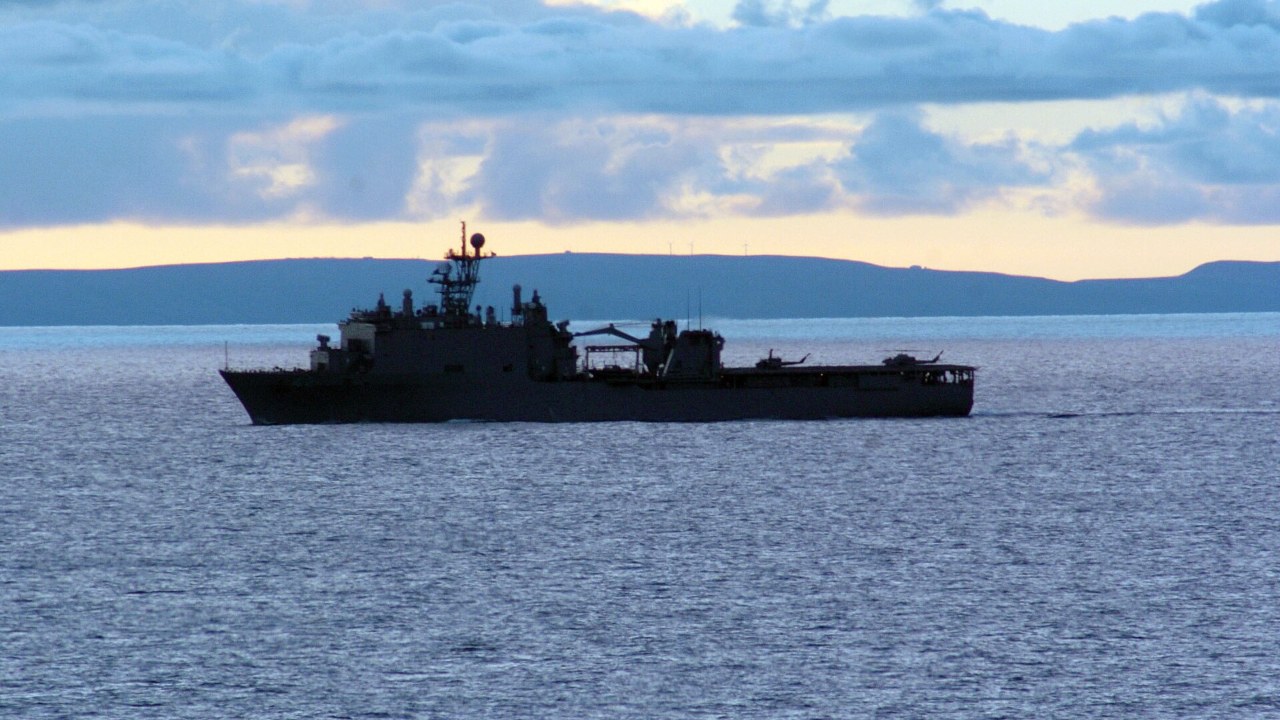
Naval Base San Diego was USS Germantown’s first homeport, and on Sept. 24, 2026, it was where the dock landing ship left the fleet. The Whidbey Island-class ship, hull number LSD 42, was decommissioned there after more than 40 years of service.
Germantown’s place in amphibious history rests on a single distinction: she was the first dock landing ship to conduct Landing Craft Air Cushion operations, the hovercraft that carry Marines and their heavy gear from ship to shore. She was commissioned on Feb. 8, 1986, and her record runs from Desert Storm to Operation Enduring Freedom, with three major disaster-relief missions along the way.
The Navy’s decommissioning release, datelined San Diego on Sept. 24, 2026 and distributed via DVIDS, describes Germantown as “the first dock landing ship to conduct Landing Craft Air Cushion amphibious operations.” It records that the ship was built by Lockheed Shipbuilding in Seattle, christened June 29, 1984, with Barbara Kelly as sponsor, and commissioned Feb. 8, 1986. She carried a crew of 22 officers and 391 enlisted Sailors, with room for a Marine detachment of 402 and surge capacity for 102 more, according to the release.
“A warship is nothing without the warfighters who walk their decks.” — Cmdr. Benjamin C. Pearlswig, Germantown’s final commanding officer
The hovercraft that changed the well deck
The LCAC and Germantown entered the fleet nearly side by side. The Navy’s Landing Craft, Air Cushion fact file states that “The first LCAC was delivered to the Navy in 1984 and initial operational capability (IOC) was achieved in 1986,” and that “LCAC first deployed in 1987 aboard USS Germantown (LSD 42).”
The same fact file describes the LCAC as an “air cushion vehicle for transporting, ship-to-shore and across the beach, personnel, weapons, equipment, and cargo of the assault elements of the Marine Air-Ground Task Force.” It lists a 60-75 ton payload, a speed of 40-plus knots with a full load, a range of 200 miles at 35 knots with a 50-ton payload, and a crew of five. The craft does not stop at the waterline; it carries its load across the beach itself.
The ship was designed around that mission. The Navy’s dock landing ship fact file says these vessels “support amphibious operations including landings via Landing Craft, Air Cushion (LCAC), conventional landing craft and helicopters, onto hostile shores.” It credits the Whidbey Island class with the largest capacity for those landing craft of any U.S. Navy amphibious platform, and lists the class at 609 feet long and 15,939 tons at full load.
Sasebo, Desert Storm and three disasters
Germantown’s career ran from San Diego to forward deployment in Sasebo, Japan, per the Navy release. Her operational record includes Desert Shield, Desert Storm, Operation Iraqi Freedom and Operation Enduring Freedom.
Disaster response filled the gaps between deployments. USNI News reported on Oct. 1, 2026 that Germantown carried out humanitarian and disaster-relief missions after the 1991 eruption of Mount Pinatubo in the Philippines, the 2004 Indian Ocean tsunami, and the 2011 earthquake and tsunami in Japan as part of Operation Tomodachi. The same report placed her retirement within a single week that also saw the cruisers USS Lake Erie and USS Shiloh decommissioned.
The release lists the ship’s honors as two Navy Unit Commendations, three Navy Meritorious Unit Commendations and six Battle “E” awards.
A name from Oct. 4, 1777
The ship took her name from the Battle of Germantown, fought on Oct. 4, 1777, according to the Navy release. The National Park Service’s history of the Philadelphia Campaign of 1777 records that Washington, having lost Philadelphia, “launched a surprise attack against their main outpost at Germantown,” and that “dense fog, miscommunication, and stiff resistance at the Chew House, allowed the British to regroup and counterattack.” The battle’s 249th anniversary fell on Oct. 4, 2026, 10 days after the ship that carried its name was retired.
Brig. Gen. Samuel L. Meyer, director of expeditionary warfare, was guest speaker at the ceremony. “Because of what this crew has done, they are setting the example of what defending the nation in the future looks like,” Meyer said, according to the release.
With the Sept. 24 ceremony, Germantown’s 40-year record is closed. The ship that took the first LCAC on deployment in 1987 now leaves the well-deck mission to the rest of the amphibious fleet.
Top image: The dock landing ship USS Germantown (LSD 42) underway off Southern California in 2005. Image Credit: U.S. Navy photo by Photographer’s Mate 2nd Class Regina L. Brown — Public domain / Wikimedia Commons
This article was produced with the assistance of AI and reviewed by Combat Rated editors prior to publication.