
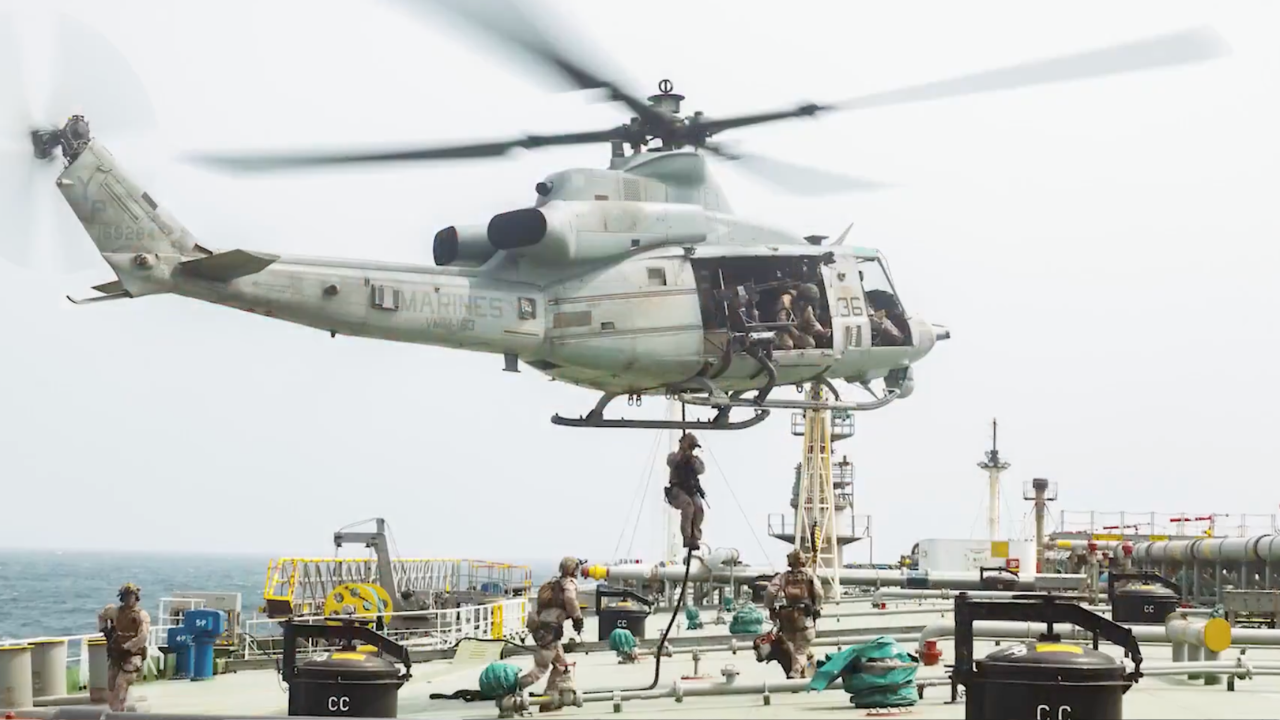
U.S. Marines from the 11th Marine Expeditionary Unit conducted a verification boarding of the tanker M/T Wen Yao in the Gulf of Oman Wednesday as CENTCOM reported the first results of the reimposed naval blockade against Iran — three commercial vessels redirected, one disabled for non-compliance and one boarded for verification since the blockade resumed on July 14.
“U.S. Marines from the 11th Marine Expeditionary Unit conduct a verification boarding aboard M/T Wen Yao in the Gulf of Oman, July 16,” CENTCOM announced on X. “As of today, American forces have redirected 3 commercial vessels trying to run the blockade, disabled 1 that didn’t comply, and boarded 1 to ensure full compliance with the ongoing U.S. naval blockade against Iran. The Strait of Hormuz and the surrounding waters remain free and open, except for vessels attempting to violate America’s steel wall blockade.”
The reimposed blockade took effect at 4 p.m. ET on July 14 at the direction of President Trump, according to the official CENTCOM press release announcing the resumption. The blockade targets all maritime traffic entering or exiting Iranian ports and coastal areas, while allowing commercial vessels of all other nations to transit the strait freely.
How the Blockade Works
Under the current enforcement framework, U.S. naval and Marine forces use a layered approach. Aircraft and warships identify vessels approaching Iranian waters and issue warnings through international maritime channels. Vessels that comply are redirected away from Iranian ports. Those that ignore warnings are boarded by Marine teams for verification of cargo and destination. Those that actively attempt to breach the blockade and refuse to comply can have their propulsion systems disabled, stranding them in international waters until they agree to divert.
The boarding of M/T Wen Yao Wednesday was a verification boarding — meaning the vessel was not attempting to run the blockade but was being checked to confirm full compliance with the blockade’s terms. Marines from the 11th MEU, embarked aboard the USS Boxer in the Gulf of Oman, conducted the operation. The 11th MEU is one of two Marine Expeditionary Units currently deployed in the CENTCOM area of operations alongside the 31st MEU embarked on USS Tripoli, giving CENTCOM approximately 7,000 Marines available for blockade enforcement and other operations in the theater, per CENTCOM public releases.
What the First Blockade Achieved
The current blockade is the second phase of naval enforcement against Iran in 2026. The first blockade ran from April 13 to June 18 — 66 days — before being lifted as part of the Islamabad Memorandum of Understanding ceasefire agreement. During that initial phase, CENTCOM reported that American forces redirected more than 140 compliant vessels, disabled nine non-compliant ships and allowed more than 50 humanitarian aid vessels to pass through without obstruction. The blockade significantly curtailed Iran’s oil export revenue during that period, according to shipping industry analysts.
The ceasefire that ended the first blockade was intended to lead to a negotiated resolution of the Iran nuclear standoff within 60 days. Instead it collapsed after 21 days when Iran attacked three commercial vessels — the Marshall Islands-flagged M/T Al Rekayyat, Saudi Arabia-flagged M/T Wedyan and Liberian-flagged M/T Cyprus Prosperity — and CENTCOM launched retaliatory strikes. Trump declared the ceasefire “over” at the NATO summit in Ankara on July 8.
What Iran Is Saying
Iran has declared the U.S. blockade illegal and vowed to respond. Iran’s Persian Gulf Strait Authority declared the Strait “unfeasible” for transit following the blockade’s reimposition and Iran’s Foreign Minister Abbas Araghchi accused the U.S. of violating the MOU’s terms. IRGC Commander Hossein Mohebbi said Iran continues to “assert our authority and control over the Strait of Hormuz with strength and power,” per prior CENTCOM and State Department reporting.
Iran has responded to resumed U.S. strikes with drone and missile attacks on U.S. bases in Kuwait, Bahrain and Jordan. CENTCOM has confirmed Iranian strikes on Ali Salem Airbase in Kuwait and U.S. infrastructure in Bahrain in the most recent exchange, with Jordan’s military confirming it intercepted four Iranian missiles that entered Jordanian airspace, according to CENTCOM’s official press releases on the strikes.
The Economic Stakes of the Blockade
The Strait of Hormuz carries approximately 20 percent of the world’s oil supply. Iran’s primary oil export terminal at Kharg Island handles roughly 90 percent of the country’s petroleum exports and sits inside the blockade zone. A sustained second blockade phase that replicates the first phase’s effectiveness would significantly further degrade Iran’s oil revenue — its primary source of government financing and the economic foundation for its military and proxy network.
Trump told reporters in France on June 17, when signing the now-collapsed ceasefire, that part of his motivation for the deal was that global oil reserves were running dangerously low. “We run out of reserves at about four weeks,” he said. “You know, there are reserves all over the world, and we would really run out.” With the blockade now reimposed, oil prices have again surged — Brent crude held above $84 a barrel as of Wednesday — raising renewed concerns about global energy stability if the blockade extends through August and beyond.
Congressional Reaction
The reimposed blockade has drawn sharp Democratic criticism, with multiple senators arguing that both the original blockade and its resumption constitute acts of war requiring congressional authorization. Sen. Chris Van Hollen called the resumed conflict a “forever war” and demanded Trump end it. Sen. Bernie Sanders has introduced a War Powers Resolution to force a withdrawal of U.S. forces. Rep. Ted Lieu called reports of Trump considering ground operations to seize Iranian islands “INSANITY” and said it would be “a forever war to hold Iranian islands,” per his X post Wednesday.
CENTCOM’s Wednesday update — three redirected, one disabled, one boarded in the blockade’s first two days — suggests enforcement is proceeding more cautiously than in the first phase, when vessels were disabled at a higher rate early in the operation. Whether the measured early pace reflects a deliberate enforcement strategy or simply the reduced volume of vessels attempting to breach the blockade in its opening days is not yet clear from CENTCOM’s public reporting.