
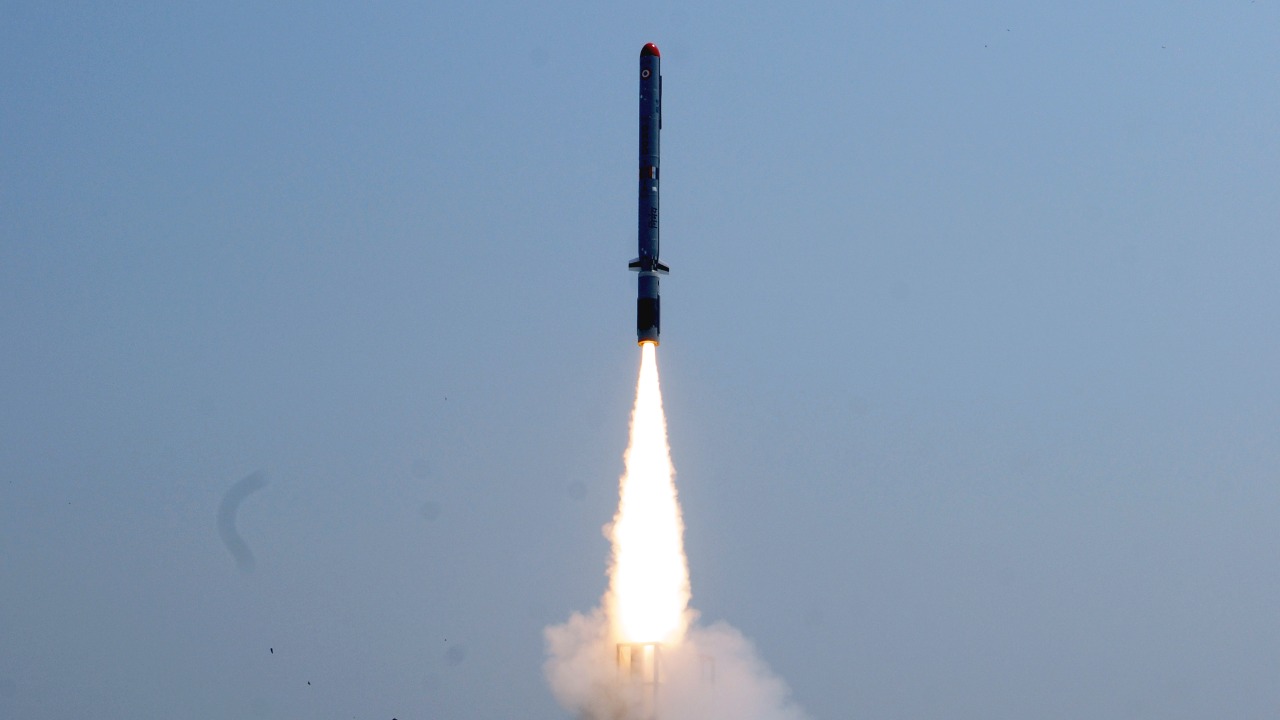
The United States Air Force has moved its newest low-cost cruise missile from concept to combat-ready hardware in remarkably short order. A live warhead trial of the Extended Range Attack Munition, better known by its Rusty Dagger moniker, has shown that a budget standoff weapon can still deliver precise, long-range effects. The demonstration caps a rapid development sprint and signals a broader shift in how the service plans to generate firepower at scale.
Behind the test lies a strategic bet that quantity, adaptability, and price will matter as much as exquisite performance in future conflicts. Rusty Dagger is designed to be bought in large numbers, integrated quickly on existing aircraft, and exported to partners facing immediate threats. Its emergence, and the foreign military sales already tied to it, suggest that affordable cruise missiles are moving from experiment to centerpiece in U.S. and allied strike planning.
Live fire proof at Eglin
The United States Air Force validated Rusty Dagger in a live fire event that paired operational realism with technical ambition. During a demonstration at the Egli test range, the service conducted a live warhead shot of the Extended Range Attack Munition, confirming that the weapon could survive launch, navigate to its aim point, and detonate as designed with a full combat load. The trial, carried out by the United States Air Force, underscored how quickly the program has moved from early prototyping to realistic testing in under two years, a pace that would have been unthinkable for legacy cruise missile efforts.
Service officials framed the event as more than a technical box check. They described how the successful shot demonstrated Rusty Dagger’s mature, next-generation, affordable long-range strike capabilities and highlighted that magazine depth and sustainment are now treated as critical design parameters rather than afterthoughts. The live warhead impact, cited in Air Force accounts of the Extended Range Attack event at Eglin Air Force Base, Florida, showed that the missile can deliver a meaningful blast and fragmentation effect at range while still fitting into a compact, low-cost package.
Designing for range, mass, and affordability
Rusty Dagger’s technical profile reflects a deliberate trade between raw performance and productivity. The missile, part of the ERAM family, is understood to have a range of between 150 and 280 miles, placing it firmly in the standoff category while remaining smaller and cheaper than premium stealth cruise missiles. It sits in the 500-pound class and carries a blast and fragmentation warhead with some degree of penetrating capability, giving it enough punch for hardened or high-value targets without driving up size and cost. That balance is central to the Air Force’s concept of “affordable mass,” which prizes the ability to saturate defenses with many shots rather than rely on a handful of exquisite weapons.
The industrial approach mirrors that philosophy. Rusty Dagger from Zone 5 Technologies, RAACM from CoAspire, and the Barracuda 500 from Anduril have all been funded by the US Air Force to expand missile production to enable what program advocates call affordable mass, a point highlighted in an update that lists Rusty Dagger alongside its peers. The reference to Barracuda 500 and the explicit 500 figure underline how weight class and manufacturability are being treated as linked variables. By keeping the missile in a manageable size bracket and leaning on modern production methods, the Air Force aims to buy thousands rather than hundreds, a scale that could change the calculus for adversary air defenses.
From Eglin test range to Ukraine’s front line
The Rusty Dagger story is not confined to U.S. test ranges. The missile sits at the center of a possible USD825 million ERAM sale to Ukraine, a package that would export the same low-cost standoff concept to a country locked in a high-intensity war. Reporting on the prospective deal notes that Rusty Dagger is the core of the ERAM offer and that the US Department of State has already approved a proposed foreign military sale that would send the weapon to Ukraine. For Kyiv, a missile that can reach deep into occupied territory while remaining cheap enough to fire in volume is an attractive proposition, particularly as stockpiles of legacy systems tighten.
The scale of the planned transfer is striking. The United States has approved the sale of 3,350 ERAM cruise missiles of two types to Ukraine, a figure that illustrates how Washington intends to arm a partner with both range and volume. Zone 5 Technologies, another key participant in the program, is cited as a supplier that brings a high degree of versatility to the package, while RAACM from CoAspire rounds out the mix of standoff options. The foreign military sales notification, described in detail in an Aug report, aligns with a separate account that the offer for ETV includes a missile printed on a 3D printer, known as RAACM, with a concealed engine nozzle to reduce signature, as noted in another Aug analysis. A later Update confirms that Rusty Dagger and RAACM cruise missiles sit behind the USD825 million ERAM FMS to Ukraine, backed by financing from the United States.
Rewriting the Air Force’s strike playbook
Rusty Dagger’s emergence is part of a broader rethink of how the Air Force plans to fight in contested airspace. The service has acknowledged that its current inventory of high-end cruise missiles is too small and too expensive for a prolonged conflict against a peer adversary. In 2026, for instance, the Air Force intends to purchase just 389 JASSMs and 118 LRASMs, at a combined cost of around one billion dollars, a ratio that leaves little room for attrition or surge demand. Those figures, cited in a Jul breakdown of the munitions plan, help explain why leaders are now pushing for thousands of cheaper cruise missiles that can be stockpiled and fired in large salvos.