
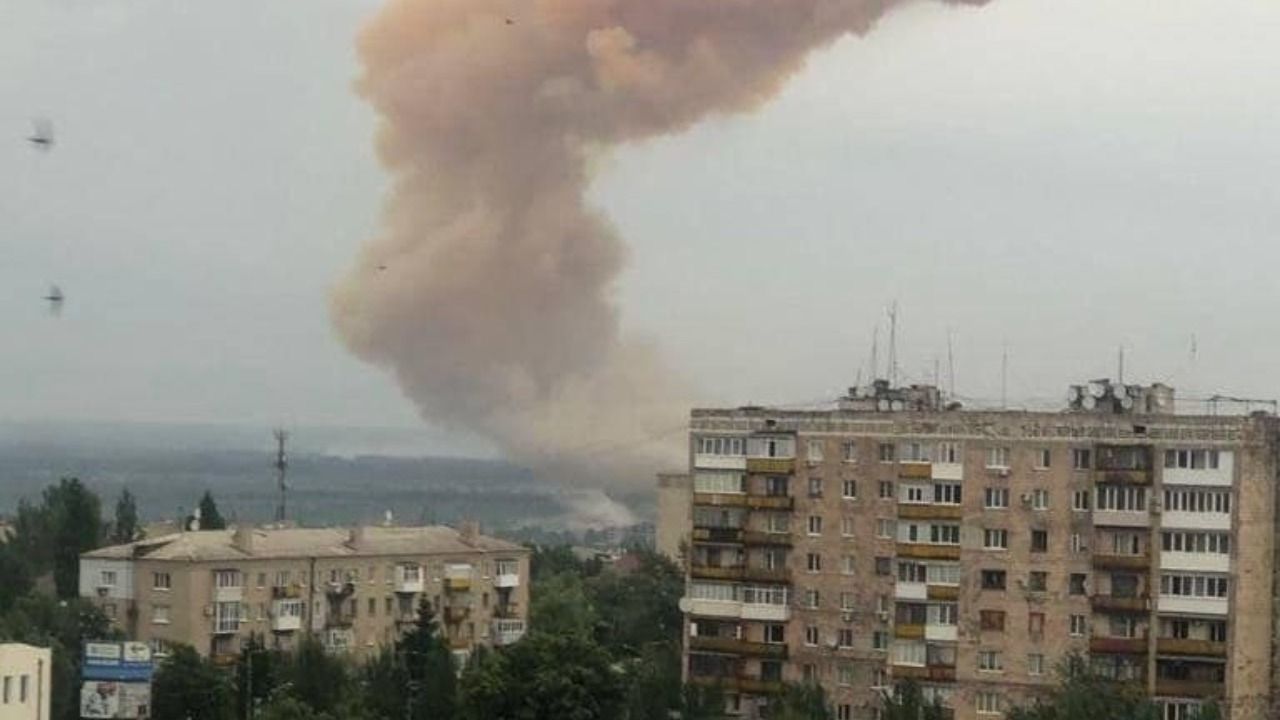
Ukrainian forces have carried out one of their deepest strikes into Russian territory, hitting a ballistic missile manufacturing complex in the Udmurtia region and signaling a new phase in the long-range contest between the two militaries. The attack targeted a facility that Russian and Ukrainian sources alike link to the production of strategic systems, raising questions about the future tempo of missile launches against Ukrainian cities.
The operation also highlighted how Ukraine is pairing domestically produced weapons with detailed intelligence to reach targets nearly 1,500 kilometers from its own territory. For Moscow, the incident underscored the vulnerability of prized defense plants far from the front line and the growing reach of a war the Kremlin has long tried to present as distant from everyday life in central Russia.
Strike on Udmurtia’s missile complex
Russian regional officials in Udmurtia acknowledged that Ukrainian drones had hit an industrial site, describing damage to a facility in the city of Votkinsk but initially downplaying the extent of the impact. The local governor said Ukrainian drones damaged a site in the region, and Russian civil aviation authority Rosaviatsiya reported disruptions at nearby airfields, a sequence that matched Ukrainian claims of a coordinated long-range operation that reached deep into Russia. Kyiv framed the strike as a direct response to repeated missile attacks on Ukrainian cities, portraying the plant as a legitimate military target rather than a symbolic gesture.
Ukrainian officials and military-linked channels described the target as a ballistic missile producer associated with systems used against Ukrainian territory. One assessment stated that Ukraine struck a ballistic missile producer deep inside Russia and that Kyiv viewed the operation as a necessary step to limit future salvos from launchers supplied by this factory, with the report specifying that Ukraine hit a ballistic missile producer deep inside Russia and citing the phrase By Reuters and the figure 49 in its timing notation. Ukrainian narratives stressed that the plant’s output fed directly into the war effort and that striking it was intended to reduce the volume and sophistication of missiles reaching Ukrainian airspace rather than to inflict civilian casualties in Udmurtia.
Evidence from imagery and local reports
Russian authorities initially released limited visual material, but independent imagery soon provided a clearer picture of the damage. Commercial satellite photos showed heavy structural damage at a key missile plant in Votkinsk, including collapsed roof sections and scorched industrial halls, with analysts identifying the site as a major component of Russia‘s missile industry. The imagery aligned with Ukrainian statements that the strike had not merely grazed the perimeter but had hit production buildings, suggesting a significant disruption rather than a minor incident.
Residents in and around Votkinsk reported loud explosions and flashes in the night sky, and Russian Telegram channels such as SHOT, described as another unofficial Russian Telegram outlet that often cites security service contacts, relayed accounts from people in Votkinsk who said the blasts shook apartment blocks. One detailed account noted that the Udmurt Republic’s main passenger airport had to suspend operations after the strike, indicating that the impact reverberated beyond the plant itself and into regional infrastructure, according to field reporting. Together, the satellite imagery and local testimony painted a picture of a well-planned operation that achieved more than the limited damage Russian officials first suggested.
Ukraine’s expanding long-range capabilities
The strike in Udmurtia formed part of a broader Ukrainian campaign to hit Russian defense industrial and energy assets far from the front. Analysts tracking the conflict reported that Ukrainian forces continued their long-range strike campaign against Russian defense industrial and energy assets on the night of the operation, noting that several facilities suffered damage as a result of a Ukrainian strike, according to a detailed campaign assessment. The pattern suggests that Kyiv is moving beyond sporadic deep strikes and toward a sustained strategy aimed at degrading Russia’s ability to replenish its arsenal.
Ukrainian sources highlighted the role of domestically developed systems in this effort, including a weapon referred to as the Flamingo missile. One broadcast stated that Ukraine’s domestically produced Flamingo missiles struck a ballistic missile manufacturing plant in Udmurtia, framing the operation as a showcase of national engineering rather than reliance on foreign-supplied systems, in a segment that linked the strike to Ukraine‘s broader bid for strategic autonomy. Reports from Ukrainian Defense Forces described how long-range missiles and drones were used in combination to overwhelm Russian air defenses and reach a target nearly 1,500 kilometers from Ukrainian-controlled territory, with one account explicitly stating that Ukraine hits missile factory nearly 1,500 kilometers inside Russia and repeating the figure 1,500 as a measure of depth.
Strategic stakes for both sides
Kyiv presented the attack as both retaliation and deterrent, arguing that taking the war to Russian missile plants could reduce the frequency and intensity of strikes on Ukrainian cities. A statement from Ukrainian Defense Forces said that Ukrainian Defense Forces late Friday night struck a Russian missile factory and that the operation targeted the source of weapons used against civilian areas, a claim that framed the strike as a defensive necessity and was summarized under the line Reports say Ukraine attacked a Russian missile factory in a dispatch that cited Ukraine‘s military. Ukrainian officials also stressed that the plant was already sanctioned by Western governments because of its role in producing systems such as the Iskander M, pointing to previous designations that linked the facility to missile campaigns against Ukrainian infrastructure.
For Moscow, the incident raised difficult questions about the security of its strategic industrial base. A separate Ukrainian account on social media stated that a Ukrainian missile strike hit a Russian plant manufacturing ballistic missiles in the remote Udmurtia region and described the facility as sanctioned by the EU, US, and other partners for its role in producing missiles for the Iskander M and other systems, according to a post by Ukrainian Gener. Military analysts noted that such deep strikes could force Russia to divert advanced air defense assets away from the front to guard plants in regions like Udmurtia, a shift that might ease pressure on Ukrainian troops in contested sectors even as it increases the sense of vulnerability among Russian civilians far from the battlefield.