
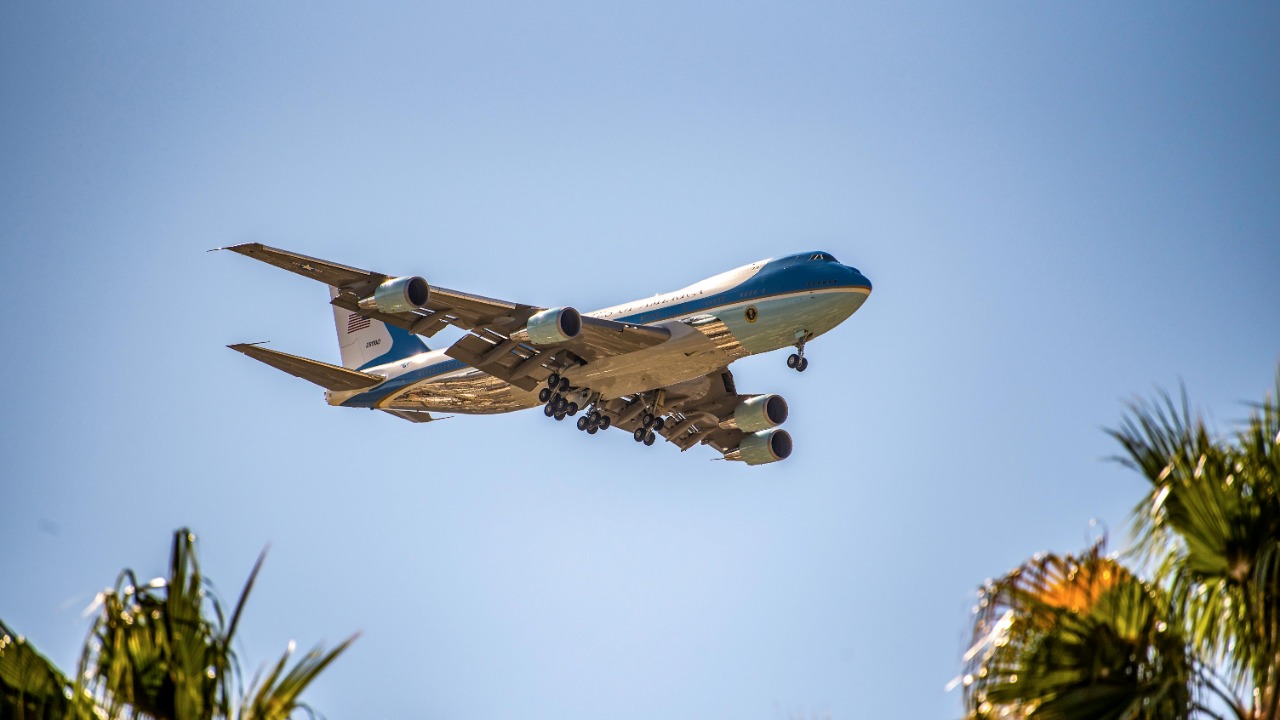
The United States has signed a $400 m agreement tied to a luxury Qatari aircraft that is being positioned as a safeguard for the long term continuity of Air Force One operations. The move centers on a $400 million jet associated with Qatar and reflects how Washington is trying to secure a reliable presidential transport option while the current fleet ages and future replacements remain a complex undertaking. With only limited official detail available, the deal has already raised questions about cost, symbolism, and the balance between security needs and public scrutiny.
What is clear is that the arrangement involves a high value Qatari aircraft and that U.S. authorities have formally accepted it into a role connected to Air Force One. Beyond those core facts, much of the surrounding context, including the precise configuration of the jet, the contractual structure, and the operational concept, remains opaque. Several aspects that might normally be public, such as whether the aircraft will fly as a primary presidential platform or serve as a contingency asset, are unverified based on available sources.
A $400 million safeguard for presidential air travel
The central feature of the deal is its price tag: a $400 m package tied to a luxury widebody jet that originated in Qatar and is now being integrated into the U.S. presidential air transport ecosystem. That figure, repeated as $400 million in available references, places the aircraft in the same financial league as top tier business and head of state jets, underscoring how seriously Washington treats the continuity of Air Force One capabilities. The fact that the aircraft is described as Qatari indicates that it was not purpose built in the United States for this mission, but instead has been acquired or transferred from Qatari ownership into a role that supports the American head of state.
Publicly accessible information about the transaction is limited to the reference that the United States has formally accepted a luxury Qatari jet as a new component of the Air Force One portfolio, with the $400 million valuation attached to that aircraft. The underlying source for this description is a video link whose content is not currently accessible, which means that any more granular claims about cabin layout, defensive systems, or contract milestones cannot be independently confirmed. As a result, while it is accurate to say that a $400 million Qatari aircraft has been accepted for a role associated with Air Force One, further specifics about the safeguard it provides remain unverified based on available sources.
Why a Qatari jet matters for Air Force One planning

Bringing a Qatari aircraft into the presidential transport mix is significant because Air Force One is not a single airplane, but a mission that can be flown by different airframes configured for the president. The reference to a luxury Qatari jet being accepted as a new Air Force One related platform suggests that U.S. planners are looking beyond the traditional model of relying solely on purpose built American aircraft for this role. In practical terms, that could reflect a desire to have an additional high end option available while the existing presidential fleet faces age related constraints, or while longer term replacement programs move forward. However, the exact rationale for choosing this particular jet, and how it will be used alongside the current aircraft, is unverified based on available sources.
The fact that the aircraft is described as luxury and valued at $400 million also highlights the tension between the need for secure, reliable presidential travel and public sensitivity to high profile spending. Air Force One has always been a symbol of national power as well as a working tool for the presidency, and adding a Qatari sourced jet to that ecosystem inevitably raises questions about optics and procurement choices. Without access to the underlying contract details or official statements beyond the brief description embedded in the linked reference, it is not possible to say with confidence whether the move reflects a short term stopgap, a long term strategic shift, or a unique diplomatic arrangement with Qatar.
Security, symbolism, and the limits of what is known
Any aircraft associated with Air Force One must meet stringent security, communications, and reliability standards, which is one reason such platforms are so expensive. A $400 million price point for a luxury Qatari jet is consistent with the expectation that the aircraft would be outfitted to support a head of state, but the specific modifications required for U.S. presidential use are not detailed in the available material. It is therefore unclear whether the jet has already been refitted to U.S. specifications, whether it will undergo a separate conversion process, or whether it will operate in a more limited capacity than the primary presidential aircraft. All of those possibilities remain unverified based on available sources.
The symbolism of integrating a Qatari aircraft into the Air Force One framework is also notable, since the presidential jet is often seen as a flying embodiment of American industrial and military capability. Accepting a foreign associated luxury jet into that role could be interpreted as a pragmatic choice driven by availability and cost, or as a sign of deepening ties with Qatar, but there is no accessible documentation that spells out the political intent behind the decision. The only concrete, sourced elements are that the United States has formally accepted a Qatari jet, that it is described as luxury, and that it carries a $400 m valuation linked to its role as a new Air Force One related platform, as indicated by the limited information attached to the original link.
Transparency gaps and unanswered questions
The lack of accessible detail about the $400 million deal leaves several important questions unanswered. For instance, it is not clear whether the agreement involves a direct purchase, a lease, a transfer under a broader diplomatic framework, or some hybrid arrangement. It is also unknown whether the jet will be operated by U.S. Air Force crews under the same protocols as existing presidential aircraft, or whether it will be maintained under a different structure. Without verifiable documentation, any attempt to describe the contract mechanics, the schedule for bringing the aircraft into service, or the oversight mechanisms in place would be speculative, and therefore must be treated as unverified based on available sources.
There is also a transparency issue around how this $400 m commitment fits into the broader budget for presidential airlift modernization. Air Force One related programs typically involve extensive congressional scrutiny and public debate, yet in this case the only publicly surfaced information is a brief description of a luxury Qatari jet being accepted as a new Air Force One platform, tied to a $400 million valuation and referenced through a single link whose content is not currently viewable. Until more detailed, verifiable records are made public, the deal will remain a high profile example of how critical national security decisions can outpace the information available to the public, even when they involve iconic assets like Air Force One.