
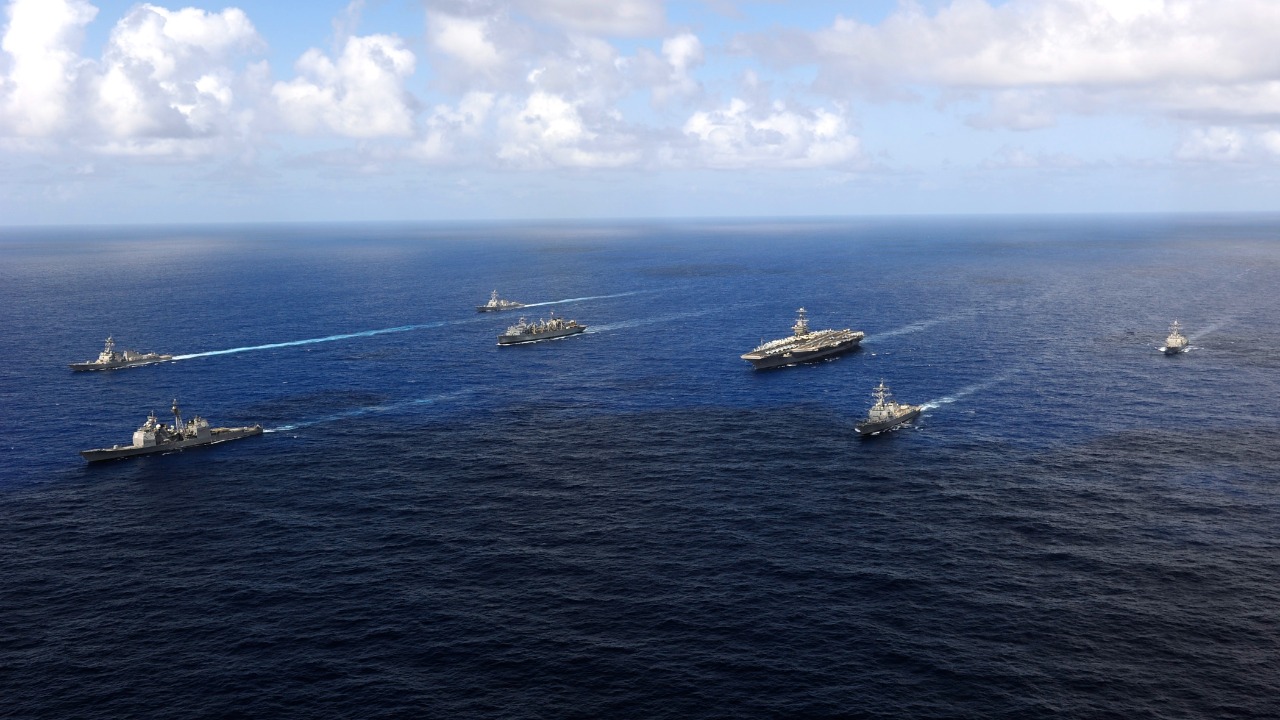
The United States is surging major naval power into the Western Pacific as China stages large-scale military drills around Taiwan, sharpening an already volatile standoff in one of the world’s most contested waterways. Two U.S. aircraft carriers and an amphibious assault ship are now operating in and around the South China Sea and East China Sea, positioning American forces close to Chinese maneuvers that simulate a blockade of the island.
The deployments underscore how quickly tensions over Taiwan can pull heavy U.S. and Chinese forces into close proximity, raising both deterrence and the risk of miscalculation. They also highlight Washington’s effort to reassure allies that it will maintain a forward presence even as Beijing’s navy and air force expand their reach.
Dual Carrier Presence Near Taiwan
The United States has deployed two aircraft carriers to the Western Pacific as China conducts intensive military exercises around Taiwan, creating a rare concentration of high-end naval power in the region. According to official descriptions, The United States moved the carriers and an amphibious assault ship into the Western Pacific after Chinese forces began drills that encircled Taiwan and pushed into the South China Sea. Reporting on the deployments notes that the U.S. ships are operating in international waters but within reach of Chinese activity, a posture intended to maintain freedom of navigation while signaling that any attempt to coerce Taiwan will face immediate American attention, as detailed in coverage of the Western Pacific movements.
The dual carrier presence is closely tied to China’s latest drills, which Beijing has framed as a response to what it calls separatist tendencies in Taiwan. Chinese forces have surrounded the island with aircraft and warships, and state media has highlighted live-fire events that simulate cutting off Taiwan’s main ports and air routes. Analysts say the U.S. decision to operate two carrier strike groups in the Western Pacific at the same time is meant to complicate any Chinese planning for a real blockade by presenting multiple axes of potential U.S. intervention, a point reinforced by reports that two U.S. carriers are in the Western Pacific during China’s drills around Taiwan.
China’s “Justice Mission” Drills and Blockade Signaling
Beijing’s exercises around Taiwan are not routine patrols but highly choreographed maneuvers that Chinese authorities say are designed to test a blockade concept. China’s People’s Liberation Army has announced that it “completed” two days of military events around Taiwan, describing the operation as a comprehensive test of joint forces. The drills, which Chinese commanders have linked to a “Justice Mission” theme, have included air, naval, and missile units practicing encirclement and strike profiles around the island, according to accounts of the People’s Liberation Army maneuvers.
Chinese military messaging has emphasized that the drills simulate sealing off Taiwan’s key approaches, a scenario that would test not only the island’s resilience but also the ability of the United States and its partners to break a blockade. A detailed assessment of the surprise exercise notes that the PRC conducted large-scale operations that ringed Taiwan and included long-range rocket fire and maritime interdiction training, portraying the event as a rehearsal for cutting off external support to the island. The same analysis describes the drills as part of a broader campaign of “Taiwan Blockade Drills” under the “Justice Mission” label, overseen by the People’s Liberation Army Eastern Theater Command, which has now wrapped its Justice Mission activities.
Key U.S. Naval Assets and Their Roles

At the center of the American response is the USS Abraham Lincoln, a Nimitz-class aircraft carrier that has moved into Indo-Pacific waters as part of a broader carrier strike group. Rear Admiral Todd Whalen, identified as Commander of the Abraham Lincoln Carrier Strike Group, has described the deployment as focused on supporting regional stability in the Seventh Fleet area of responsibility, underscoring that “Our” forces are prepared to operate with allies and partners throughout the region. The carrier, which previously operated in the Philippine Sea and conducted a port visit to Guam, is now engaged in routine operations that place it within reach of the South China Sea and Taiwan Strait, according to reports on USS Abraham Lincoln entering Indo-Pacific waters.
The USS George Washington, another carrier, is also a key part of the picture, serving as the forward-deployed flattop based in Japan. Fleet tracking data shows that Aircraft carrier USS George Washington, designated CVN, has been operating in the Philippine Sea as part of a carrier strike group that includes guided missile destroyers, placing it close to critical sea lanes that connect Japan, Taiwan, and the broader Western Pacific. The same tracking notes that the ship, identified as USS George Washington (CVN-73), has been active in exercises and patrols that reinforce U.S. presence near the first island chain, as detailed in the Philippine Sea tracker.
USS Tripoli and Amphibious Power Projection
Alongside the carriers, the amphibious assault ship USS Tripoli has emerged as a flexible tool for U.S. planners seeking to counter Chinese pressure without escalating to a purely carrier-centric posture. The ship, which can operate F-35B short takeoff and vertical landing jets, has been conducting operations in the South China Sea and East China Sea before returning to Sasebo, Japan. Reports on the current posture note that USS Tripoli has been part of a pattern of amphibious deployments that place Marine and naval aviation assets close to potential flashpoints, with the ship’s recent activities highlighted in coverage of USS Tripoli operations.
The presence of an amphibious assault ship alongside two carriers gives the United States a more layered set of options, from humanitarian assistance to rapid insertion of Marines or airpower in a crisis. Amphibious ships like USS Tripoli can disperse aircraft and troops across a wider area, making it harder for an adversary to target a single high-value platform. Analysts note that this mix of carriers and amphibious ships is part of a broader U.S. Pacific Fleet posture that includes approximately 200 ships and 1,500 aircraft, a force designed to sustain a long-term commitment to a free and open Indo-Pacific while responding quickly to events such as the current drills amid China targeting Taiwan.
Strategic Signaling and Risks of Escalation
U.S. officials and military leaders are using the carrier deployments to send a clear deterrent message to Beijing while trying to avoid direct confrontation. Analysts argue that placing two carrier strike groups and an amphibious assault ship in the Western Pacific at the same time is meant to project strength and complicate Chinese decision-making, particularly if the PRC were to consider turning its “Justice Mission” drills into a real blockade. Commentary on recent U.S. naval movements describes how a fleet of aircraft carriers and stealth F-35 fighters has been sent into what some call “China’s backyard,” with the explicit goal of demonstrating that Chinese forces cannot easily challenge the U.S. Navy in contested waters, as highlighted in an analysis of the Chinese challenge.
At the same time, the concentration of powerful forces on both sides raises the risk of incidents that could spiral. Taiwan’s military has already been on alert during previous Chinese moves, including a surprise transit by U.S. naval forces through the Taiwan Strait that prompted heightened readiness on the island, as recounted in a briefing hosted by Laurel Stewart. With China’s People Liberation Army Navy expanding its blue-water capabilities, including new carriers such as CNS platforms highlighted in regional naval reviews, and the Nimitz-class carriers of the U.S. Navy still able to carry up to 130 aircraft and remain at sea for extended periods, both sides now possess large, complex systems that operate in close quarters. Experts warn that managing communications, rules of engagement, and crisis hotlines will be essential to prevent a miscalculation in the Western Pacific from triggering a wider conflict, a concern echoed in assessments of the Nimitz fleet and broader international operations in the region.