
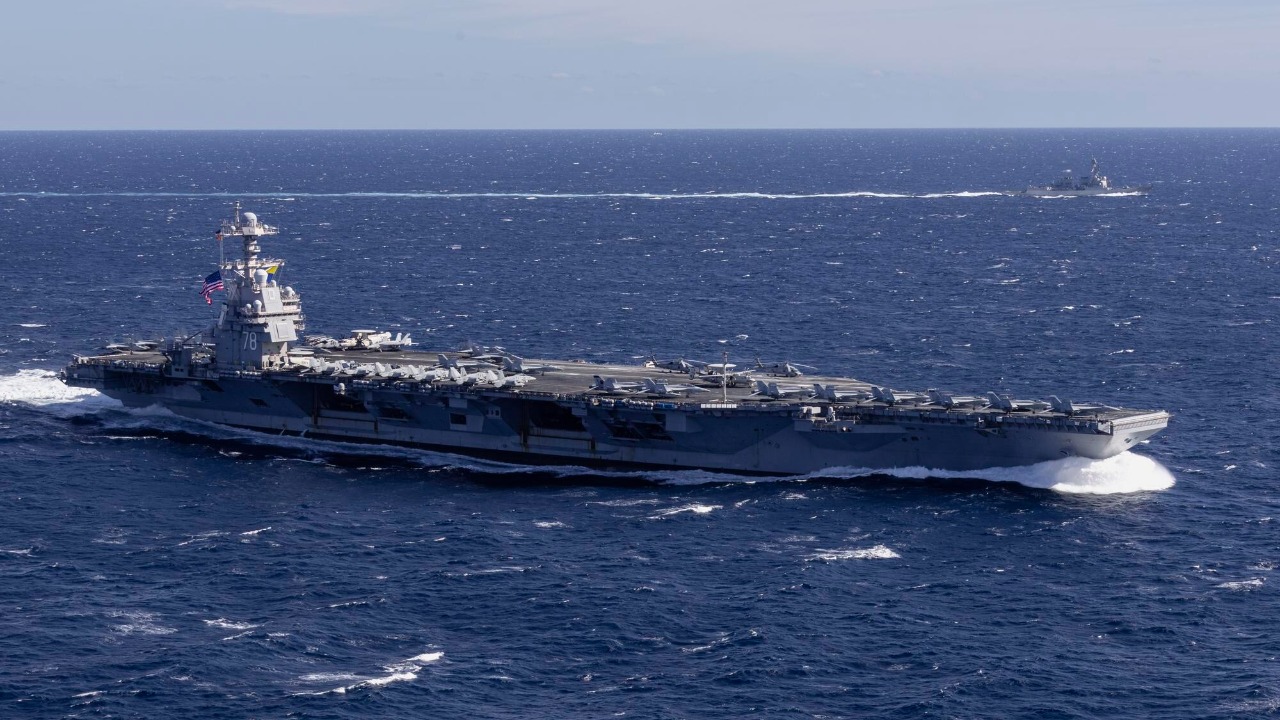
President Donald Trump is sending the United States Navy’s most advanced aircraft carrier to the Middle East, deepening a military buildup as tensions with Iran intensify. The deployment of the USS Gerald R. Ford, described by the administration as a multibillion-dollar “supercarrier,” will place a second powerful strike group in the region alongside the USS Abraham Lincoln. The move is intended to increase pressure on Tehran while talks over Iran’s nuclear program and regional behavior struggle to gain traction.
The decision to commit such a costly and symbolically loaded asset signals that Washington is prepared to keep substantial firepower on station even as it publicly insists that it prefers negotiation. It also raises the risk of miscalculation, as Iranian leaders weigh how to respond to a larger American presence in nearby waters at the same time that international inspectors report difficulties in monitoring Iran’s nuclear activities.
The Ford joins an expanding U.S. armada
At the core of the latest move is a straightforward development: the USS Gerald R. Ford is being dispatched to the Middle East to operate alongside the USS Abraham Lincoln as part of a broader effort by the United States to confront Iran. Officials describe the Ford as the world’s largest aircraft carrier, a new-generation platform that significantly expands the number of aircraft and missiles available to the president in any crisis. By adding the Ford to the Lincoln’s existing presence, the White House is effectively doubling down on a strategy that relies on visible, sustained naval power to shape Tehran’s calculations, a posture that goes well beyond routine deterrence patrols.
Reports indicate that the USS Gerald R. Ford will join the USS Abraham Lincoln in regional waters, creating a two-carrier presence that U.S. planners rarely maintain outside major conflicts. The Ford’s arrival follows earlier decisions to move additional air and missile defense assets into the Middle East, part of a buildup that began when the administration concluded that Iran’s actions required a more visible show of strength. The USS Abraham Lincoln, a Nimitz-class carrier, had already been shifted from other duties to support this posture, reflecting how a single regional crisis is now drawing in some of the most valuable ships in the American fleet.
From late-January buildup to a two-carrier signal
The Ford’s deployment is the latest step in a chain of moves that started with a broader military reinforcement earlier this year. Beginning in late January 2026, the United States started moving additional naval and air assets into the Middle East as part of what officials described as a response to the 2026 United States-Iran crisis. That initial wave of deployments was framed as a way to protect shipping lanes, reassure partners, and signal readiness for any contingency, but it also set the stage for more dramatic decisions, including the choice to send a second carrier strike group.
Accounts of the buildup explain that, starting in late January, the United States moved forces into the Middle East to signal readiness for contingency operations involving Iran. Within that sequence, the USS Abraham Lincoln, a Nimitz-class carrier, was ordered away from previous tasking to support the new mission. One account notes that the USS Abraham Lincoln, a Nimitz-class aircraft carrier, had been operating off the coast of Virginia before reassignment, underscoring how quickly the Navy adjusted its global posture once the crisis with Iran intensified.
Trump’s mix of pressure and promised diplomacy
Even as he orders more military hardware into the region, Trump continues to insist that he expects diplomacy with Iran to succeed. In public remarks, he has said that he believes negotiations will be “successful,” framing the deployment of the USS Gerald R. Ford as a way to strengthen his hand at the bargaining table rather than as a prelude to war. That message is aimed both at domestic audiences wary of another Middle East conflict and at Iranian leaders, whom Trump portrays as responsive to clear demonstrations of American strength.
Trump’s comments about diplomacy came as he confirmed that the USS Gerald R. Ford would head to the Middle East, with one report noting that Trump says he with Iran will be “successful” even as he sends the second carrier. At the same time, Trump stated that he views a “change in power” in Iran as the “best” outcome, linking his military decisions to a broader objective of influencing Iran’s leadership. In that account, Trump is quoted as saying that Iran’s leaders have been “talking and talking and talking,” a criticism that he pairs with the argument that only sustained pressure will force Tehran to make meaningful concessions.
Inspections, nuclear concerns, and Tehran’s next move
The military buildup is unfolding against a fraught nuclear backdrop that makes every additional ship and aircraft more consequential. As the United States adds the Gerald R. Ford to its regional forces, the United Nations nuclear watchdog is reporting new difficulties in monitoring Iran’s nuclear program. Rafael Grossi, who leads the International Atomic Energy Agency, has publicly described trouble getting Iran to provide the access and transparency inspectors say they need, raising fears that the nuclear file is drifting further from the guardrails that previous agreements had imposed.
One account of diplomatic efforts notes that the latest negotiations continue, while United Nations nuclear watchdog chief Rafael Grossi has reported difficulties in securing full cooperation from Iran on inspection demands. That difficulty feeds directly into the logic behind the carrier deployments: Washington argues that only sustained military pressure, embodied in the presence of the USS Gerald R. Ford and the USS Abraham Lincoln, can convince Iran that it cannot simply wait out international concern. For Tehran, the choice is now whether to test that resolve with its own shows of force or to return more fully to talks, a decision that will determine whether the current standoff remains a tense deterrence contest or slides into open confrontation.