
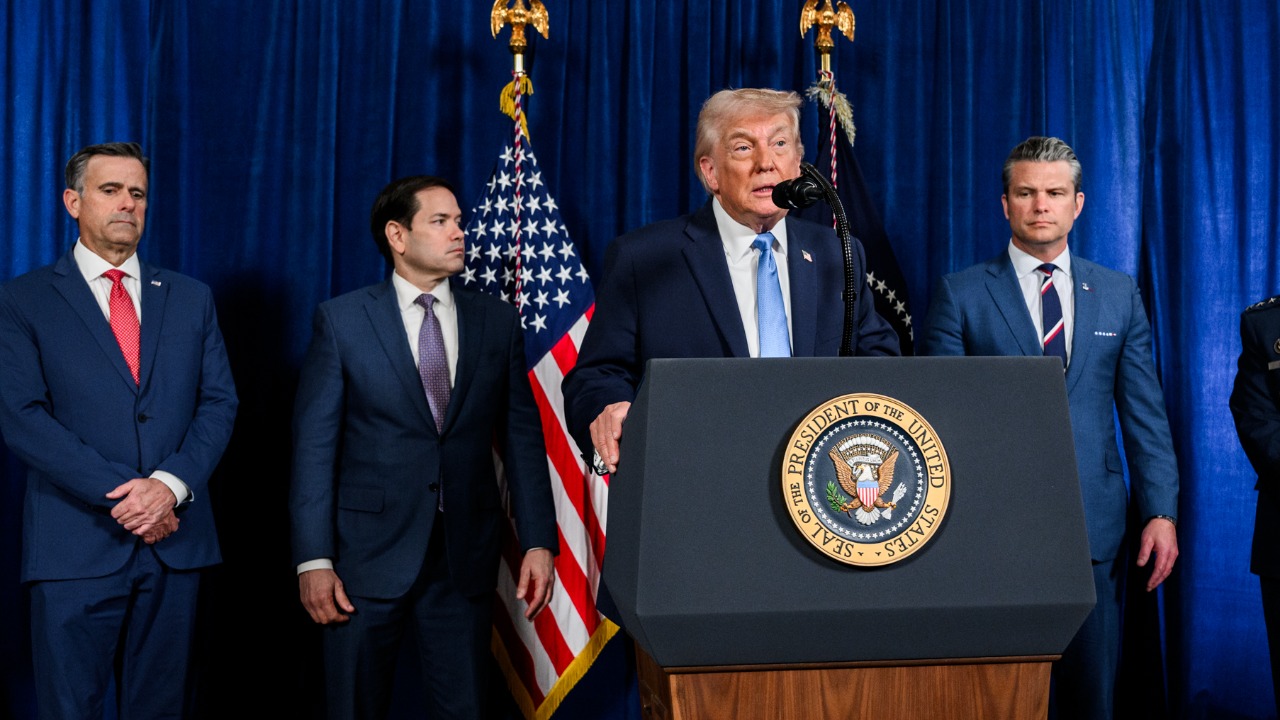
President Donald Trump’s remark that “if it expires, it expires” about the last remaining nuclear arms pact between Washington and Moscow signals a stark break with decades of cautious management of the world’s most destructive weapons. As the New START Treaty nears its end, his blunt stance raises immediate questions about how the United States will handle strategic stability with Russia and what comes next for a global order that has long relied on formal limits and inspections.
I see his comment not as an offhand aside but as a window into a broader philosophy of power, one that treats legal constraints as optional and personal judgment as paramount. With the treaty’s clock running down and rival powers watching closely, the stakes of that philosophy are no longer theoretical.
The treaty at the edge of the cliff
To understand what is at risk, I start with what New START actually does. The agreement between The United States and the Russian Federation caps each side’s deployed strategic nuclear warheads and delivery systems and, crucially, provides a regime of inspections and data exchanges that keeps both arsenals under regular scrutiny. According to the official description of the accord, the treaty’s original term was ten years, and it was later extended so that it now runs through early February 2026, with no further prolongation available under its own terms, a structure that leaves both countries facing a hard legal stop on the current framework of strategic offensive limits.
That looming deadline arrives in a world already stripped of most of the Cold War era’s arms control scaffolding. Earlier bilateral arrangements that once constrained entire classes of weapons have fallen away, leaving New START as the final formal barrier between the two largest nuclear powers and an unconstrained buildup. Analysts who track European security have warned that the end of The New START Treaty would leave NATO allies exposed to a less predictable Russian arsenal and a more complex deterrence landscape, a concern that has been voiced in assessments of how the pact’s expiry could reshape Europe’s nuclear arsenal.
Trump’s shrug at the deadline
Against that backdrop, President Trump’s recent comments land with unusual force. In an interview with the NYT, he indicated that he might simply allow the New START framework to lapse, saying that if the pact runs out, it runs out, a formulation that strips away the diplomatic euphemisms that usually surround nuclear policy and instead presents expiration as an acceptable outcome rather than a crisis to be averted, a stance that was relayed in detail when he told the NYT that “if it expires, it expires” about the U.S. Russia nuclear treaty, as reported by coverage of his.
His posture is not entirely new. Earlier, Trump signaled that he might let the last U.S. Russia nuclear treaty expire, framing the accord as a flawed holdover and hinting that he preferred a broader arrangement that could also involve China, a position described in accounts that noted how he has repeatedly questioned the value of an agreement designed to last for ten years and now nearing its end, as seen in reports that he may let the last U.S. Russia nuclear treaty expire from Xinhua summaries.
Competing visions from Moscow and Washington
Trump’s indifference to the deadline also collides with a more traditional arms control pitch coming from Moscow. Russian President Vladimir Putin has floated the idea of extending New START by one additional year, to keep the existing limits in place until 2027, and The United States now faces a decision on whether to engage with that proposal or let it die on the vine, a choice that will shape whether the current caps on deployed warheads survive even briefly beyond 2026, as outlined in assessments of Putin’s offer to keep New START alive until 2027 and its implications for arsenals that could otherwise reach 1,000 warheads by 2030, described in analyses of his.
It is worth remembering that this is not the first time the Kremlin has pressed for more time under the existing rules. As late as December of 2020, President Vladimir Putin was calling for an unconditional extension of New START, a push that eventually led Putin and President Joe Biden to agree to prolong the treaty to its current end date in 2026, a sequence that underscores how Moscow has often portrayed itself as the party seeking continuity in the regime of inspections and limits, as documented in historical timelines of New START negotiations.
What a post‑treaty world could look like
If New START is allowed to lapse, the consequences will extend far beyond a single line in a diplomatic ledger. The treaty is the last agreement between Washington and Russia that directly limits the number of strategic nuclear weapons held by both countries, and its end would remove the only binding cap on deployed warheads and launchers at a time when both sides are modernizing their forces, a reality that has been underscored in recent examinations of how New START, as the final U.S. Russia nuclear treaty about to expire, has functioned as a guardrail on strategic nuclear weapons.
Trump himself has sent mixed signals about what would follow. Over the summer he said he would like to maintain the limits set out in the treaty even after it expires, suggesting that the United States and Russia could continue to observe the pact’s ceilings informally, a notion that arms control advocates view as far less reliable than a legally binding accord with inspections, as reflected in accounts noting that Trump said he would like to maintain the treaty’s limits after expiry and that experts at the Arms Control Association advocacy group have warned about the risks of relying on voluntary restraint, as detailed in summaries of his.
A president who trusts his own instincts
For me, the most revealing thread running through these choices is Trump’s view of his own authority. He has said that his “own morality” is the only limit on his power, a statement attributed directly to the President in discussions of his willingness to keep U.S. forces in Venezuela for years and his approach to Nuclear Policy and other hard security questions, a formulation that suggests he sees legal and institutional checks as secondary to his personal judgment, as reported in analyses of his claim that his own morality is the only limit on his power in recent interviews.
That same confidence is visible in his handling of New START. Trump has made it clear that he is not unnerved by the expiration of the Russian New START on Feb. 5, 2026, and has instead floated the idea of negotiating a broader agreement that would involve China, a far more complex undertaking that could take years to materialize, as described in reviews of how Trump has framed the looming end of the current pact and his preference for a wider trilateral agreement.
Arms control without a safety net
Trump’s rhetoric has already begun to shape expectations among experts and foreign capitals. Reports on his NYT interview note that he indicated he might let the New STAR pact lapse while still expressing a desire to keep its numerical limits in place, a combination that leaves allies guessing whether Washington will prioritize legal structure or informal understandings, as captured in accounts that quote him saying he might let the New STAR treaty expire while hinting at continued adherence to its ceilings, as seen in summaries of his.
At the same time, detailed briefings on The New START Treaty emphasize that it took effect in 2011 and was designed from the outset to limit each party’s deployed strategic nuclear warheads and launchers, with only a single extension permitted under its terms, a structure that means the current arrangement cannot simply be rolled over again and that any future framework would require fresh negotiation, as explained in technical descriptions of how The New START was crafted to last for ten years with one extension and is now approaching the end of that limited lifespan.
The choice that will define the next decade
As the deadline approaches, I see a widening gap between the gravity of the decision and the casualness of the phrase “if it expires, it expires.” Detailed accounts of Trump’s comments stress that he has repeatedly signaled he may let the last U.S. Russia nuclear treaty expire, even as advisers and outside experts warn that walking away without a replacement would remove the last formal constraint on two vast arsenals, a tension that has been highlighted in reports that Trump signals he may let the last U.S. Russia nuclear treaty expire and that his administration has yet to present a concrete alternative, as described in recent briefings.
Other detailed rundowns of his NYT interview note that New START cannot be extended again because it has already used the single prolongation allowed under the treaty and that Putin and President Joe Biden previously agreed to that extension, a reminder that the current moment is not an accident but the predictable end point of a legal design that always envisioned a finite life, as laid out in explanations that New START cannot be extended further and that Putin and President Joe Biden already used the one extension the text allows, described in recent coverage.