
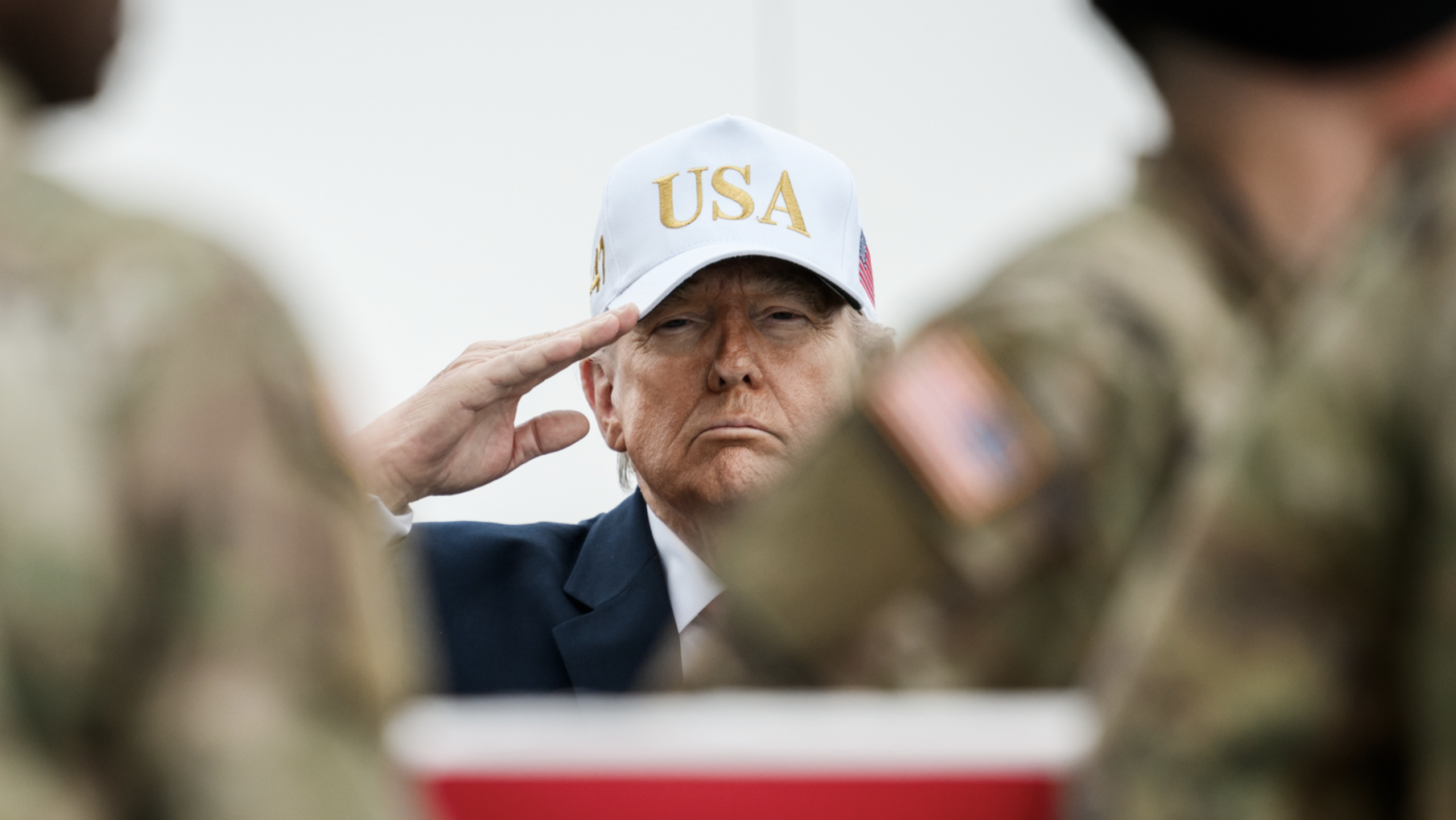
President Donald Trump departed the White House Wednesday for Dover Air Force Base in Delaware, where he attended the dignified transfer of four U.S. service members killed in the war against Iran, calling the responsibility one of the most difficult parts of serving as commander-in-chief.
Speaking to reporters before boarding Air Force One, Trump framed the ceremony around the stated objective of the four-month campaign. “We’re going and some of you are going with us to honor our heroes and they are indeed great heroes,” Trump said. “Actually, they said and they all of them said very strongly, we can’t let you cannot let Iran have a nuclear weapon. They won’t have a nuclear weapon. So, we’re going to honor them.”
Trump then addressed the weight of the ceremony itself. “It’s one of the hardest things to do for me. It’s one of the hardest things to do as a president, but it has to be done,” he said.
Wednesday’s dignified transfer was the third that Trump has personally attended since he launched Operation Epic Fury against Iran on February 28, 2026. Two soldiers returned Wednesday were killed in Iranian missile and drone attacks on Muwaffaq Salti Air Base in Jordan on July 17: 1st Lt. Tyler James Feehan, 25, of Ewa Beach, Hawaii, and Pvt. Isabella Gonzales, 19, of Carrollton, Texas. A third soldier initially listed as missing after the same attack, Sgt. Angel S. Rampersad, 28, of Ozone Park, New York, was confirmed dead after remains were recovered and identified. A fourth service member, Sgt. Michael Emmanuel Swinton, 30, of Spring Lake, North Carolina, was killed in northern Iraq on July 18 during a controlled detonation of unexploded ordnance from a downed Iranian drone.
Their deaths bring the total number of U.S. service members killed since the war began to 18.
A Recurring Duty
Wednesday’s ceremony continued a pattern that has defined Trump’s second term since the war’s opening days. Trump has now attended three dignified transfers in five months, each one following a spike in American casualties tied to Iranian retaliatory strikes across Jordan, Iraq, and the broader region.
The dignified transfer ritual, conducted at Dover’s Charles C. Carson Center for Mortuary Affairs, is among the most solemn duties assigned to a sitting president, involving the return of fallen service members’ remains to their families on American soil. Trump’s attendance Wednesday came as the Pentagon continues to investigate the circumstances of the Jordan attack that killed three of the four service members honored.
Comparing the Toll
A day before the Dover ceremony, Trump posted a comparison of U.S. combat deaths across conflicts to his Truth Social account, contrasting the current death toll with those of previous wars. “Afghanistan War: 20 years, 2,000 DEAD. Iraq War: 9 years, 4,600 DEAD. Vietnam War: 19 years and 5 months, 58,220 DEAD. Korean War: 3 years and 1 month, 36,574 DEAD. Venezuela War: 1 day, 0 DEAD. Iran Military Conflict: 4 months, 18 DEAD,” Trump wrote on July 21 at 2:51 p.m.
The post reflects a framing Trump has repeated at multiple points during the war, emphasizing the relatively low number of American fatalities compared with the death tolls of Vietnam, Korea, Iraq, and Afghanistan, conflicts that in most cases lasted years rather than months.
Public Opinion Diverges
The comparison arrives as public approval of the war remains low. A Quinnipiac University poll released in late June found that 34 percent of voters approved of the way Trump was handling the situation with Iran, while 62 percent disapproved. Separate polling has found that roughly a third of Americans support the conflict, while close to 60 percent oppose it.
A mid-July Ipsos poll found that 79 percent of Americans now expect U.S. military involvement in Iran to continue for an extended period of time, a 14-point increase from late March. Approval of the war has also broken sharply along party lines, with Republican voters far more supportive of Trump’s handling of the conflict than independents or Democrats.
The Broader Campaign
Operation Epic Fury began on February 28, when U.S. forces, in coordination with Israel, launched strikes against Iranian military and leadership targets, including sites linked to the country’s ballistic missile program and nuclear infrastructure. The Department of War has said the operation’s core objectives include preventing Iran from producing a nuclear weapon and dismantling its capacity to threaten American forces and allies in the region.
In the months since, the conflict has expanded to include retaliatory Iranian strikes on U.S. positions in Jordan, Iraq, and elsewhere in the Middle East, with American and allied forces sustaining periodic casualties even as the Trump administration has described the campaign’s broader military objectives as largely achieved.
Families Await Word
The four service members honored Wednesday join a small but growing number of American families who have received their loved ones’ remains at Dover since February. The Department of War identified the soldiers killed at Muwaffaq Salti Air Base in a formal release, noting that the incident remains under investigation.
As Trump prepared to depart for Dover, he did not elaborate further on the investigation into the Jordan attack, telling reporters only that the matter was being handled separately. The president’s remarks Wednesday reflected both the continued human cost of the operation and his consistent framing of that cost relative to America’s past wars.