
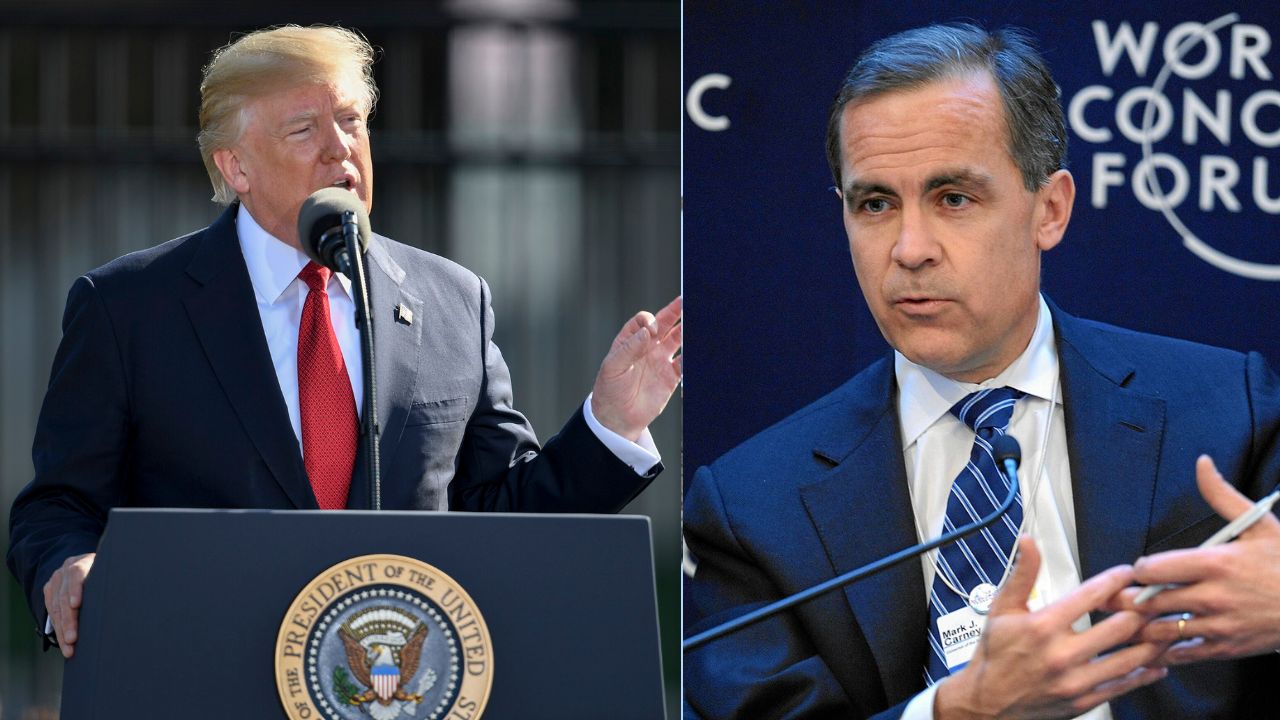
President Donald Trump has turned a technical dispute over missile defense and trade into a sweeping warning that “China will eat Canada alive,” casting Ottawa’s choices on security, Greenland, and Beijing as a single test of loyalty. His escalating rhetoric, paired with threats of 100% tariffs, has jolted one of Washington’s closest alliances and raised questions about how far the White House is prepared to go to force Canada into alignment.
At the center of the clash is the proposed Golden Dome defense system, a vast American project that Trump insists must extend over Greenland and involve Canada, and a new trade opening between China and Canada that he portrays as a direct challenge to United States power. The result is a rare moment when missile shields, Arctic strategy, and tariff brinkmanship are colliding in full view of the world.
Golden Dome: Trump’s grand shield and Canada’s strategic hesitation
Trump has framed the Golden Dome as a defining legacy project, a space-age shield that he argues only the United States can build and lead. The plan envisions a multi-layer defense stretching from ground-based interceptors to systems in orbit, designed to counter everything from small drones to hypersonic weapons, with a price tag publicly described as $175 billion. Supporters in Washington present it as a natural evolution from earlier missile defense concepts, while critics warn that such a system could spur a new arms race and strain alliances if partners feel pressured rather than persuaded.
Technical descriptions of the Golden Dome describe a constellation of interceptors and sensors, a “Visualization of” a shield that would try to destroy incoming threats before they reach North American airspace or fall back to Earth. A Canadian-focused fact sheet notes that the aim is a multi-layered “shield” from the ground into space, capable of stopping drones, cruise missiles, and hypersonic systems, and that Ottawa has been drawn into consultations through NATO and bilateral channels. Yet those same analyses underline the cost and sovereignty questions for Canada, which would be asked to help fund and host elements of a system largely designed in Washington.
Greenland as the new fault line in North American defense
Trump has seized on Greenland as the geographic and symbolic hinge of his Golden Dome vision, arguing that control of the Arctic gateway is too important to leave to what he calls “middle powers.” In a high-profile appearance at Davos, he declared that only the United States can truly secure Greenland, and he has pressed Canada to accept Golden Dome deployments tied to that strategy. In his telling, any hesitation from Ottawa is not a routine policy debate but a dangerous indulgence that leaves the Arctic exposed.
Canadian leaders have pushed back, with Prime Minister Mark Carney meeting his cabinet for extended discussions amid what local reports describe as a rift with Trump over the project. Coverage of those meeting notes that Trump has publicly accused Canada of opposing Golden Dome deployments in Greenland, casting that stance as a rejection of United States-backed security. At the World Economic Forum, he folded the Greenland dispute into a broader critique of Ottawa’s trade and defense choices, telling an audience that Canada should be “grateful” for American protection rather than questioning the terms on which it is offered.
“China will eat Canada alive”: tariffs as leverage over Beijing ties
The sharpest escalation has come on trade, where Trump has linked Canada’s security posture to its economic outreach to Beijing. After Carney announced in Beijing that China and Canada had reached a deal to ease some of the tariffs they had imposed on each other, Trump responded with a threat to impose 100% tariffs on all Canadian goods entering America if Ottawa proceeded. He has repeated that warning in multiple forums, including remarks in ISTANBUL where he said President Donald Trump would not allow a neighbor to “sell out” to China without consequences for access to the American market.
In those same interventions, Trump has sharpened his language into a stark prediction that China will “eat Canada alive, completely devour it, including the destruction of their businesses, social fabric, and general way of life” if Ottawa deepens economic ties with Beijing. He has argued that any easing of tariffs between China and Canada undermines his broader trade agenda and weakens collective leverage over Beijing. Reports from the World Economic Forum describe him telling the audience that China will “eat them up” and that Canada is aligning with the wrong power at a moment of strategic competition.
Personal politics: Carney, Trudeau, and Trump’s public scolding
The policy clash has been intensified by Trump’s personal style and his history with Canadian leaders. He has revived a derisive nickname he once used for Justin Trudeau and applied it to Carney, signaling that he sees the new prime minister as part of the same liberal camp he has long criticized. Reports on his tariff threat note that he has accused Carney of chasing applause in Beijing at the expense of North American security, and that he has suggested Canada is taking the United States for granted after decades of close partnership.
Carney has not remained silent. Coverage of his response describes him as publicly defending Canadian sovereignty and rejecting the idea that Ottawa must accept every American proposal to prove its friendship. When Trump declared that “Canada lives because of the United States,” remarks that offended many Canadians and provoked Carney to retort that his country would not be bullied, the dispute shifted from a technical argument over missile defense and tariffs into a broader contest over respect. Trump has even moved to bar Carney from a United States-affiliated peace board, a symbolic step that underscores how personal the rift has become.
WEF stagecraft and the merging of Golden Dome, Greenland, and China
The World Economic Forum has served as Trump’s main stage for weaving Golden Dome, Greenland, and China into a single narrative about Canada’s future. In a set of remarks that blended security warnings with trade threats, he told the WEF audience that Canada is against the Golden Dome being extended over Greenland, is drifting toward Beijing on trade, and risks being overwhelmed by China if it continues on that path. He cast the United States as the only reliable shield, insisting that “middle powers” cannot secure the Arctic or stand up to China without American leadership, and he pointed to POLL numbers that his allies say validate a hard line on trade.
Trump has reinforced that message on social media and in broadcast clips, including a video in which President Donald Trump on Friday slammed Canada for rejecting his proposed Golden Dome missile defence project over Greenland and warned that turning to China instead of the United States-backed security would leave Ottawa exposed. Another clip shows President Donald Trump on Friday criticizing Canada for its stance on the Golden Dome and its trade opening with Beijing, again predicting that China will “eat them up.” By merging these themes, Trump has turned a set of discrete policy disagreements into a single loyalty test, one that leaves Canada balancing its economic interests, Arctic ambitions, and defense partnerships under the glare of a very public ultimatum.