
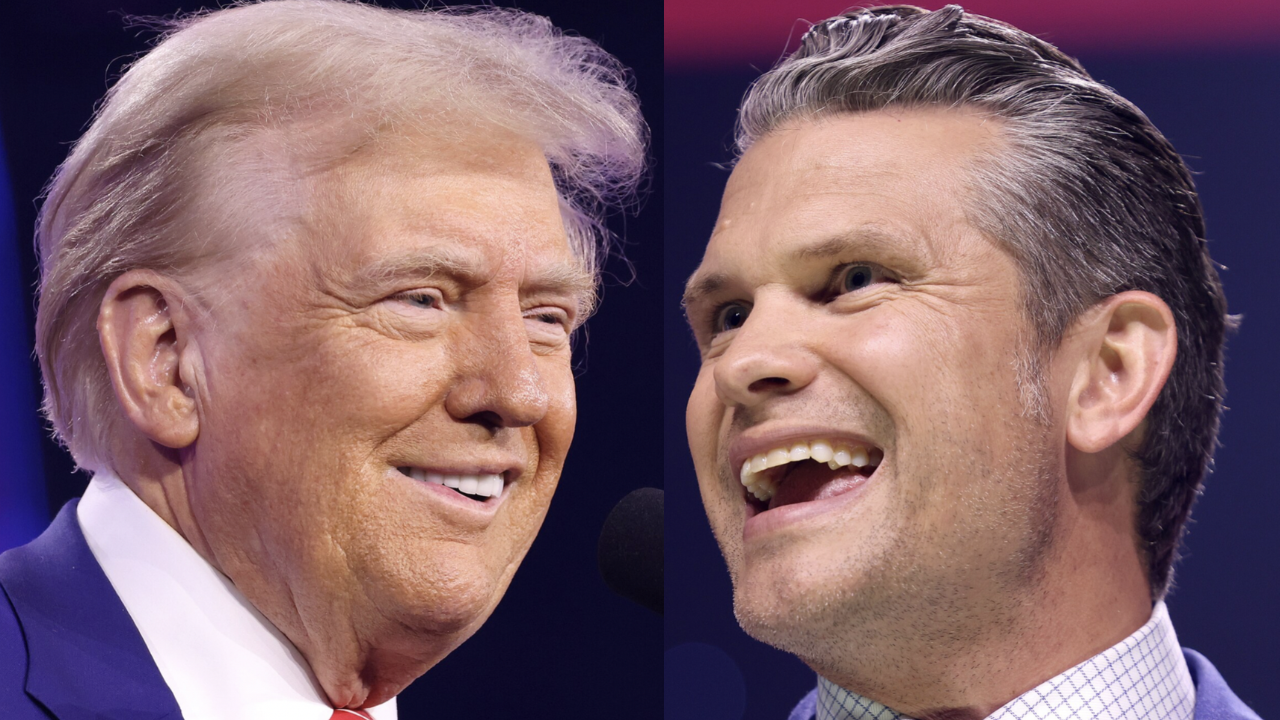
President Donald Trump forcefully defended Defense Secretary Pete Hegseth in a Truth Social post Thursday morning, dismissing days of reporting on a rift between the two men as fabricated and accusing The Washington Post of “treasonous” journalism. The post marked Trump’s most direct and detailed denial yet of an account that has dominated national security coverage this week: that he privately confronted Hegseth at Camp David over a dwindling U.S. munitions stockpile in the middle of the ongoing war with Iran.
“The Fake News, as usual, is spreading false and completely unfounded rumors,” Trump wrote. “I am extremely happy with the job that Pete Hegseth is doing,” he continued, adding that “everything has been extraordinary.”
Trump pointed to two operations by name as evidence of Hegseth’s performance. He credited the defense secretary with the U.S. strike on Venezuela, writing that “the result was accomplished in less than one day,” which he said allowed the administration to bring Nicolas Maduro, whom he called “one of the worst criminals anywhere in the World,” to justice. He also addressed the ongoing conflict with Iran directly, writing that the country “has been decimated for the purpose of NOT ALLOWING IT TO EVER HAVE A NUCLEAR WEAPON” and that the effort “is going very well.”
The president closed his defense of Hegseth by pointing to changes inside the Pentagon under his leadership. “Pete is highly respected within the Military, and has made tremendous improvements, including getting rid of DEI, and increasing recruitment to historic levels,” Trump wrote, before turning his attention back to the source of the controversy.
Trump named The Washington Post directly, referring to the outlet by a derisive nickname he has used repeatedly throughout his term. “This rumor was started by The Washington ComPost, one of the worst Media Outlets in the business, despite our telling them their story is completely FALSE,” he wrote, before delivering his sharpest line of the post: “In actuality, I really believe their fake ‘reporting’ is treasonous!”
The post came in direct response to a Washington Post story published Wednesday night that described a tense confrontation between Trump and Hegseth on the sidelines of a Cabinet meeting at Camp David last Friday. Citing two people familiar with the exchange, the Post reported that Trump demanded to know why he had apparently been misled about extreme shortages in long-range guided missiles and air-defense interceptors, telling Hegseth he had believed the problem “had been fixed.”
According to the Post’s sourcing, the shortages have been a factor behind Trump’s decision to pull back from launching additional large-scale missile strikes on Iran in recent days, and have altered how U.S. forces decide whether to intercept incoming threats. When confronted over the stockpile, Hegseth reportedly shifted responsibility to his deputy, Stephen Feinberg, telling Trump that Feinberg had failed to keep him fully informed of the scope of the shortages.
Separate reporting from NBC News, cited in coverage of the episode, indicated that Feinberg received an angry call from Trump the evening of the Camp David meeting and convened an emergency session with senior Pentagon officials afterward. Trump reportedly pressed Feinberg on how the shortages would be resolved and raised the possibility of removing him from his post.
The scale of the shortfall was outlined in a report from the Center for Strategic and International Studies released last month, which found that the U.S. military held roughly 2,330 Patriot interceptor systems and 452 Terminal High Altitude Area Defense, or THAAD, systems before the war with Iran began. As of late July, that number had fallen to an estimated 759 to 827 Patriot systems and 234 to 278 THAAD systems. Separate reporting from CNN this week found that the U.S. has used close to 80 percent of its THAAD interceptors and roughly half of its Patriot interceptors since the conflict escalated.
The White House rejected the Post’s account before Trump’s Thursday post. Press Secretary Karoline Leavitt told the outlet the story was “100% fake news” and that it “literally never happened,” adding that the president “has the utmost confidence in Secretary Hegseth.” Pentagon chief spokesman Sean Parnell issued a similar denial, saying Hegseth “did not mislead anyone about our munitions posture, and did not blame Deputy Secretary Feinberg.”
Thursday’s post was not Trump’s first response to the story. Hours earlier, in a separate Truth Social post published after midnight, Trump had focused his anger on the anonymous sources behind the Post’s reporting rather than denying the substance of the account outright. “The ‘leakers’ of these treasonous statements are being hunted down. Long term jail sentences will be sought!” he wrote in that earlier post, a message that notably stopped short of calling the underlying munitions claims false.
By Thursday afternoon, Trump’s position had hardened into a full denial, with the president using his platform to simultaneously defend Hegseth’s record and attack the credibility of the news outlet that broke the story. The escalation from targeting leakers to branding the newspaper’s reporting itself as treasonous reflects the pressure the administration has faced as the war with Iran stretches into its sixth month, far longer than the three-to-four-week timeline officials had projected when strikes began.
The munitions shortage has also become a flashpoint on Capitol Hill. Hegseth, Feinberg, and Joint Chiefs Chairman Gen. Dan Caine have asked lawmakers for an additional $67 billion in military funding, with Hegseth telling Congress last month the request filled an “urgent” need. During recent testimony, Hegseth declined to detail the advice he had given the president on the war and instead attributed any munitions shortfalls to the prior administration’s handling of the military rather than to operations conducted under his own tenure.
Trump’s reference to the Venezuela operation points to the U.S. military action that resulted in the capture of Nicolas Maduro, an operation the administration has repeatedly cited as a signature achievement of Hegseth’s tenure at the Pentagon. His characterization of the Iran campaign as “going very well,” despite the reported munitions strain, underscores the administration’s continued public messaging that the war is proceeding on the president’s terms even as internal accounts describe growing constraints on military options.
Hegseth has publicly maintained a supportive posture toward Trump throughout the controversy. Despite the reported tension at Camp David, he was seen praising the president during Friday’s Cabinet meeting, according to the same Washington Post account that first surfaced the private confrontation.
Whether Thursday’s post closes the story or fuels further scrutiny remains to be seen. The dispute has drawn attention not only to the state of U.S. weapons stockpiles nearly half a year into the Iran war, but to the durability of Trump’s public confidence in one of his most prominent Cabinet officials, a question that is likely to persist as the administration continues to press its case that the war, and Hegseth’s leadership of it, are unfolding exactly as planned.