
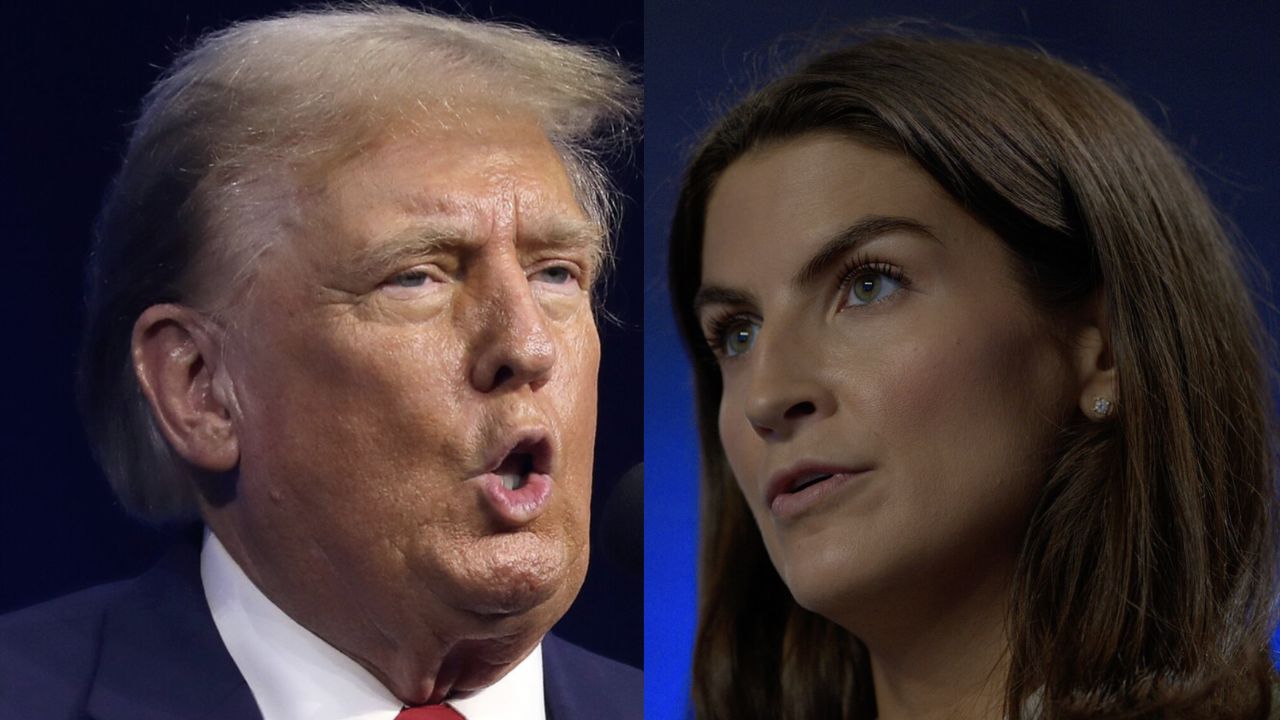
President Donald Trump late Tuesday renewed his attacks on CNN correspondent Kaitlan Collins and the broader White House press corps, branding journalists “sick, treasonous, and demented” in a Truth Social post that came as his administration fights a federal lawsuit over its ban of three major news outlets from the White House.
In the post, Trump wrote:
“All of the SLEAZEBAGS, like Third Rate ‘Reporter,’ Kaitlan Collins, of Fake News CNN, a truly unhappy person, said they weren’t going to be covering me. Then why were they ranting and raving like Lunatics, in the Press Area, at the United Nations? Why was she there? She’s got a ‘TRUMP’ addiction, and so does CNN and MSDNC. They’re all sick, treasonous, and demented! The ‘good news’ is that they have a great, for them, and totally disloyal Judge. MAKE AMERICA GREAT AGAIN!”
The Post and Its Trigger
The president’s message referenced Collins’ presence in the press area at the United Nations in New York, where Trump was attending the U.N. General Assembly this week. Collins, CNN’s chief White House correspondent, had appeared there despite CNN being among the outlets Trump barred from the White House days earlier, a discrepancy the president seized on to accuse her of hypocrisy. Trump’s post came hours after Collins defended herself and her network on Anderson Cooper 360° against his earlier criticism.
The White House Press Ban
Tuesday’s post cannot be separated from the broader dispute that has consumed the White House press corps for nearly a week. On Friday, Trump announced he would bar CNN, Politico, and MS NOW from White House grounds. By Saturday, reporters from those outlets — including CNN’s Betsy Klein, Politico’s Cheyenne Haslett, and MS NOW’s Akayla Gardner — were turned away at the gates, with Secret Service officers confiscating their hard-pass credentials on site.
The three outlets, along with the individual reporters, filed a First Amendment and due-process lawsuit against Trump and senior administration officials on Monday in the U.S. District Court for the District of Columbia. Their complaint argued that the ban amounted to viewpoint discrimination and asked the court to immediately restore both their credentials and their access to the White House complex.
The lawsuit prompted an unusual show of solidarity from rival networks: television pool crews declined to provide coverage of the president’s activities on Monday in protest of CNN’s exclusion from the rotation.
Jacqui Heinrich, president of the White House Correspondents’ Association and a Fox News correspondent, said in a statement that “the American people, through a free and independent press, must be able to scrutinize those elected to power, regardless of whether government officials view it favorably,” adding that courts have consistently held that once access is granted to journalists, it cannot be revoked arbitrarily or based on the content of their reporting.
The “Disloyal Judge”
Trump’s Tuesday post referred obliquely to U.S. District Judge Timothy J. Kelly, a Trump appointee who was assigned to oversee the outlets’ case and who scheduled a videoconference hearing on the news organizations’ request for a temporary restraining order. Trump had earlier suggested on social media that Kelly’s assignment to the case would work against the administration.
The reference carries historical weight. Kelly is the same judge who, during Trump’s first term, presided over a nearly identical dispute involving then-CNN correspondent Jim Acosta, whose press badge was revoked in 2018 after a contentious exchange with Trump at a news conference. Kelly ruled in Acosta’s favor at the time, ordering the administration to temporarily restore his credentials after finding he had not been afforded due process.
That 2018 case never reached a full resolution on the merits, but it has become the central precedent both sides are now citing as the current dispute plays out in the same courthouse, before the same judge, nearly eight years later.
A Familiar Pattern
Tuesday’s language was not an isolated outburst. Trump has repeatedly described journalists and news organizations he views as adversarial using charged, martial terminology — “enemy of the people,” “traitors,” and “treasonous” among them — dating back to his first term, when he first used the phrase “enemy of the people” to describe major outlets including CNN, NBC, and the New York Times.
Press-freedom advocates and historians have long noted that the phrase carries a dark lineage, having been invoked by authoritarian figures including Stalin and Mao Zedong against those deemed disloyal to the state, a connection that has drawn criticism from journalists and lawmakers of both parties over the years.
Collins herself has been a frequent target of Trump’s criticism throughout his time in office, including being called a “nasty person” during a 2023 CNN town hall and “stupid and nasty” in a December Truth Social post over her questions about White House renovation costs.
What Comes Next
The legal fight over the ban was set to reach a critical juncture this week, with Kelly scheduling a hearing on the outlets’ request for a temporary restraining order that would immediately restore the credentials of the affected reporters while the broader lawsuit proceeds.
The White House press office, asked for comment on the lawsuit, has directed reporters to Trump’s own Truth Social posts defending the ban, rather than issuing a separate statement through official channels.
The outcome of the hearing is expected to determine not only whether CNN, Politico, and MS NOW regain immediate access to the White House, but also set an early marker for how courts will treat future efforts by the administration to restrict press access based on the content of an outlet’s coverage.