
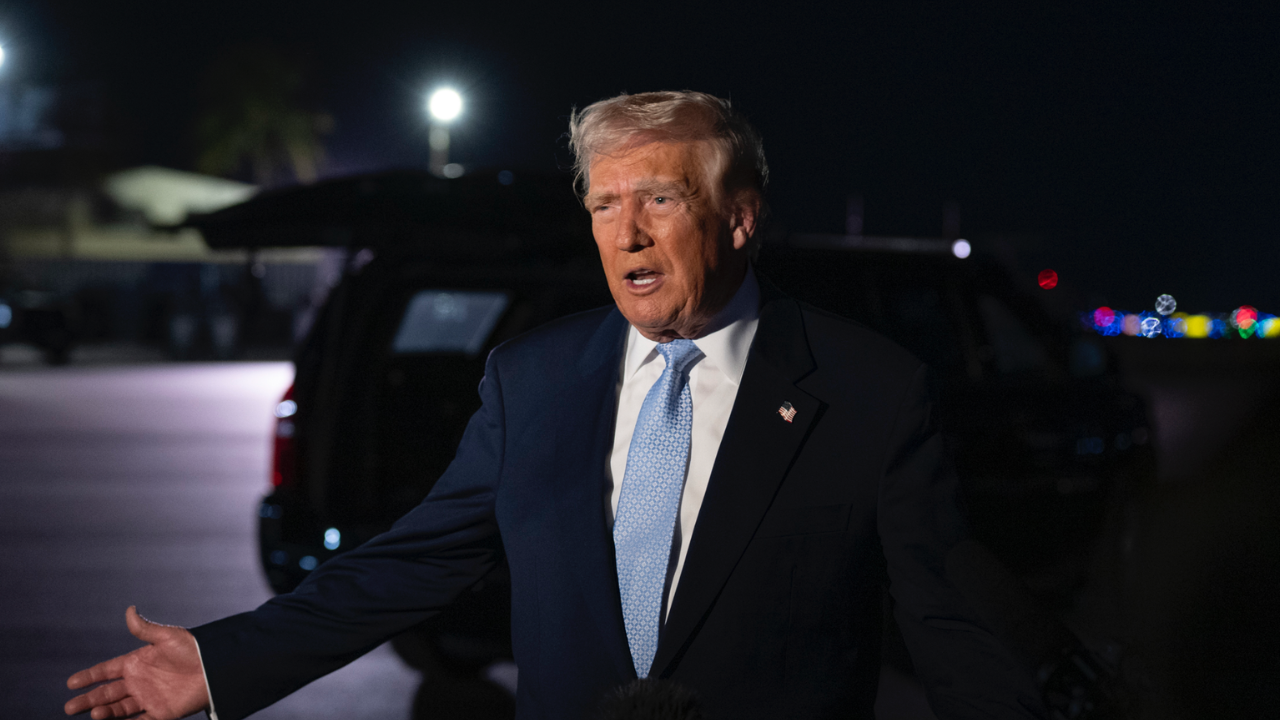
President Trump declined to confirm or deny reports that the U.S. military is repositioning troops out of Bahrain and Kuwait, offering no explanation when pressed by a reporter aboard Air Force One.
“Sir, there’s a report that you’re moving U.S. troops out of Bahrain and Kuwait. Are troops being moved out of the Middle East?” a reporter asked Trump during an Aug. 2 press gaggle, according to official White House video of the exchange en route to Joint Base Andrews. “I don’t want to comment on that,” Trump replied.
The question follows a Wall Street Journal investigation published in late June that found Iranian strikes had caused significantly more damage to U.S. facilities in Bahrain than the Pentagon had publicly acknowledged. Using satellite imagery, social media footage and interviews with current and former service members, the Journal found that Naval Support Activity Bahrain, headquarters of the U.S. Navy’s Fifth Fleet, was repeatedly targeted between late February and June, with strikes damaging the command headquarters building, at least a dozen other structures, two satellite communications terminals, a barracks and a water tank. The Journal estimated the construction cost of repairs alone at roughly $400 million, based on Pentagon procurement cost models, while a Center for Strategic and International Studies analyst cited in the report said the true cost could be far higher depending on what the damaged buildings had housed. The U.S. military said no one was killed in the strikes and that operations were not significantly affected, though the Pentagon has not publicly detailed the damage itself.
The Journal reported that the damage prompted a broader Pentagon review of its Gulf basing posture, with officials considering options including moving command functions underground, declining to rebuild some destroyed structures, curbing troop presence in Bahrain, Kuwait and Saudi Arabia, and shifting some capabilities farther from Iran’s missile range, potentially including an expanded footprint in Israel, according to Times of Israel reporting on the same investigation. Secretary of State Marco Rubio met with Bahrain’s king and other regional leaders shortly after the report’s publication, saying on social media that “we stand united on regional stability, a free and open Strait of Hormuz, and preventing Iran from acquiring a nuclear weapon.”
Iran’s attacks on U.S. positions in the Gulf were part of a broader campaign the country has called Operation True Promise IV, targeting regional states hosting American military assets, including Bahrain’s Fifth Fleet headquarters, the UAE’s Al Dhafra Air Base and Qatar’s Al Udeid Air Base. Kuwait International Airport, used as a logistics hub for coalition transport, was also repeatedly targeted, leading to a total suspension of commercial aviation in Kuwaiti airspace during periods of the conflict.
CENTCOM has consistently emphasized that protecting personnel, rather than buildings, remains its priority, and Pentagon and CENTCOM spokespeople have said the military continually assesses the security environment in the region and adjusts its posture accordingly, without confirming specific large-scale withdrawal plans when asked by reporters.
There is no public confirmation of a complete or permanent withdrawal of U.S. forces from either Bahrain or Kuwait. Reporting on the posture review has described dispersal of exposed assets, hardening of facilities and consideration of longer-term basing changes rather than a full exit from the region, and U.S. forces have continued operating in the broader theater, including maritime operations tied to the Strait of Hormuz.
The Gulf basing question comes amid a broader pattern of reduced U.S. troop presence in Europe and public silence on other force-posture questions, with Trump similarly declining in recent weeks to detail plans for reductions elsewhere.
Bahrain hosts the U.S. Fifth Fleet under a decades-old basing arrangement that has anchored American naval power in the Middle East, positioned roughly 150 miles from Iran’s southern coast and capable of supporting any class of U.S. Navy vessel. Kuwait has historically hosted one of the larger U.S. troop contingents in the region, a legacy of the buildup following the 1991 Gulf War.
Earlier in the conflict, the U.S. authorized the departure of military dependents and some non-essential personnel from Bahrain and other regional posts for safety reasons, a step distinct from any formal combat troop withdrawal.
Neither the Pentagon nor CENTCOM has issued a public statement confirming or detailing specific troop movements out of Bahrain or Kuwait as of Trump’s remarks.